

τ 1 /τ 2 = 1/4
τ 1 /τ 2 = 1/3
τ 1 /τ 2 = 1/2
2
12
7.5
25
20
8
5
15
1
0
5
10
15
10
4
2.5
5
0
0
5
6
7
0.8
1
1.2
5
6
7
8
0
0.7
1.4
2.1
Output Period (s)
Output Amplitude
0
0
1
3
5
7
9
Driving Input u 0
Time Constant τ 1
1.0
2.0
3.0
4.0
5.0
6.0
2.1
2.4
2.7
3.0
Adaptation Coefficient β
Connection Weight w
Output period
Output amplitude
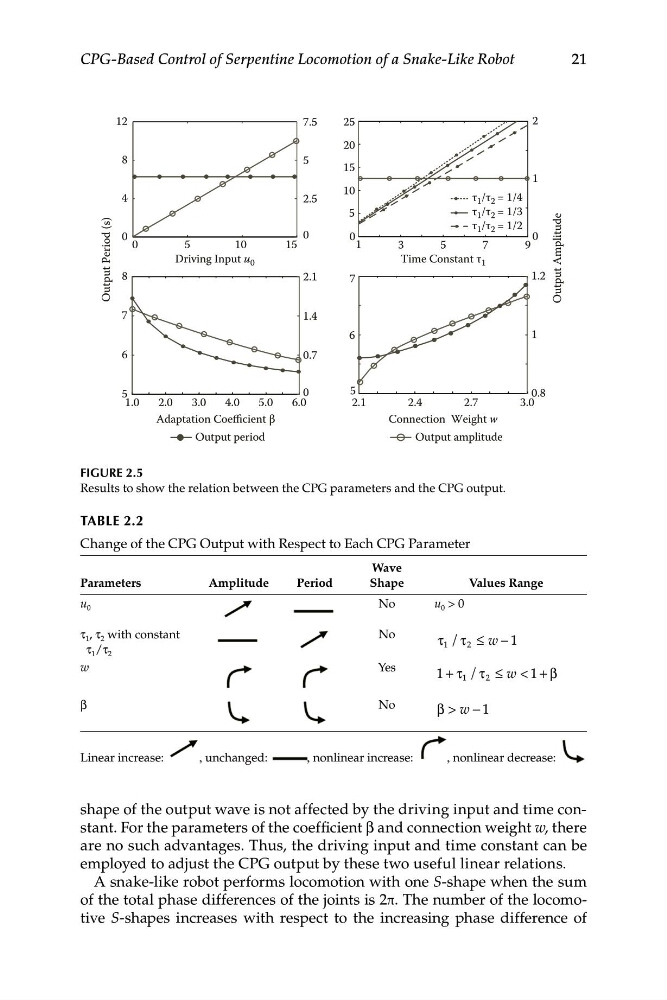
FIGURE 2.5
Results to show the relation between the CPG parameters and the CPG output.
TABLE 2.2
Change of the CPG Output with Respect to Each CPG Parameter
Wave
Parameters
Amplitude
Period
Shape
Values Range
u 0
No
u 0 > 0
τ 1 , τ 2 with constant
τ 1 /τ 2
No
τ 1 /τ 2 ≤ Z − 1
w
Yes
1 + τ 1 /τ 2 ≤ Z < 1 + β
β
No
β > Z −
Linear increase:
unchanged:
nonlinear increase:
nonlinear decrease:
CPG-Based Control of Serpentine Locomotion of a Snake-Like Robot
21
shape of the output wave is not affected by the driving input and time constant. For the parameters of the coefficient β and connection weight w, there
are no such advantages. Thus, the driving input and time constant can be
employed to adjust the CPG output by these two useful linear relations.
A snake-like robot performs locomotion with one S-shape when the sum
of the total phase differences of the joints is 2π. The number of the locomotive S-shapes increases with respect to the increasing phase difference of
τ 1 /τ 2 = 1/3
τ 1 /τ 2 = 1/2
2
12
7.5
25
20
8
5
15
1
0
5
10
15
10
4
2.5
5
0
0
5
6
7
0.8
1
1.2
5
6
7
8
0
0.7
1.4
2.1
Output Period (s)
Output Amplitude
0
0
1
3
5
7
9
Driving Input u 0
Time Constant τ 1
1.0
2.0
3.0
4.0
5.0
6.0
2.1
2.4
2.7
3.0
Adaptation Coefficient β
Connection Weight w
Output period
Output amplitude
FIGURE 2.5
Results to show the relation between the CPG parameters and the CPG output.
TABLE 2.2
Change of the CPG Output with Respect to Each CPG Parameter
Wave
Parameters
Amplitude
Period
Shape
Values Range
u 0
No
u 0 > 0
τ 1 , τ 2 with constant
τ 1 /τ 2
No
τ 1 /τ 2 ≤ Z − 1
w
Yes
1 + τ 1 /τ 2 ≤ Z < 1 + β
β
No
β > Z −
Linear increase:
unchanged:
nonlinear increase:
nonlinear decrease:
CPG-Based Control of Serpentine Locomotion of a Snake-Like Robot
21
shape of the output wave is not affected by the driving input and time constant. For the parameters of the coefficient β and connection weight w, there
are no such advantages. Thus, the driving input and time constant can be
employed to adjust the CPG output by these two useful linear relations.
A snake-like robot performs locomotion with one S-shape when the sum
of the total phase differences of the joints is 2π. The number of the locomotive S-shapes increases with respect to the increasing phase difference of