

297
A Test Environment for Studying Robotic Eye Movements
Teleoperation
Alteration
Interaction
Scene camera
Scene view
Scene monitor
LED
Wizard
Virtual interaction
Participant
Curtain
Robot ELIAS
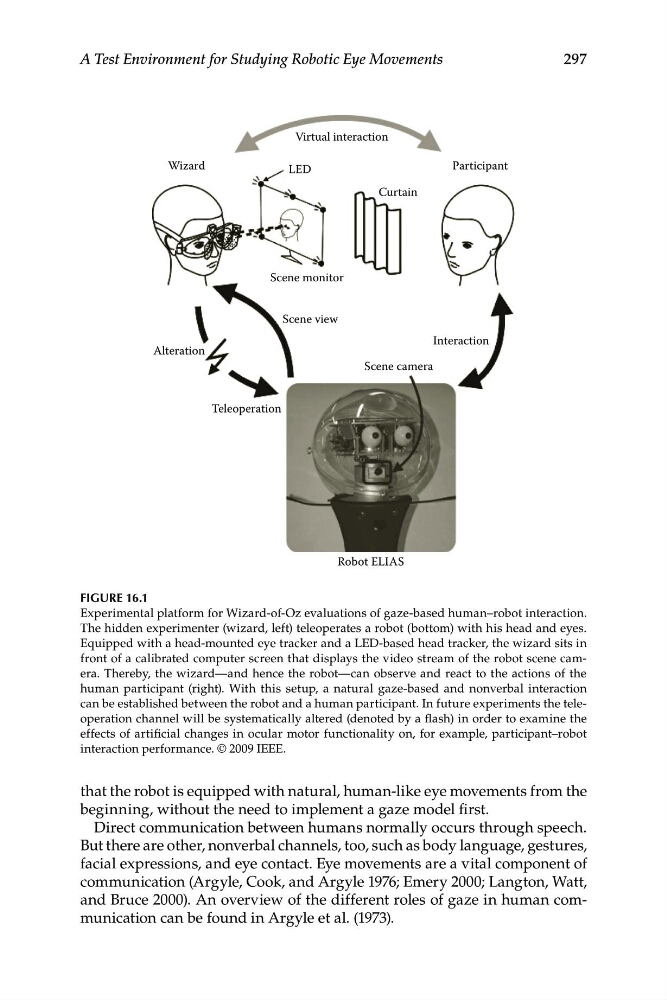
FIGURE 16.1
Experimental platform for Wizard-of-Oz evaluations of gaze-based human–robot interaction.
The hidden experimenter (wizard, left) teleoperates a robot (bottom) with his head and eyes.
Equipped with a head-mounted eye tracker and a LED-based head tracker, the wizard sits in
front of a calibrated computer screen that displays the video stream of the robot scene camera. Thereby, the wizard—and hence the robot—can observe and react to the actions of the
human participant (right). With this setup, a natural gaze-based and nonverbal interaction
can be established between the robot and a human participant. In future experiments the teleoperation channel will be systematically altered (denoted by a flash) in order to examine the
effects of artificial changes in ocular motor functionality on, for example, participant–robot
interaction performance. © 2009 IEEE.
that the robot is equipped with natural, human-like eye movements from the
beginning, without the need to implement a gaze model first.
Direct communication between humans normally occurs through speech.
But there are other, nonverbal channels, too, such as body language, gestures,
facial expressions, and eye contact. Eye movements are a vital component of
communication (Argyle, Cook, and Argyle 1976; Emery 2000; Langton, Watt,
and Bruce 2000). An overview of the different roles of gaze in human communication can be found in Argyle et al. (1973).
A Test Environment for Studying Robotic Eye Movements
Teleoperation
Alteration
Interaction
Scene camera
Scene view
Scene monitor
LED
Wizard
Virtual interaction
Participant
Curtain
Robot ELIAS
FIGURE 16.1
Experimental platform for Wizard-of-Oz evaluations of gaze-based human–robot interaction.
The hidden experimenter (wizard, left) teleoperates a robot (bottom) with his head and eyes.
Equipped with a head-mounted eye tracker and a LED-based head tracker, the wizard sits in
front of a calibrated computer screen that displays the video stream of the robot scene camera. Thereby, the wizard—and hence the robot—can observe and react to the actions of the
human participant (right). With this setup, a natural gaze-based and nonverbal interaction
can be established between the robot and a human participant. In future experiments the teleoperation channel will be systematically altered (denoted by a flash) in order to examine the
effects of artificial changes in ocular motor functionality on, for example, participant–robot
interaction performance. © 2009 IEEE.
that the robot is equipped with natural, human-like eye movements from the
beginning, without the need to implement a gaze model first.
Direct communication between humans normally occurs through speech.
But there are other, nonverbal channels, too, such as body language, gestures,
facial expressions, and eye contact. Eye movements are a vital component of
communication (Argyle, Cook, and Argyle 1976; Emery 2000; Langton, Watt,
and Bruce 2000). An overview of the different roles of gaze in human communication can be found in Argyle et al. (1973).