

9
Introduction to Biologically Inspired Robotics
Robot
Memory
K
+
_ +
+
u k (t)
u k+1 (t)
y k (t)
y d (t)
Computer
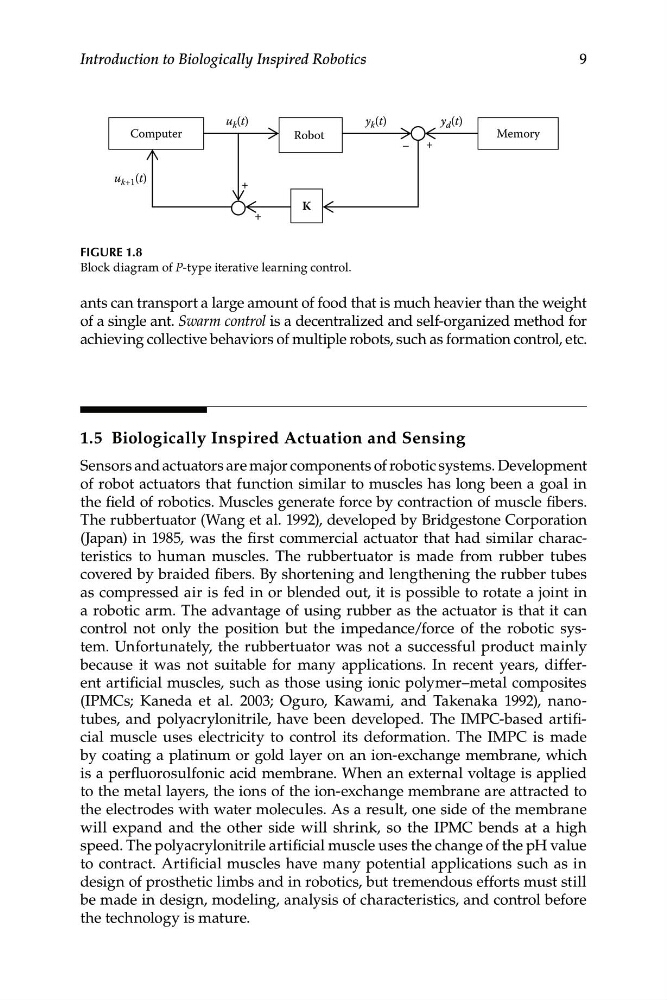
FIGURE 1.8
Block diagram of P-type iterative learning control.
ants can transport a large amount of food that is much heavier than the weight
of a single ant. Swarm control is a decentralized and self-organized method for
achieving collective behaviors of multiple robots, such as formation control, etc.
1.5 Biologically Inspired Actuation and Sensing
Sensors and actuators are major components of robotic systems. Development
of robot actuators that function similar to muscles has long been a goal in
the field of robotics. Muscles generate force by contraction of muscle fibers.
The rubbertuator (Wang et al. 1992), developed by Bridgestone Corporation
(Japan) in 1985, was the first commercial actuator that had similar characteristics to human muscles. The rubbertuator is made from rubber tubes
covered by braided fibers. By shortening and lengthening the rubber tubes
as compressed air is fed in or blended out, it is possible to rotate a joint in
a robotic arm. The advantage of using rubber as the actuator is that it can
control not only the position but the impedance/force of the robotic system. Unfortunately, the rubbertuator was not a successful product mainly
because it was not suitable for many applications. In recent years, different artificial muscles, such as those using ionic polymer–metal composites
(IPMCs; Kaneda et al. 2003; Oguro, Kawami, and Takenaka 1992), nanotubes, and polyacrylonitrile, have been developed. The IMPC-based artificial muscle uses electricity to control its deformation. The IMPC is made
by coating a platinum or gold layer on an ion-exchange membrane, which
is a perfluorosulfonic acid membrane. When an external voltage is applied
to the metal layers, the ions of the ion-exchange membrane are attracted to
the electrodes with water molecules. As a result, one side of the membrane
will expand and the other side will shrink, so the IPMC bends at a high
speed. The polyacrylonitrile artificial muscle uses the change of the pH value
to contract. Artificial muscles have many potential applications such as in
design of prosthetic limbs and in robotics, but tremendous efforts must still
be made in design, modeling, analysis of characteristics, and control before
the technology is mature.
Introduction to Biologically Inspired Robotics
Robot
Memory
K
+
_ +
+
u k (t)
u k+1 (t)
y k (t)
y d (t)
Computer
FIGURE 1.8
Block diagram of P-type iterative learning control.
ants can transport a large amount of food that is much heavier than the weight
of a single ant. Swarm control is a decentralized and self-organized method for
achieving collective behaviors of multiple robots, such as formation control, etc.
1.5 Biologically Inspired Actuation and Sensing
Sensors and actuators are major components of robotic systems. Development
of robot actuators that function similar to muscles has long been a goal in
the field of robotics. Muscles generate force by contraction of muscle fibers.
The rubbertuator (Wang et al. 1992), developed by Bridgestone Corporation
(Japan) in 1985, was the first commercial actuator that had similar characteristics to human muscles. The rubbertuator is made from rubber tubes
covered by braided fibers. By shortening and lengthening the rubber tubes
as compressed air is fed in or blended out, it is possible to rotate a joint in
a robotic arm. The advantage of using rubber as the actuator is that it can
control not only the position but the impedance/force of the robotic system. Unfortunately, the rubbertuator was not a successful product mainly
because it was not suitable for many applications. In recent years, different artificial muscles, such as those using ionic polymer–metal composites
(IPMCs; Kaneda et al. 2003; Oguro, Kawami, and Takenaka 1992), nanotubes, and polyacrylonitrile, have been developed. The IMPC-based artificial muscle uses electricity to control its deformation. The IMPC is made
by coating a platinum or gold layer on an ion-exchange membrane, which
is a perfluorosulfonic acid membrane. When an external voltage is applied
to the metal layers, the ions of the ion-exchange membrane are attracted to
the electrodes with water molecules. As a result, one side of the membrane
will expand and the other side will shrink, so the IPMC bends at a high
speed. The polyacrylonitrile artificial muscle uses the change of the pH value
to contract. Artificial muscles have many potential applications such as in
design of prosthetic limbs and in robotics, but tremendous efforts must still
be made in design, modeling, analysis of characteristics, and control before
the technology is mature.