

7
Introduction to Biologically Inspired Robotics
(a)
(b)
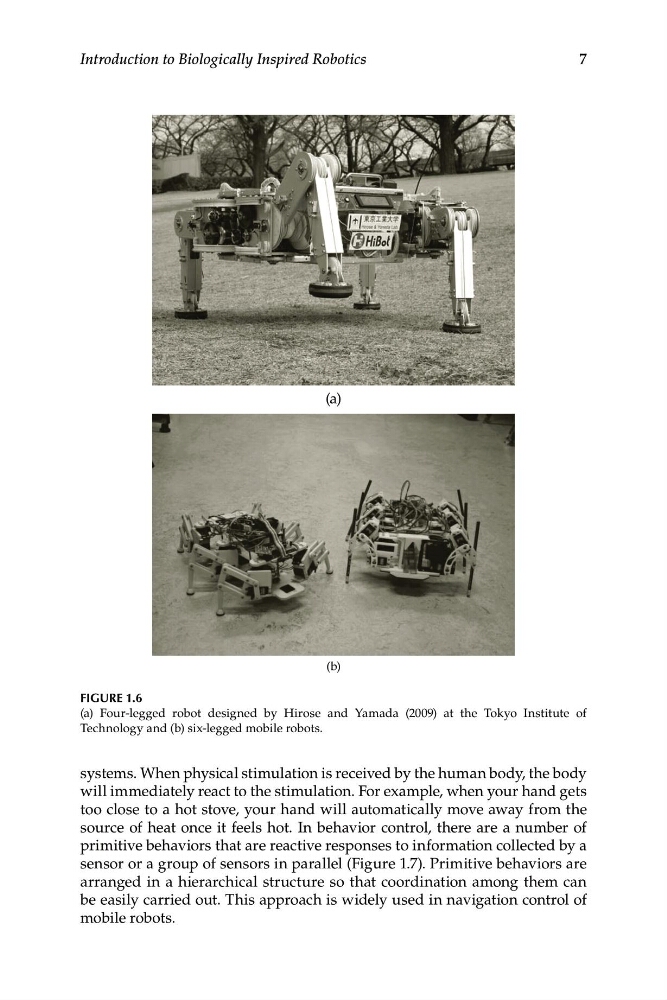
FIGURE 1.6
(a) Four-legged robot designed by Hirose and Yamada (2009) at the Tokyo Institute of
Technology and (b) six-legged mobile robots.
systems. When physical stimulation is received by the human body, the body
will immediately react to the stimulation. For example, when your hand gets
too close to a hot stove, your hand will automatically move away from the
source of heat once it feels hot. In behavior control, there are a number of
primitive behaviors that are reactive responses to information collected by a
sensor or a group of sensors in parallel (Figure 1.7). Primitive behaviors are
arranged in a hierarchical structure so that coordination among them can
be easily carried out. This approach is widely used in navigation control of
mobile robots.
Introduction to Biologically Inspired Robotics
(a)
(b)
FIGURE 1.6
(a) Four-legged robot designed by Hirose and Yamada (2009) at the Tokyo Institute of
Technology and (b) six-legged mobile robots.
systems. When physical stimulation is received by the human body, the body
will immediately react to the stimulation. For example, when your hand gets
too close to a hot stove, your hand will automatically move away from the
source of heat once it feels hot. In behavior control, there are a number of
primitive behaviors that are reactive responses to information collected by a
sensor or a group of sensors in parallel (Figure 1.7). Primitive behaviors are
arranged in a hierarchical structure so that coordination among them can
be easily carried out. This approach is widely used in navigation control of
mobile robots.