

193
Measurement of Brain Activity Using Optical and Electrical Methods
Absorbance
Artery
Vein
Tissue
ε artery
C artery
(d) artery
S artery
ε tissue
C tissue
(d) tissue
S tissue
ε vein
C vein
(d) vein
S vein
Time
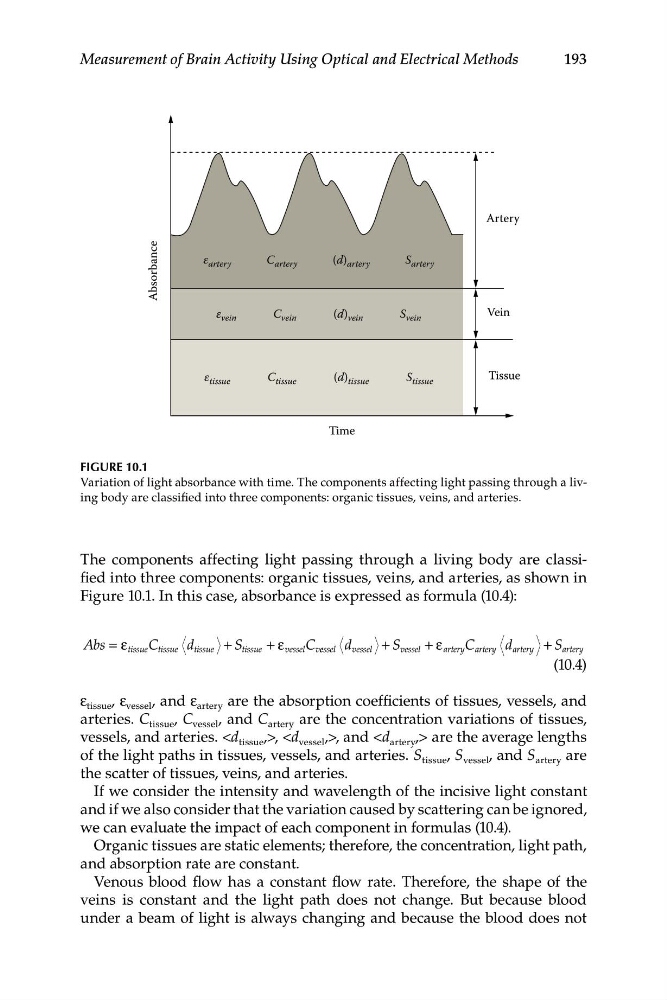
FIGURE 10.1
Variation of light absorbance with time. The components affecting light passing through a living body are classified into three components: organic tissues, veins, and arteries.
The components affecting light passing through a living body are classified into three components: organic tissues, veins, and arteries, as shown in
Figure 10.1. In this case, absorbance is expressed as formula (10.4):
Abs = ε tissue C tissue d t issue + S t issue + ε vessel C vessel e d vessel + S vessel + ε artery C artery d artery + + S artery
(10.4)
ε tissue , ε vessel , and ε artery are the absorption coefficients of tissues, vessels, and
arteries. C tissue , C vessel , and C artery are the concentration variations of tissues,
vessels, and arteries., , and are the average lengths
of the light paths in tissues, vessels, and arteries. S tissue , S vessel , and S artery are
the scatter of tissues, veins, and arteries.
If we consider the intensity and wavelength of the incisive light constant
and if we also consider that the variation caused by scattering can be ignored,
we can evaluate the impact of each component in formulas (10.4).
Organic tissues are static elements; therefore, the concentration, light path,
and absorption rate are constant.
Venous blood flow has a constant flow rate. Therefore, the shape of the
veins is constant and the light path does not change. But because blood
under a beam of light is always changing and because the blood does not
Measurement of Brain Activity Using Optical and Electrical Methods
Absorbance
Artery
Vein
Tissue
ε artery
C artery
(d) artery
S artery
ε tissue
C tissue
(d) tissue
S tissue
ε vein
C vein
(d) vein
S vein
Time
FIGURE 10.1
Variation of light absorbance with time. The components affecting light passing through a living body are classified into three components: organic tissues, veins, and arteries.
The components affecting light passing through a living body are classified into three components: organic tissues, veins, and arteries, as shown in
Figure 10.1. In this case, absorbance is expressed as formula (10.4):
Abs = ε tissue C tissue d t issue + S t issue + ε vessel C vessel e d vessel + S vessel + ε artery C artery d artery + + S artery
(10.4)
ε tissue , ε vessel , and ε artery are the absorption coefficients of tissues, vessels, and
arteries. C tissue , C vessel , and C artery are the concentration variations of tissues,
vessels, and arteries.
of the light paths in tissues, vessels, and arteries. S tissue , S vessel , and S artery are
the scatter of tissues, veins, and arteries.
If we consider the intensity and wavelength of the incisive light constant
and if we also consider that the variation caused by scattering can be ignored,
we can evaluate the impact of each component in formulas (10.4).
Organic tissues are static elements; therefore, the concentration, light path,
and absorption rate are constant.
Venous blood flow has a constant flow rate. Therefore, the shape of the
veins is constant and the light path does not change. But because blood
under a beam of light is always changing and because the blood does not