

V a lv e s c o n n e c t io n
( p o r t 2 )
Silicon tube
Valve type 1
Layer 1
Layer 2
Air-chamber
Port 2
Port 3
Port 1 Micro-channel
Glass cover
Thin membrane
Valve type 2
Air-chamber Port 2
Port 3
Layer 1
Layer 3
Layer 2
Port 1 Micro-channel
Glass cover
Port 4
Thin membrane
Connection for next
module (port 3)
Supply
direction
Monitoring
area
Cell
Suction
direction
Docking
Connection for
area
micro-glass
pump (port 1)
Connected to rotary
tube (port 3)
132
Biologically Inspired Robotics
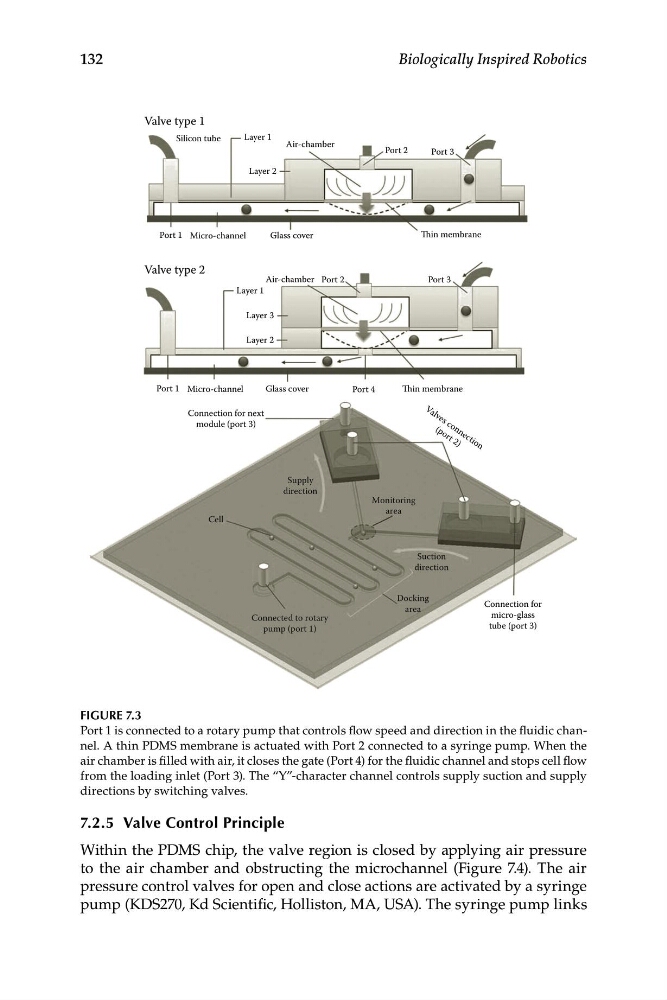
FIGURE 7.3
Port 1 is connected to a rotary pump that controls flow speed and direction in the fluidic channel. A thin PDMS membrane is actuated with Port 2 connected to a syringe pump. When the
air chamber is filled with air, it closes the gate (Port 4) for the fluidic channel and stops cell flow
from the loading inlet (Port 3). The “Y”-character channel controls supply suction and supply
directions by switching valves.
7.2.5 Valve Control Principle
Within the PDMS chip, the valve region is closed by applying air pressure
to the air chamber and obstructing the microchannel (Figure 7.4). The air
pressure control valves for open and close actions are activated by a syringe
pump (KDS270, Kd Scientific, Holliston, MA, USA). The syringe pump links
( p o r t 2 )
Silicon tube
Valve type 1
Layer 1
Layer 2
Air-chamber
Port 2
Port 3
Port 1 Micro-channel
Glass cover
Thin membrane
Valve type 2
Air-chamber Port 2
Port 3
Layer 1
Layer 3
Layer 2
Port 1 Micro-channel
Glass cover
Port 4
Thin membrane
Connection for next
module (port 3)
Supply
direction
Monitoring
area
Cell
Suction
direction
Docking
Connection for
area
micro-glass
pump (port 1)
Connected to rotary
tube (port 3)
132
Biologically Inspired Robotics
FIGURE 7.3
Port 1 is connected to a rotary pump that controls flow speed and direction in the fluidic channel. A thin PDMS membrane is actuated with Port 2 connected to a syringe pump. When the
air chamber is filled with air, it closes the gate (Port 4) for the fluidic channel and stops cell flow
from the loading inlet (Port 3). The “Y”-character channel controls supply suction and supply
directions by switching valves.
7.2.5 Valve Control Principle
Within the PDMS chip, the valve region is closed by applying air pressure
to the air chamber and obstructing the microchannel (Figure 7.4). The air
pressure control valves for open and close actions are activated by a syringe
pump (KDS270, Kd Scientific, Holliston, MA, USA). The syringe pump links