

120
Biologically Inspired Robotics
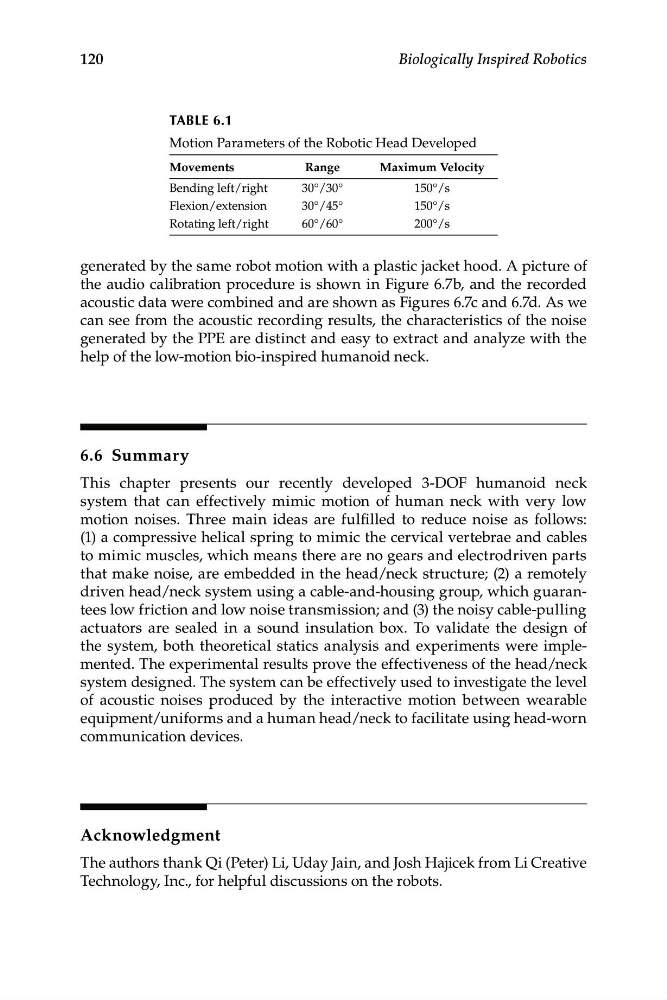
TABLE 6.1
Motion Parameters of the Robotic Head Developed
Movements
Range
Maximum Velocity
Bending left/right
30°/30°
150°/s
Flexion/extension
30°/45°
150°/s
Rotating left/right
60°/60°
200°/s
generated by the same robot motion with a plastic jacket hood. A picture of
the audio calibration procedure is shown in Figure 6.7b, and the recorded
acoustic data were combined and are shown as Figures 6.7c and 6.7d. As we
can see from the acoustic recording results, the characteristics of the noise
generated by the PPE are distinct and easy to extract and analyze with the
help of the low-motion bio-inspired humanoid neck.
6.6 Summary
This chapter presents our recently developed 3-DOF humanoid neck
system that can effectively mimic motion of human neck with very low
motion noises. Three main ideas are fulfilled to reduce noise as follows:
(1) a compressive helical spring to mimic the cervical vertebrae and cables
to mimic muscles, which means there are no gears and electrodriven parts
that make noise, are embedded in the head/neck structure; (2) a remotely
driven head/neck system using a cable-and-housing group, which guarantees low friction and low noise transmission; and (3) the noisy cable-pulling
actuators are sealed in a sound insulation box. To validate the design of
the system, both theoretical statics analysis and experiments were implemented. The experimental results prove the effectiveness of the head/neck
system designed. The system can be effectively used to investigate the level
of acoustic noises produced by the interactive motion between wearable
equipment/uniforms and a human head/neck to facilitate using head-worn
communication devices.
Acknowledgment
The authors thank Qi (Peter) Li, Uday Jain, and Josh Hajicek from Li Creative
Technology, Inc., for helpful discussions on the robots.
Biologically Inspired Robotics
TABLE 6.1
Motion Parameters of the Robotic Head Developed
Movements
Range
Maximum Velocity
Bending left/right
30°/30°
150°/s
Flexion/extension
30°/45°
150°/s
Rotating left/right
60°/60°
200°/s
generated by the same robot motion with a plastic jacket hood. A picture of
the audio calibration procedure is shown in Figure 6.7b, and the recorded
acoustic data were combined and are shown as Figures 6.7c and 6.7d. As we
can see from the acoustic recording results, the characteristics of the noise
generated by the PPE are distinct and easy to extract and analyze with the
help of the low-motion bio-inspired humanoid neck.
6.6 Summary
This chapter presents our recently developed 3-DOF humanoid neck
system that can effectively mimic motion of human neck with very low
motion noises. Three main ideas are fulfilled to reduce noise as follows:
(1) a compressive helical spring to mimic the cervical vertebrae and cables
to mimic muscles, which means there are no gears and electrodriven parts
that make noise, are embedded in the head/neck structure; (2) a remotely
driven head/neck system using a cable-and-housing group, which guarantees low friction and low noise transmission; and (3) the noisy cable-pulling
actuators are sealed in a sound insulation box. To validate the design of
the system, both theoretical statics analysis and experiments were implemented. The experimental results prove the effectiveness of the head/neck
system designed. The system can be effectively used to investigate the level
of acoustic noises produced by the interactive motion between wearable
equipment/uniforms and a human head/neck to facilitate using head-worn
communication devices.
Acknowledgment
The authors thank Qi (Peter) Li, Uday Jain, and Josh Hajicek from Li Creative
Technology, Inc., for helpful discussions on the robots.