

3.2 Ultrathin PNHSMA Polymer Films
51
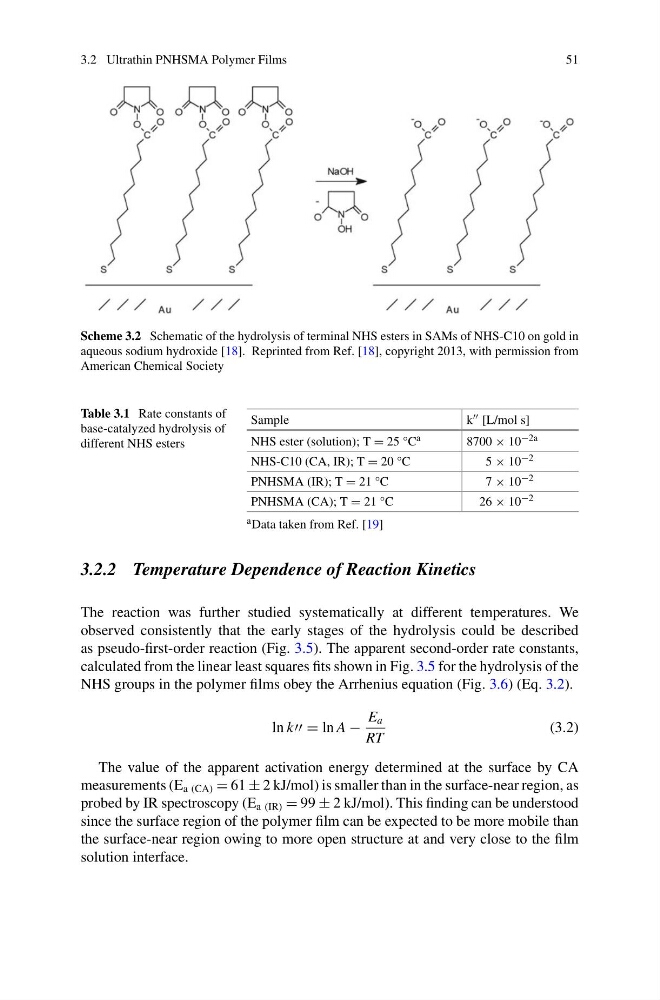
Scheme 3.2 Schematic of the hydrolysis of terminal NHS esters in SAMs of NHS-C10 on gold in
aqueous sodium hydroxide [18]. Reprinted from Ref. [18], copyright 2013, with permission from
American Chemical Society
Table 3.1 Rate constants of
base-catalyzed hydrolysis of
different NHS esters
Sample
k [L/mol s]
NHS ester (solution); T = 25 °C a
8700 × 10 −2a
NHS-C10 (CA, IR); T = 20 °C
5 × 10 −2
PNHSMA (IR); T = 21 °C
7 × 10 −2
PNHSMA (CA); T = 21 °C
26 × 10 −2
a Data taken from Ref. [19]
3.2.2 Temperature Dependence of Reaction Kinetics
The reaction was further studied systematically at different temperatures. We
observed consistently that the early stages of the hydrolysis could be described
as pseudo-first-order reaction (Fig. 3.5). The apparent second-order rate constants,
calculated from the linear least squares fits shown in Fig. 3.5 for the hydrolysis of the
NHS groups in the polymer films obey the Arrhenius equation (Fig. 3.6) (Eq. 3.2).
ln k = ln A −
E a
RT
(3.2)
The value of the apparent activation energy determined at the surface by CA
measurements (E a (CA) = 61 ± 2 kJ/mol) is smaller than in the surface-near region, as
probed by IR spectroscopy (E a (IR) = 99 ± 2 kJ/mol). This finding can be understood
since the surface region of the polymer film can be expected to be more mobile than
the surface-near region owing to more open structure at and very close to the film
solution interface.
51
Scheme 3.2 Schematic of the hydrolysis of terminal NHS esters in SAMs of NHS-C10 on gold in
aqueous sodium hydroxide [18]. Reprinted from Ref. [18], copyright 2013, with permission from
American Chemical Society
Table 3.1 Rate constants of
base-catalyzed hydrolysis of
different NHS esters
Sample
k [L/mol s]
NHS ester (solution); T = 25 °C a
8700 × 10 −2a
NHS-C10 (CA, IR); T = 20 °C
5 × 10 −2
PNHSMA (IR); T = 21 °C
7 × 10 −2
PNHSMA (CA); T = 21 °C
26 × 10 −2
a Data taken from Ref. [19]
3.2.2 Temperature Dependence of Reaction Kinetics
The reaction was further studied systematically at different temperatures. We
observed consistently that the early stages of the hydrolysis could be described
as pseudo-first-order reaction (Fig. 3.5). The apparent second-order rate constants,
calculated from the linear least squares fits shown in Fig. 3.5 for the hydrolysis of the
NHS groups in the polymer films obey the Arrhenius equation (Fig. 3.6) (Eq. 3.2).
ln k = ln A −
E a
RT
(3.2)
The value of the apparent activation energy determined at the surface by CA
measurements (E a (CA) = 61 ± 2 kJ/mol) is smaller than in the surface-near region, as
probed by IR spectroscopy (E a (IR) = 99 ± 2 kJ/mol). This finding can be understood
since the surface region of the polymer film can be expected to be more mobile than
the surface-near region owing to more open structure at and very close to the film
solution interface.