

2.3 Patterned Organic and Polymeric Films for Tailored (Bio)Interfaces
41
Spin-coated block copolymers have also been used to control deposition of
proteins and other biomolecules on the nanometer scale because of their ability
to produce periodical functional patterns via phase separation. Very recently, Kumar
et al. [59] have reported a technique to immobilize various protein molecules
including bovine immunoglobulin G (IgG), fluorescein isothiocyanate conjugated
anti-bovine IgG, and protein G through physical adsorption using the microphaseseparated domains of polystyrene-b-poly(methyl methacrylate) diblock copolymer
ultrathin films. These proteins can selectively self-segregate on the microdomain
regions of polystyrene due to their preferential interactions with polystyrene. By
using the phase separation of diblock copolymer, such method represents a step
toward nanometer-spaced protein immobilization with high areal density. However,
there are drawbacks of this method, including self-segregation of the proteins on the
polymer films by physical adsorption, which will lead to instable adsorption of the
proteins on the films.
Phase separation of block copolymers can offer several advantages. In small
volumes, biochemical reactions may not be diffusion-limited and may thus be more
efficient; less reagent and sample solution are used, lowering the costs per test. Miniaturized assays can be achieved and carried out simultaneously in large numbers on
phase-separated block copolymer; small scales can be the key to the realization of
certain types of assays. In addition, it is also possible to deposit a variety of different
biomolecules onto copolymers with nanometer films scale periodical patterns and
then read them out by using scanning force microscopy techniques. This can provide a
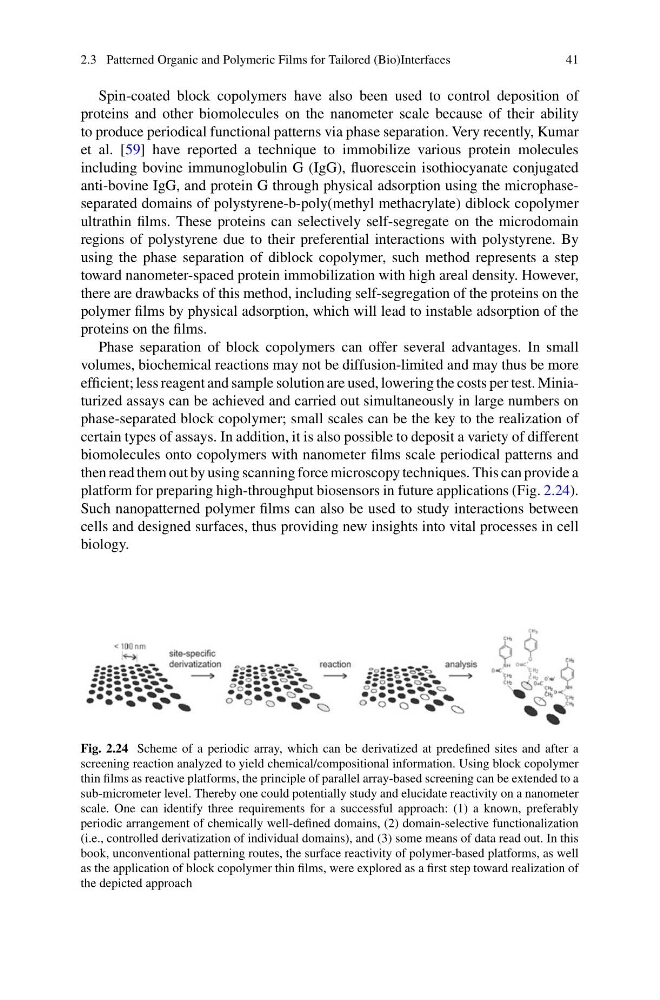
platform for preparing high-throughput biosensors in future applications (Fig. 2.24).
Such nanopatterned polymer films can also be used to study interactions between
cells and designed surfaces, thus providing new insights into vital processes in cell
biology.
Fig. 2.24 Scheme of a periodic array, which can be derivatized at predefined sites and after a
screening reaction analyzed to yield chemical/compositional information. Using block copolymer
thin films as reactive platforms, the principle of parallel array-based screening can be extended to a
sub-micrometer level. Thereby one could potentially study and elucidate reactivity on a nanometer
scale. One can identify three requirements for a successful approach: (1) a known, preferably
periodic arrangement of chemically well-defined domains, (2) domain-selective functionalization
(i.e., controlled derivatization of individual domains), and (3) some means of data read out. In this
book, unconventional patterning routes, the surface reactivity of polymer-based platforms, as well
as the application of block copolymer thin films, were explored as a first step toward realization of
the depicted approach
41
Spin-coated block copolymers have also been used to control deposition of
proteins and other biomolecules on the nanometer scale because of their ability
to produce periodical functional patterns via phase separation. Very recently, Kumar
et al. [59] have reported a technique to immobilize various protein molecules
including bovine immunoglobulin G (IgG), fluorescein isothiocyanate conjugated
anti-bovine IgG, and protein G through physical adsorption using the microphaseseparated domains of polystyrene-b-poly(methyl methacrylate) diblock copolymer
ultrathin films. These proteins can selectively self-segregate on the microdomain
regions of polystyrene due to their preferential interactions with polystyrene. By
using the phase separation of diblock copolymer, such method represents a step
toward nanometer-spaced protein immobilization with high areal density. However,
there are drawbacks of this method, including self-segregation of the proteins on the
polymer films by physical adsorption, which will lead to instable adsorption of the
proteins on the films.
Phase separation of block copolymers can offer several advantages. In small
volumes, biochemical reactions may not be diffusion-limited and may thus be more
efficient; less reagent and sample solution are used, lowering the costs per test. Miniaturized assays can be achieved and carried out simultaneously in large numbers on
phase-separated block copolymer; small scales can be the key to the realization of
certain types of assays. In addition, it is also possible to deposit a variety of different
biomolecules onto copolymers with nanometer films scale periodical patterns and
then read them out by using scanning force microscopy techniques. This can provide a
platform for preparing high-throughput biosensors in future applications (Fig. 2.24).
Such nanopatterned polymer films can also be used to study interactions between
cells and designed surfaces, thus providing new insights into vital processes in cell
biology.
Fig. 2.24 Scheme of a periodic array, which can be derivatized at predefined sites and after a
screening reaction analyzed to yield chemical/compositional information. Using block copolymer
thin films as reactive platforms, the principle of parallel array-based screening can be extended to a
sub-micrometer level. Thereby one could potentially study and elucidate reactivity on a nanometer
scale. One can identify three requirements for a successful approach: (1) a known, preferably
periodic arrangement of chemically well-defined domains, (2) domain-selective functionalization
(i.e., controlled derivatization of individual domains), and (3) some means of data read out. In this
book, unconventional patterning routes, the surface reactivity of polymer-based platforms, as well
as the application of block copolymer thin films, were explored as a first step toward realization of
the depicted approach