

38
2 Surface Reactions and Fabrication of Bioreactive Platforms …
array of high-aspect-ratio silica posts with a hierarchical structure. This method can
be generalized to the patterning of a wide range of materials using graphoepitaxy
processes.
2.3.4.2 Phase Behavior of Diblock Copolymers
The blocks of diblock copolymers are usually mutually immiscible because they
consist of blocks of chemically distinct immiscible polymers. As a result, microphase
separation can often be observed in the bulk and on the surface of films of this
kind of polymers. Typically, the temperature, the composition, the chemical nature
of the phases, and the molar mass will influence the morphology of the diblock
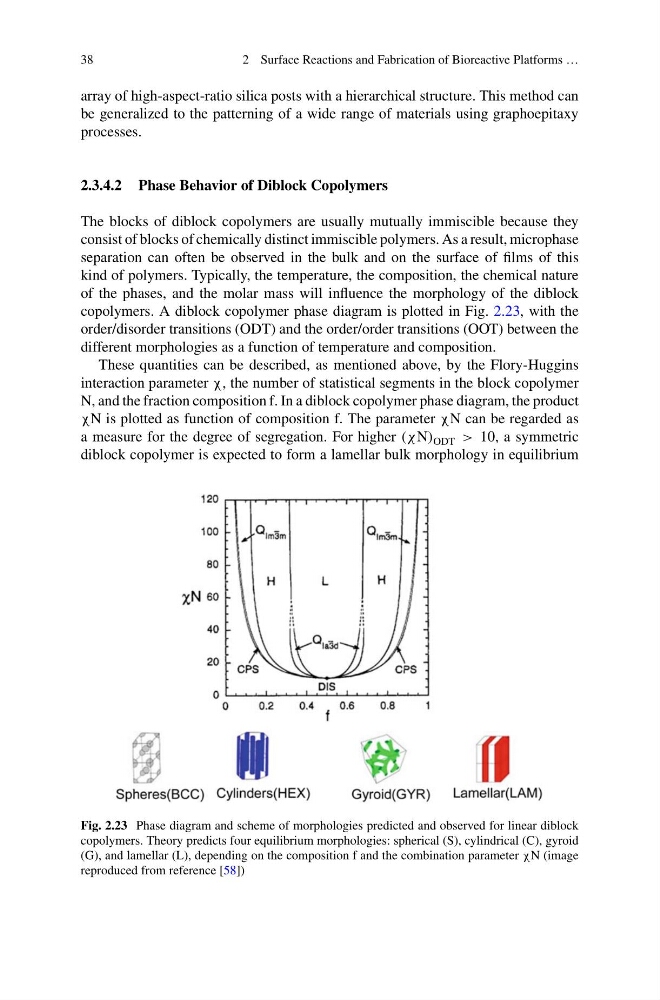
copolymers. A diblock copolymer phase diagram is plotted in Fig. 2.23, with the
order/disorder transitions (ODT) and the order/order transitions (OOT) between the
different morphologies as a function of temperature and composition.
These quantities can be described, as mentioned above, by the Flory-Huggins
interaction parameter χ, the number of statistical segments in the block copolymer
N, and the fraction composition f. In a diblock copolymer phase diagram, the product
χN is plotted as function of composition f. The parameter χN can be regarded as
a measure for the degree of segregation. For higher (χ N) ODT > 10, a symmetric
diblock copolymer is expected to form a lamellar bulk morphology in equilibrium
Fig. 2.23 Phase diagram and scheme of morphologies predicted and observed for linear diblock
copolymers. Theory predicts four equilibrium morphologies: spherical (S), cylindrical (C), gyroid
(G), and lamellar (L), depending on the composition f and the combination parameter χN (image
reproduced from reference [58])
2 Surface Reactions and Fabrication of Bioreactive Platforms …
array of high-aspect-ratio silica posts with a hierarchical structure. This method can
be generalized to the patterning of a wide range of materials using graphoepitaxy
processes.
2.3.4.2 Phase Behavior of Diblock Copolymers
The blocks of diblock copolymers are usually mutually immiscible because they
consist of blocks of chemically distinct immiscible polymers. As a result, microphase
separation can often be observed in the bulk and on the surface of films of this
kind of polymers. Typically, the temperature, the composition, the chemical nature
of the phases, and the molar mass will influence the morphology of the diblock
copolymers. A diblock copolymer phase diagram is plotted in Fig. 2.23, with the
order/disorder transitions (ODT) and the order/order transitions (OOT) between the
different morphologies as a function of temperature and composition.
These quantities can be described, as mentioned above, by the Flory-Huggins
interaction parameter χ, the number of statistical segments in the block copolymer
N, and the fraction composition f. In a diblock copolymer phase diagram, the product
χN is plotted as function of composition f. The parameter χN can be regarded as
a measure for the degree of segregation. For higher (χ N) ODT > 10, a symmetric
diblock copolymer is expected to form a lamellar bulk morphology in equilibrium
Fig. 2.23 Phase diagram and scheme of morphologies predicted and observed for linear diblock
copolymers. Theory predicts four equilibrium morphologies: spherical (S), cylindrical (C), gyroid
(G), and lamellar (L), depending on the composition f and the combination parameter χN (image
reproduced from reference [58])