

22
2 Surface Reactions and Fabrication of Bioreactive Platforms …
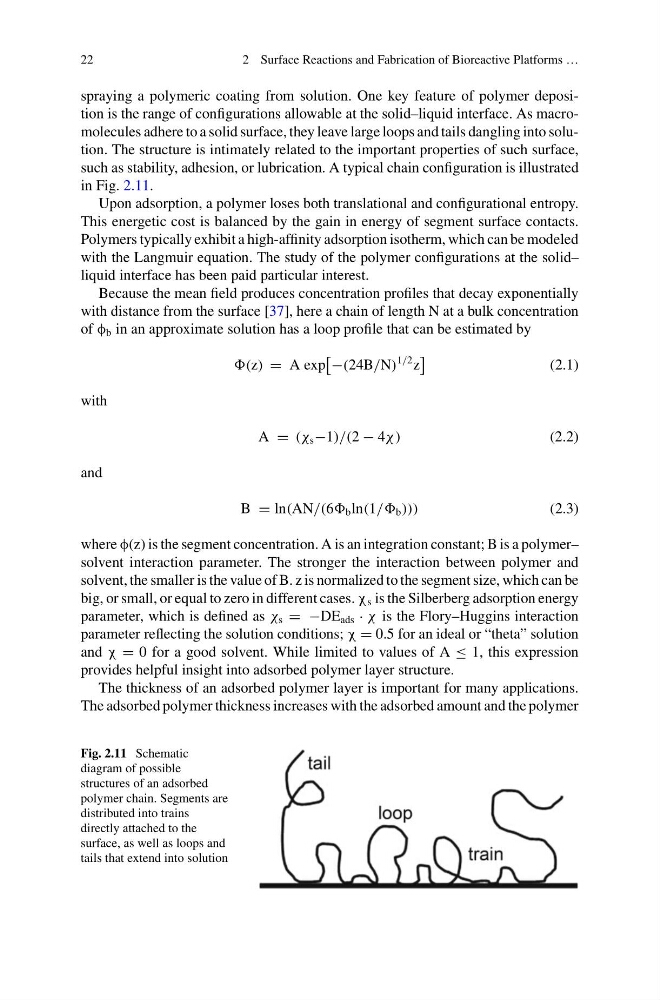
spraying a polymeric coating from solution. One key feature of polymer deposition is the range of configurations allowable at the solid–liquid interface. As macromolecules adhere to a solid surface, they leave large loops and tails dangling into solution. The structure is intimately related to the important properties of such surface,
such as stability, adhesion, or lubrication. A typical chain configuration is illustrated
in Fig. 2.11.
Upon adsorption, a polymer loses both translational and configurational entropy.
This energetic cost is balanced by the gain in energy of segment surface contacts.
Polymers typically exhibit a high-affinity adsorption isotherm, which can be modeled
with the Langmuir equation. The study of the polymer configurations at the solid–
liquid interface has been paid particular interest.
Because the mean field produces concentration profiles that decay exponentially
with distance from the surface [37], here a chain of length N at a bulk concentration
of φ b in an approximate solution has a loop profile that can be estimated by
(z) = A exp
−(24B/N)
1/2 z
(2.1)
with
A = (χ s −1)/(2 − 4χ)
(2.2)
and
B = ln(AN/(6 b ln(1// b )))
(2.3)
where φ(z) is the segment concentration. A is an integration constant; B is a polymer–
solvent interaction parameter. The stronger the interaction between polymer and
solvent, the smaller is the value of B. z is normalized to the segment size, which can be
big, or small, or equal to zero in different cases. χ s is the Silberberg adsorption energy
parameter, which is defined as χ s = −DE ads · χ is the Flory–Huggins interaction
parameter reflecting the solution conditions; χ = 0.5 for an ideal or “theta” solution
and χ = 0 for a good solvent. While limited to values of A ≤ 1, this expression
provides helpful insight into adsorbed polymer layer structure.
The thickness of an adsorbed polymer layer is important for many applications.
The adsorbed polymer thickness increases with the adsorbed amount and the polymer
Fig. 2.11 Schematic
diagram of possible
structures of an adsorbed
polymer chain. Segments are
distributed into trains
directly attached to the
surface, as well as loops and
tails that extend into solution
2 Surface Reactions and Fabrication of Bioreactive Platforms …
spraying a polymeric coating from solution. One key feature of polymer deposition is the range of configurations allowable at the solid–liquid interface. As macromolecules adhere to a solid surface, they leave large loops and tails dangling into solution. The structure is intimately related to the important properties of such surface,
such as stability, adhesion, or lubrication. A typical chain configuration is illustrated
in Fig. 2.11.
Upon adsorption, a polymer loses both translational and configurational entropy.
This energetic cost is balanced by the gain in energy of segment surface contacts.
Polymers typically exhibit a high-affinity adsorption isotherm, which can be modeled
with the Langmuir equation. The study of the polymer configurations at the solid–
liquid interface has been paid particular interest.
Because the mean field produces concentration profiles that decay exponentially
with distance from the surface [37], here a chain of length N at a bulk concentration
of φ b in an approximate solution has a loop profile that can be estimated by
(z) = A exp
−(24B/N)
1/2 z
(2.1)
with
A = (χ s −1)/(2 − 4χ)
(2.2)
and
B = ln(AN/(6 b ln(1// b )))
(2.3)
where φ(z) is the segment concentration. A is an integration constant; B is a polymer–
solvent interaction parameter. The stronger the interaction between polymer and
solvent, the smaller is the value of B. z is normalized to the segment size, which can be
big, or small, or equal to zero in different cases. χ s is the Silberberg adsorption energy
parameter, which is defined as χ s = −DE ads · χ is the Flory–Huggins interaction
parameter reflecting the solution conditions; χ = 0.5 for an ideal or “theta” solution
and χ = 0 for a good solvent. While limited to values of A ≤ 1, this expression
provides helpful insight into adsorbed polymer layer structure.
The thickness of an adsorbed polymer layer is important for many applications.
The adsorbed polymer thickness increases with the adsorbed amount and the polymer
Fig. 2.11 Schematic
diagram of possible
structures of an adsorbed
polymer chain. Segments are
distributed into trains
directly attached to the
surface, as well as loops and
tails that extend into solution