

20
2 Surface Reactions and Fabrication of Bioreactive Platforms …
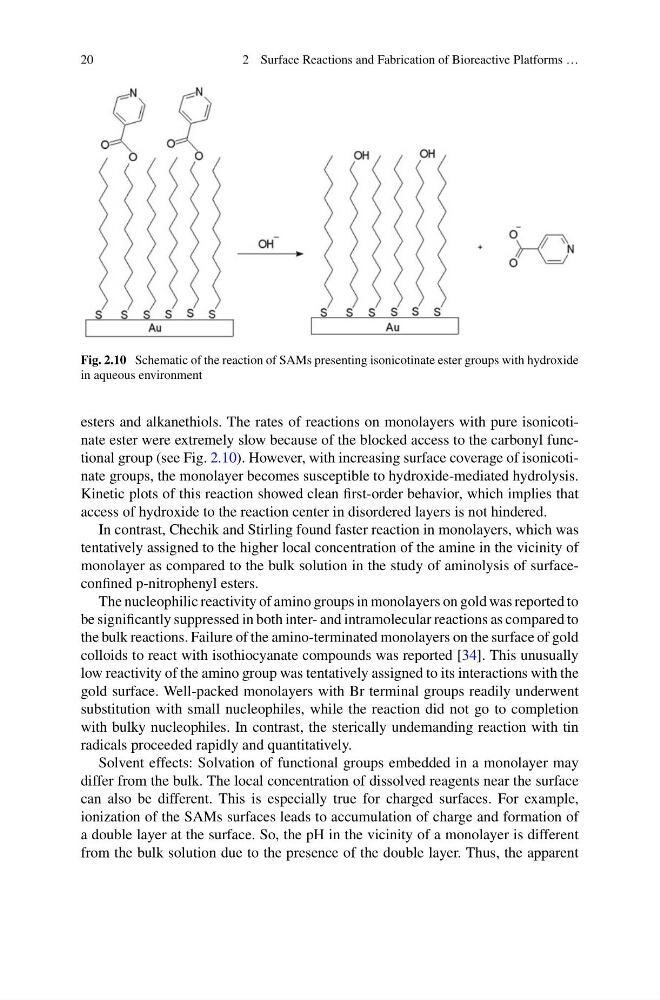
Fig. 2.10 Schematic of the reaction of SAMs presenting isonicotinate ester groups with hydroxide
in aqueous environment
esters and alkanethiols. The rates of reactions on monolayers with pure isonicotinate ester were extremely slow because of the blocked access to the carbonyl functional group (see Fig. 2.10). However, with increasing surface coverage of isonicotinate groups, the monolayer becomes susceptible to hydroxide-mediated hydrolysis.
Kinetic plots of this reaction showed clean first-order behavior, which implies that
access of hydroxide to the reaction center in disordered layers is not hindered.
In contrast, Chechik and Stirling found faster reaction in monolayers, which was
tentatively assigned to the higher local concentration of the amine in the vicinity of
monolayer as compared to the bulk solution in the study of aminolysis of surfaceconfined p-nitrophenyl esters.
The nucleophilic reactivity of amino groups in monolayers on gold was reported to
be significantly suppressed in both inter- and intramolecular reactions as compared to
the bulk reactions. Failure of the amino-terminated monolayers on the surface of gold
colloids to react with isothiocyanate compounds was reported [34]. This unusually
low reactivity of the amino group was tentatively assigned to its interactions with the
gold surface. Well-packed monolayers with Br terminal groups readily underwent
substitution with small nucleophiles, while the reaction did not go to completion
with bulky nucleophiles. In contrast, the sterically undemanding reaction with tin
radicals proceeded rapidly and quantitatively.
Solvent effects: Solvation of functional groups embedded in a monolayer may
differ from the bulk. The local concentration of dissolved reagents near the surface
can also be different. This is especially true for charged surfaces. For example,
ionization of the SAMs surfaces leads to accumulation of charge and formation of
a double layer at the surface. So, the pH in the vicinity of a monolayer is different
from the bulk solution due to the presence of the double layer. Thus, the apparent
2 Surface Reactions and Fabrication of Bioreactive Platforms …
Fig. 2.10 Schematic of the reaction of SAMs presenting isonicotinate ester groups with hydroxide
in aqueous environment
esters and alkanethiols. The rates of reactions on monolayers with pure isonicotinate ester were extremely slow because of the blocked access to the carbonyl functional group (see Fig. 2.10). However, with increasing surface coverage of isonicotinate groups, the monolayer becomes susceptible to hydroxide-mediated hydrolysis.
Kinetic plots of this reaction showed clean first-order behavior, which implies that
access of hydroxide to the reaction center in disordered layers is not hindered.
In contrast, Chechik and Stirling found faster reaction in monolayers, which was
tentatively assigned to the higher local concentration of the amine in the vicinity of
monolayer as compared to the bulk solution in the study of aminolysis of surfaceconfined p-nitrophenyl esters.
The nucleophilic reactivity of amino groups in monolayers on gold was reported to
be significantly suppressed in both inter- and intramolecular reactions as compared to
the bulk reactions. Failure of the amino-terminated monolayers on the surface of gold
colloids to react with isothiocyanate compounds was reported [34]. This unusually
low reactivity of the amino group was tentatively assigned to its interactions with the
gold surface. Well-packed monolayers with Br terminal groups readily underwent
substitution with small nucleophiles, while the reaction did not go to completion
with bulky nucleophiles. In contrast, the sterically undemanding reaction with tin
radicals proceeded rapidly and quantitatively.
Solvent effects: Solvation of functional groups embedded in a monolayer may
differ from the bulk. The local concentration of dissolved reagents near the surface
can also be different. This is especially true for charged surfaces. For example,
ionization of the SAMs surfaces leads to accumulation of charge and formation of
a double layer at the surface. So, the pH in the vicinity of a monolayer is different
from the bulk solution due to the presence of the double layer. Thus, the apparent