

1.2 Chemical and Topographical Pattern Fabrication …
3
between RGD [12] functionalized cell-adhesive dots on the nanometer scale may
determine cell attachment and spreading on patterned surfaces. These effects have
been attributed to the corresponding cellular responses to restricted integrin clustering
rather than insufficient number of ligand molecules in the cell–matrix interface [13].
Current developments to miniaturize patterns rely on “top-down” techniques, such
as photolithography [14] and soft lithography [15–17]. Among these techniques,
microcontact printing (µCP) is one of the promising approaches for producing
(bio)chemical patterns on various solid substrates. In applications, such as the development of certain biosensors [18], the simplicity of the method, as well as the low
cost, the flexibility, and the possibility to pattern curved substrates make µCP a
very attractive technique to fabricate chemical patterns. Alternative routes have
also been opened by unconventional techniques [19], such as microwriting [20],
micromachining [21], and dip-pen nanolithography [22].
It has been realized that the requirement to create patterns in 10–100 nm range for
future applications is also highly relevant in many other fields outside the bionano- or
nanobiotechnology area. These areas include, among others, electronics [23], analytical chemistry [24], and preparation of nanoarrays [25], where the large-scale, routine
formation of nanometer-sized structures remain a challenge that limits advances in
many fields of nanotechnology.
In this sense, “bottom-up” self-assembly approaches are becoming increasingly a
viable tool for nanofabrication. In these approaches the controlled, yet spontaneous
assembly of complex structures of nanometer dimensions starting from molecular
building blocks is being exploited. Among the various promising materials, block
copolymers are widely considered as ideal precursors for the formation of ordered
organic, but also inorganic [26] structures.
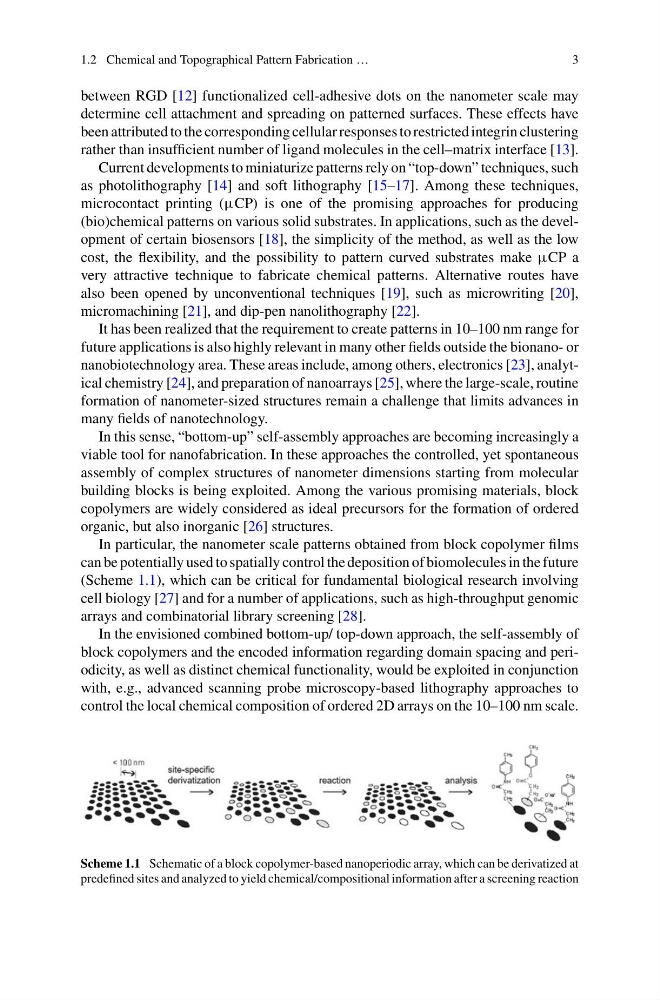
In particular, the nanometer scale patterns obtained from block copolymer films
can be potentially used to spatially control the deposition of biomolecules in the future
(Scheme 1.1), which can be critical for fundamental biological research involving
cell biology [27] and for a number of applications, such as high-throughput genomic
arrays and combinatorial library screening [28].
In the envisioned combined bottom-up/ top-down approach, the self-assembly of
block copolymers and the encoded information regarding domain spacing and periodicity, as well as distinct chemical functionality, would be exploited in conjunction
with, e.g., advanced scanning probe microscopy-based lithography approaches to
control the local chemical composition of ordered 2D arrays on the 10–100 nm scale.
Scheme 1.1 Schematic of a block copolymer-based nanoperiodic array, which can be derivatized at
predefined sites and analyzed to yield chemical/compositional information after a screening reaction
3
between RGD [12] functionalized cell-adhesive dots on the nanometer scale may
determine cell attachment and spreading on patterned surfaces. These effects have
been attributed to the corresponding cellular responses to restricted integrin clustering
rather than insufficient number of ligand molecules in the cell–matrix interface [13].
Current developments to miniaturize patterns rely on “top-down” techniques, such
as photolithography [14] and soft lithography [15–17]. Among these techniques,
microcontact printing (µCP) is one of the promising approaches for producing
(bio)chemical patterns on various solid substrates. In applications, such as the development of certain biosensors [18], the simplicity of the method, as well as the low
cost, the flexibility, and the possibility to pattern curved substrates make µCP a
very attractive technique to fabricate chemical patterns. Alternative routes have
also been opened by unconventional techniques [19], such as microwriting [20],
micromachining [21], and dip-pen nanolithography [22].
It has been realized that the requirement to create patterns in 10–100 nm range for
future applications is also highly relevant in many other fields outside the bionano- or
nanobiotechnology area. These areas include, among others, electronics [23], analytical chemistry [24], and preparation of nanoarrays [25], where the large-scale, routine
formation of nanometer-sized structures remain a challenge that limits advances in
many fields of nanotechnology.
In this sense, “bottom-up” self-assembly approaches are becoming increasingly a
viable tool for nanofabrication. In these approaches the controlled, yet spontaneous
assembly of complex structures of nanometer dimensions starting from molecular
building blocks is being exploited. Among the various promising materials, block
copolymers are widely considered as ideal precursors for the formation of ordered
organic, but also inorganic [26] structures.
In particular, the nanometer scale patterns obtained from block copolymer films
can be potentially used to spatially control the deposition of biomolecules in the future
(Scheme 1.1), which can be critical for fundamental biological research involving
cell biology [27] and for a number of applications, such as high-throughput genomic
arrays and combinatorial library screening [28].
In the envisioned combined bottom-up/ top-down approach, the self-assembly of
block copolymers and the encoded information regarding domain spacing and periodicity, as well as distinct chemical functionality, would be exploited in conjunction
with, e.g., advanced scanning probe microscopy-based lithography approaches to
control the local chemical composition of ordered 2D arrays on the 10–100 nm scale.
Scheme 1.1 Schematic of a block copolymer-based nanoperiodic array, which can be derivatized at
predefined sites and analyzed to yield chemical/compositional information after a screening reaction