

152
8 Nanofabrication on Reactive Block Copolymer Film …
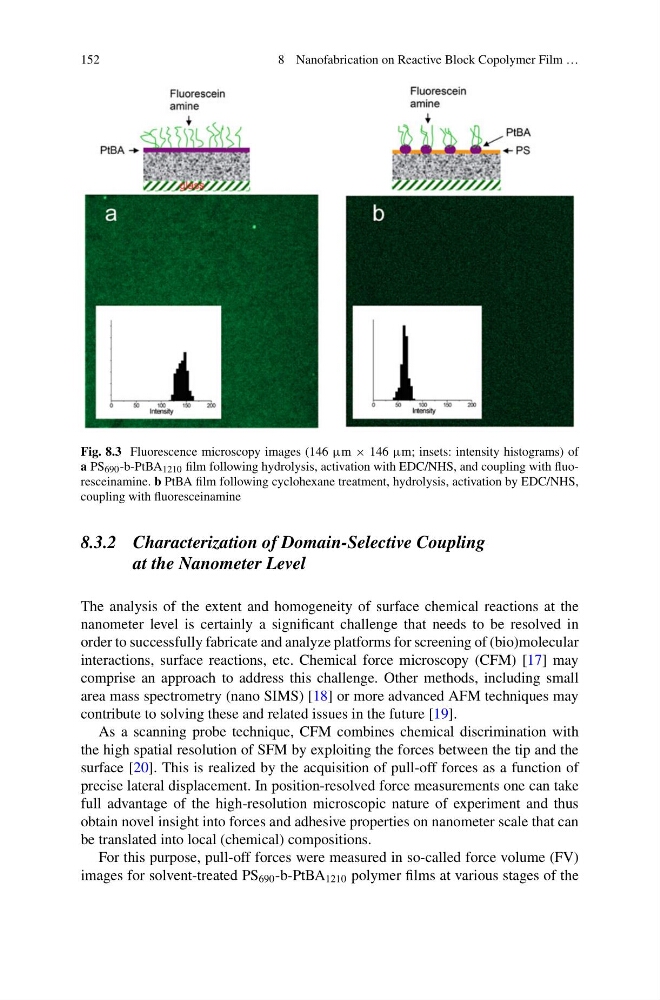
Fig. 8.3 Fluorescence microscopy images (146 μm × 146 μm; insets: intensity histograms) of
a PS 690 -b-PtBA 1210 film following hydrolysis, activation with EDC/NHS, and coupling with fluoresceinamine. b PtBA film following cyclohexane treatment, hydrolysis, activation by EDC/NHS,
coupling with fluoresceinamine
8.3.2 Characterization of Domain-Selective Coupling
at the Nanometer Level
The analysis of the extent and homogeneity of surface chemical reactions at the
nanometer level is certainly a significant challenge that needs to be resolved in
order to successfully fabricate and analyze platforms for screening of (bio)molecular
interactions, surface reactions, etc. Chemical force microscopy (CFM) [17] may
comprise an approach to address this challenge. Other methods, including small
area mass spectrometry (nano SIMS) [18] or more advanced AFM techniques may
contribute to solving these and related issues in the future [19].
As a scanning probe technique, CFM combines chemical discrimination with
the high spatial resolution of SFM by exploiting the forces between the tip and the
surface [20]. This is realized by the acquisition of pull-off forces as a function of
precise lateral displacement. In position-resolved force measurements one can take
full advantage of the high-resolution microscopic nature of experiment and thus
obtain novel insight into forces and adhesive properties on nanometer scale that can
be translated into local (chemical) compositions.
For this purpose, pull-off forces were measured in so-called force volume (FV)
images for solvent-treated PS 690 -b-PtBA 1210 polymer films at various stages of the
8 Nanofabrication on Reactive Block Copolymer Film …
Fig. 8.3 Fluorescence microscopy images (146 μm × 146 μm; insets: intensity histograms) of
a PS 690 -b-PtBA 1210 film following hydrolysis, activation with EDC/NHS, and coupling with fluoresceinamine. b PtBA film following cyclohexane treatment, hydrolysis, activation by EDC/NHS,
coupling with fluoresceinamine
8.3.2 Characterization of Domain-Selective Coupling
at the Nanometer Level
The analysis of the extent and homogeneity of surface chemical reactions at the
nanometer level is certainly a significant challenge that needs to be resolved in
order to successfully fabricate and analyze platforms for screening of (bio)molecular
interactions, surface reactions, etc. Chemical force microscopy (CFM) [17] may
comprise an approach to address this challenge. Other methods, including small
area mass spectrometry (nano SIMS) [18] or more advanced AFM techniques may
contribute to solving these and related issues in the future [19].
As a scanning probe technique, CFM combines chemical discrimination with
the high spatial resolution of SFM by exploiting the forces between the tip and the
surface [20]. This is realized by the acquisition of pull-off forces as a function of
precise lateral displacement. In position-resolved force measurements one can take
full advantage of the high-resolution microscopic nature of experiment and thus
obtain novel insight into forces and adhesive properties on nanometer scale that can
be translated into local (chemical) compositions.
For this purpose, pull-off forces were measured in so-called force volume (FV)
images for solvent-treated PS 690 -b-PtBA 1210 polymer films at various stages of the