

8.1 Introduction
149
films of PS 690 -b-PtBA 1210 diblock copolymers will be described and future directions, e.g., via implementation of scanning probe lithographic approaches, will be
indicated.
8.2 Solvent-Induced Surface Reorientation of PS-b-PtBA
Films
The conventional film preparation of spin-coating and annealing results for the PS 690 -
b-PtBA 1210 diblock copolymer system on glass and oxidized silicon in the formation
of a PtBA skin layer (Chap. 3). Due to the balance of interfacial energies symmetric
wetting is observed. Thus, in order to expose both blocks at the film–air interface
and to obtain the desired nanoperiodic chemically functionalized surface, a solvent
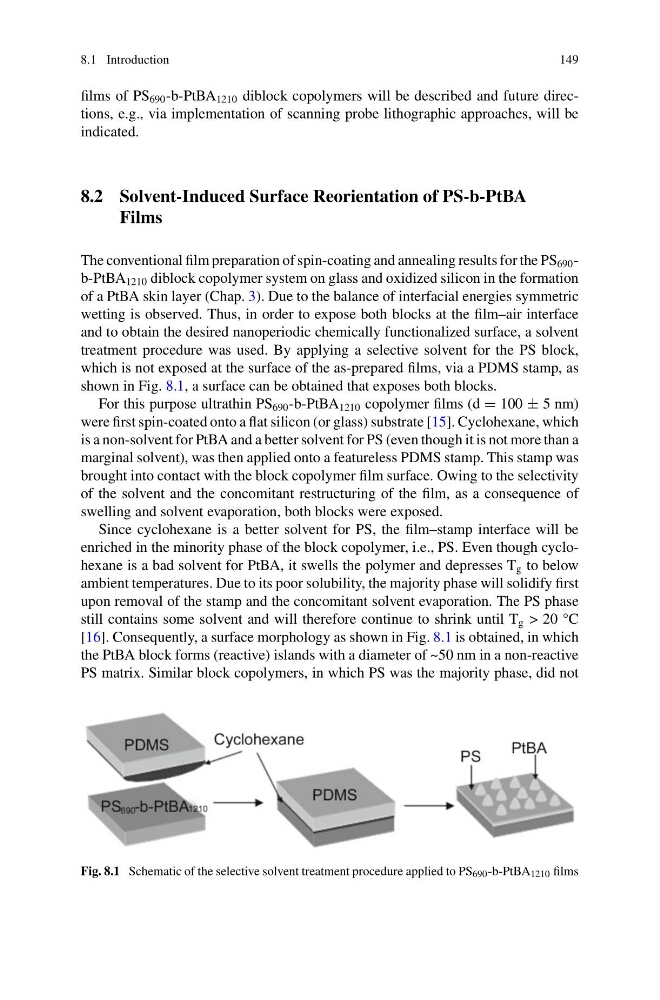
treatment procedure was used. By applying a selective solvent for the PS block,
which is not exposed at the surface of the as-prepared films, via a PDMS stamp, as
shown in Fig. 8.1, a surface can be obtained that exposes both blocks.
For this purpose ultrathin PS 690 -b-PtBA 1210 copolymer films (d = 100 ± 5 nm)
were first spin-coated onto a flat silicon (or glass) substrate [15]. Cyclohexane, which
is a non-solvent for PtBA and a better solvent for PS (even though it is not more than a
marginal solvent), was then applied onto a featureless PDMS stamp. This stamp was
brought into contact with the block copolymer film surface. Owing to the selectivity
of the solvent and the concomitant restructuring of the film, as a consequence of
swelling and solvent evaporation, both blocks were exposed.
Since cyclohexane is a better solvent for PS, the film–stamp interface will be
enriched in the minority phase of the block copolymer, i.e., PS. Even though cyclohexane is a bad solvent for PtBA, it swells the polymer and depresses T g to below
ambient temperatures. Due to its poor solubility, the majority phase will solidify first
upon removal of the stamp and the concomitant solvent evaporation. The PS phase
still contains some solvent and will therefore continue to shrink until T g > 20 °C
[16]. Consequently, a surface morphology as shown in Fig. 8.1 is obtained, in which
the PtBA block forms (reactive) islands with a diameter of ~50 nm in a non-reactive
PS matrix. Similar block copolymers, in which PS was the majority phase, did not
Fig. 8.1 Schematic of the selective solvent treatment procedure applied to PS 690 -b-PtBA 1210 films
149
films of PS 690 -b-PtBA 1210 diblock copolymers will be described and future directions, e.g., via implementation of scanning probe lithographic approaches, will be
indicated.
8.2 Solvent-Induced Surface Reorientation of PS-b-PtBA
Films
The conventional film preparation of spin-coating and annealing results for the PS 690 -
b-PtBA 1210 diblock copolymer system on glass and oxidized silicon in the formation
of a PtBA skin layer (Chap. 3). Due to the balance of interfacial energies symmetric
wetting is observed. Thus, in order to expose both blocks at the film–air interface
and to obtain the desired nanoperiodic chemically functionalized surface, a solvent
treatment procedure was used. By applying a selective solvent for the PS block,
which is not exposed at the surface of the as-prepared films, via a PDMS stamp, as
shown in Fig. 8.1, a surface can be obtained that exposes both blocks.
For this purpose ultrathin PS 690 -b-PtBA 1210 copolymer films (d = 100 ± 5 nm)
were first spin-coated onto a flat silicon (or glass) substrate [15]. Cyclohexane, which
is a non-solvent for PtBA and a better solvent for PS (even though it is not more than a
marginal solvent), was then applied onto a featureless PDMS stamp. This stamp was
brought into contact with the block copolymer film surface. Owing to the selectivity
of the solvent and the concomitant restructuring of the film, as a consequence of
swelling and solvent evaporation, both blocks were exposed.
Since cyclohexane is a better solvent for PS, the film–stamp interface will be
enriched in the minority phase of the block copolymer, i.e., PS. Even though cyclohexane is a bad solvent for PtBA, it swells the polymer and depresses T g to below
ambient temperatures. Due to its poor solubility, the majority phase will solidify first
upon removal of the stamp and the concomitant solvent evaporation. The PS phase
still contains some solvent and will therefore continue to shrink until T g > 20 °C
[16]. Consequently, a surface morphology as shown in Fig. 8.1 is obtained, in which
the PtBA block forms (reactive) islands with a diameter of ~50 nm in a non-reactive
PS matrix. Similar block copolymers, in which PS was the majority phase, did not
Fig. 8.1 Schematic of the selective solvent treatment procedure applied to PS 690 -b-PtBA 1210 films