

136
7 Reactive μCP on Ultrathin Block Copolymer Films …
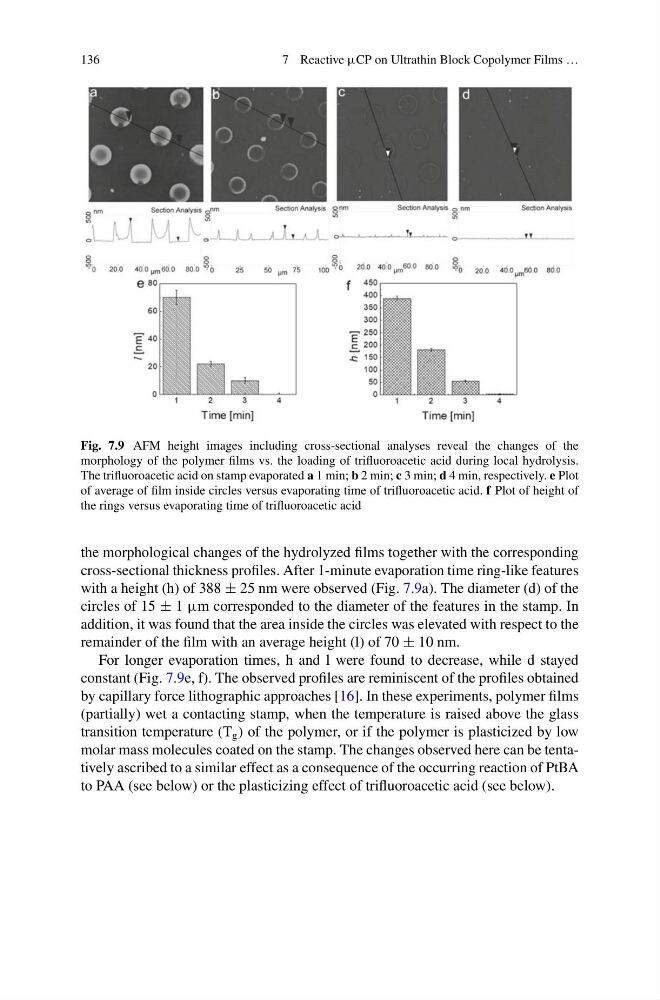
Fig. 7.9 AFM height images including cross-sectional analyses reveal the changes of the
morphology of the polymer films vs. the loading of trifluoroacetic acid during local hydrolysis.
The trifluoroacetic acid on stamp evaporated a 1 min; b 2 min; c 3 min; d 4 min, respectively. e Plot
of average of film inside circles versus evaporating time of trifluoroacetic acid. f Plot of height of
the rings versus evaporating time of trifluoroacetic acid
the morphological changes of the hydrolyzed films together with the corresponding
cross-sectional thickness profiles. After 1-minute evaporation time ring-like features
with a height (h) of 388 ± 25 nm were observed (Fig. 7.9a). The diameter (d) of the
circles of 15 ± 1 μm corresponded to the diameter of the features in the stamp. In
addition, it was found that the area inside the circles was elevated with respect to the
remainder of the film with an average height (l) of 70 ± 10 nm.
For longer evaporation times, h and l were found to decrease, while d stayed
constant (Fig. 7.9e, f). The observed profiles are reminiscent of the profiles obtained
by capillary force lithographic approaches [16]. In these experiments, polymer films
(partially) wet a contacting stamp, when the temperature is raised above the glass
transition temperature (T g ) of the polymer, or if the polymer is plasticized by low
molar mass molecules coated on the stamp. The changes observed here can be tentatively ascribed to a similar effect as a consequence of the occurring reaction of PtBA
to PAA (see below) or the plasticizing effect of trifluoroacetic acid (see below).
7 Reactive μCP on Ultrathin Block Copolymer Films …
Fig. 7.9 AFM height images including cross-sectional analyses reveal the changes of the
morphology of the polymer films vs. the loading of trifluoroacetic acid during local hydrolysis.
The trifluoroacetic acid on stamp evaporated a 1 min; b 2 min; c 3 min; d 4 min, respectively. e Plot
of average of film inside circles versus evaporating time of trifluoroacetic acid. f Plot of height of
the rings versus evaporating time of trifluoroacetic acid
the morphological changes of the hydrolyzed films together with the corresponding
cross-sectional thickness profiles. After 1-minute evaporation time ring-like features
with a height (h) of 388 ± 25 nm were observed (Fig. 7.9a). The diameter (d) of the
circles of 15 ± 1 μm corresponded to the diameter of the features in the stamp. In
addition, it was found that the area inside the circles was elevated with respect to the
remainder of the film with an average height (l) of 70 ± 10 nm.
For longer evaporation times, h and l were found to decrease, while d stayed
constant (Fig. 7.9e, f). The observed profiles are reminiscent of the profiles obtained
by capillary force lithographic approaches [16]. In these experiments, polymer films
(partially) wet a contacting stamp, when the temperature is raised above the glass
transition temperature (T g ) of the polymer, or if the polymer is plasticized by low
molar mass molecules coated on the stamp. The changes observed here can be tentatively ascribed to a similar effect as a consequence of the occurring reaction of PtBA
to PAA (see below) or the plasticizing effect of trifluoroacetic acid (see below).