

92
5 Tailored Biointerfaces via Derivatization of Polystyrene-b-Poly …
which have a more complicated internal structure, including a defined, membranelimited nucleus. Cells interact with the external environment via transmembrane
proteins and many of these proteins are receptors, which are characterized by an
extracellular ligand-binding domain and an intracellular signaling domain. Many of
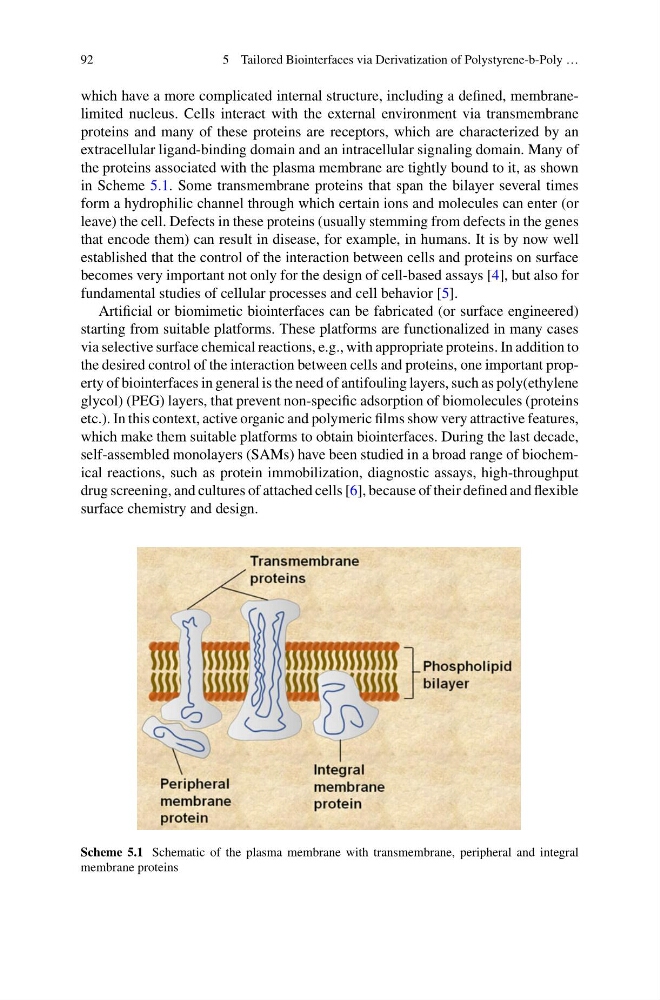
the proteins associated with the plasma membrane are tightly bound to it, as shown
in Scheme 5.1. Some transmembrane proteins that span the bilayer several times
form a hydrophilic channel through which certain ions and molecules can enter (or
leave) the cell. Defects in these proteins (usually stemming from defects in the genes
that encode them) can result in disease, for example, in humans. It is by now well
established that the control of the interaction between cells and proteins on surface
becomes very important not only for the design of cell-based assays [4], but also for
fundamental studies of cellular processes and cell behavior [5].
Artificial or biomimetic biointerfaces can be fabricated (or surface engineered)
starting from suitable platforms. These platforms are functionalized in many cases
via selective surface chemical reactions, e.g., with appropriate proteins. In addition to
the desired control of the interaction between cells and proteins, one important property of biointerfaces in general is the need of antifouling layers, such as poly(ethylene
glycol) (PEG) layers, that prevent non-specific adsorption of biomolecules (proteins
etc.). In this context, active organic and polymeric films show very attractive features,
which make them suitable platforms to obtain biointerfaces. During the last decade,
self-assembled monolayers (SAMs) have been studied in a broad range of biochemical reactions, such as protein immobilization, diagnostic assays, high-throughput
drug screening, and cultures of attached cells [6], because of their defined and flexible
surface chemistry and design.
Scheme 5.1 Schematic of the plasma membrane with transmembrane, peripheral and integral
membrane proteins
5 Tailored Biointerfaces via Derivatization of Polystyrene-b-Poly …
which have a more complicated internal structure, including a defined, membranelimited nucleus. Cells interact with the external environment via transmembrane
proteins and many of these proteins are receptors, which are characterized by an
extracellular ligand-binding domain and an intracellular signaling domain. Many of
the proteins associated with the plasma membrane are tightly bound to it, as shown
in Scheme 5.1. Some transmembrane proteins that span the bilayer several times
form a hydrophilic channel through which certain ions and molecules can enter (or
leave) the cell. Defects in these proteins (usually stemming from defects in the genes
that encode them) can result in disease, for example, in humans. It is by now well
established that the control of the interaction between cells and proteins on surface
becomes very important not only for the design of cell-based assays [4], but also for
fundamental studies of cellular processes and cell behavior [5].
Artificial or biomimetic biointerfaces can be fabricated (or surface engineered)
starting from suitable platforms. These platforms are functionalized in many cases
via selective surface chemical reactions, e.g., with appropriate proteins. In addition to
the desired control of the interaction between cells and proteins, one important property of biointerfaces in general is the need of antifouling layers, such as poly(ethylene
glycol) (PEG) layers, that prevent non-specific adsorption of biomolecules (proteins
etc.). In this context, active organic and polymeric films show very attractive features,
which make them suitable platforms to obtain biointerfaces. During the last decade,
self-assembled monolayers (SAMs) have been studied in a broad range of biochemical reactions, such as protein immobilization, diagnostic assays, high-throughput
drug screening, and cultures of attached cells [6], because of their defined and flexible
surface chemistry and design.
Scheme 5.1 Schematic of the plasma membrane with transmembrane, peripheral and integral
membrane proteins