

82
D. Ghose et al.
1 Introduction
Kerala, having an area of over 38,863 km
2 , is a state on the Malabar Coast in southwestern India [1]. Kerala is land logged on its Northern, Southern, and North-eastern
sides and has the Arabian Sea and the Lakshadweep Sea to its West [1]. The coastline
of Kerala runs an approximate of 580 km in length along the seas. The long sea-facing
coastline along the state provides opportunities for utilization of the energy of the
ocean in various ways, particularly as a source of renewable energy. Oceans, covering
vast areas of the Earth’s surface, absorb most of the radiations from the sun and are
established to be one of the largest reservoirs of energy [2]. They act as carbon-dioxide
free, eco-friendly, vast renewable energy reserves [3]. Energy from the ocean can
be in the form of wave energy, tidal energy, ocean currents, ocean winds, and ocean
thermal energy. While tidal energy involves the conversion of the energy of tides
by storing and controlling the release of water to pass through turbine generators
producing electricity [4], wave energy is fundamentally the energy possessed by
winds, created in the mid-latitude regions of the Earth under influence of heat from
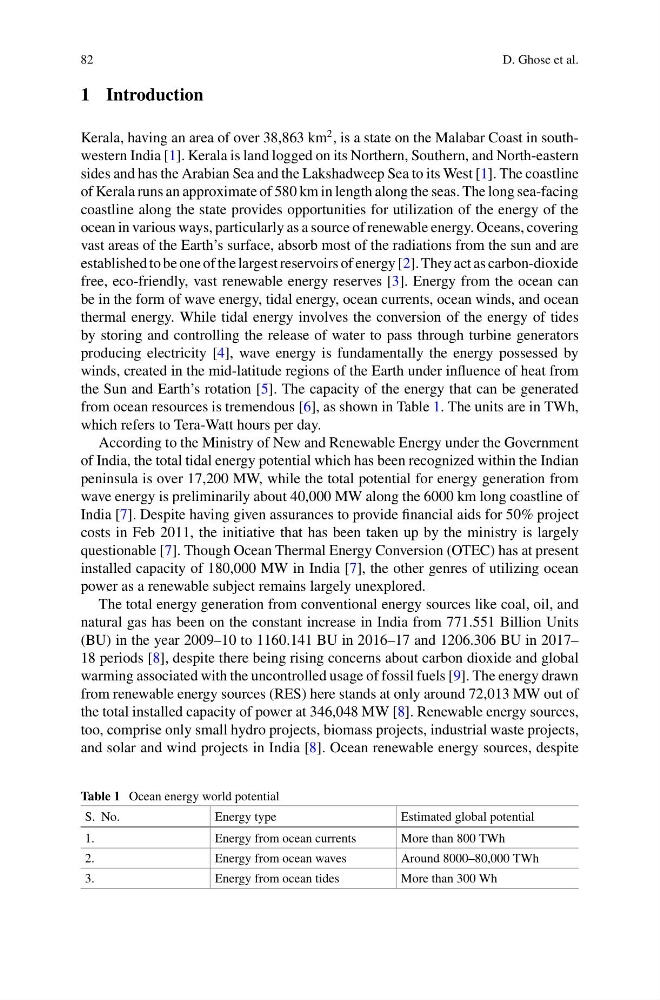
the Sun and Earth’s rotation [5]. The capacity of the energy that can be generated
from ocean resources is tremendous [6], as shown in Table 1. The units are in TWh,
which refers to Tera-Watt hours per day.
According to the Ministry of New and Renewable Energy under the Government
of India, the total tidal energy potential which has been recognized within the Indian
peninsula is over 17,200 MW, while the total potential for energy generation from
wave energy is preliminarily about 40,000 MW along the 6000 km long coastline of
India [7]. Despite having given assurances to provide financial aids for 50% project
costs in Feb 2011, the initiative that has been taken up by the ministry is largely
questionable [7]. Though Ocean Thermal Energy Conversion (OTEC) has at present
installed capacity of 180,000 MW in India [7], the other genres of utilizing ocean
power as a renewable subject remains largely unexplored.
The total energy generation from conventional energy sources like coal, oil, and
natural gas has been on the constant increase in India from 771.551 Billion Units
(BU) in the year 2009–10 to 1160.141 BU in 2016–17 and 1206.306 BU in 2017–
18 periods [8], despite there being rising concerns about carbon dioxide and global
warming associated with the uncontrolled usage of fossil fuels [9]. The energy drawn
from renewable energy sources (RES) here stands at only around 72,013 MW out of
the total installed capacity of power at 346,048 MW [8]. Renewable energy sources,
too, comprise only small hydro projects, biomass projects, industrial waste projects,
and solar and wind projects in India [8]. Ocean renewable energy sources, despite
Table 1 Ocean energy world potential
S. No.
Energy type
Estimated global potential
1.
Energy from ocean currents
More than 800 TWh
2.
Energy from ocean waves
Around 8000–80,000 TWh
3.
Energy from ocean tides
More than 300 Wh
D. Ghose et al.
1 Introduction
Kerala, having an area of over 38,863 km
2 , is a state on the Malabar Coast in southwestern India [1]. Kerala is land logged on its Northern, Southern, and North-eastern
sides and has the Arabian Sea and the Lakshadweep Sea to its West [1]. The coastline
of Kerala runs an approximate of 580 km in length along the seas. The long sea-facing
coastline along the state provides opportunities for utilization of the energy of the
ocean in various ways, particularly as a source of renewable energy. Oceans, covering
vast areas of the Earth’s surface, absorb most of the radiations from the sun and are
established to be one of the largest reservoirs of energy [2]. They act as carbon-dioxide
free, eco-friendly, vast renewable energy reserves [3]. Energy from the ocean can
be in the form of wave energy, tidal energy, ocean currents, ocean winds, and ocean
thermal energy. While tidal energy involves the conversion of the energy of tides
by storing and controlling the release of water to pass through turbine generators
producing electricity [4], wave energy is fundamentally the energy possessed by
winds, created in the mid-latitude regions of the Earth under influence of heat from
the Sun and Earth’s rotation [5]. The capacity of the energy that can be generated
from ocean resources is tremendous [6], as shown in Table 1. The units are in TWh,
which refers to Tera-Watt hours per day.
According to the Ministry of New and Renewable Energy under the Government
of India, the total tidal energy potential which has been recognized within the Indian
peninsula is over 17,200 MW, while the total potential for energy generation from
wave energy is preliminarily about 40,000 MW along the 6000 km long coastline of
India [7]. Despite having given assurances to provide financial aids for 50% project
costs in Feb 2011, the initiative that has been taken up by the ministry is largely
questionable [7]. Though Ocean Thermal Energy Conversion (OTEC) has at present
installed capacity of 180,000 MW in India [7], the other genres of utilizing ocean
power as a renewable subject remains largely unexplored.
The total energy generation from conventional energy sources like coal, oil, and
natural gas has been on the constant increase in India from 771.551 Billion Units
(BU) in the year 2009–10 to 1160.141 BU in 2016–17 and 1206.306 BU in 2017–
18 periods [8], despite there being rising concerns about carbon dioxide and global
warming associated with the uncontrolled usage of fossil fuels [9]. The energy drawn
from renewable energy sources (RES) here stands at only around 72,013 MW out of
the total installed capacity of power at 346,048 MW [8]. Renewable energy sources,
too, comprise only small hydro projects, biomass projects, industrial waste projects,
and solar and wind projects in India [8]. Ocean renewable energy sources, despite
Table 1 Ocean energy world potential
S. No.
Energy type
Estimated global potential
1.
Energy from ocean currents
More than 800 TWh
2.
Energy from ocean waves
Around 8000–80,000 TWh
3.
Energy from ocean tides
More than 300 Wh