

Hydrochemical Analysis of Six Sacred Lakes …
63
L1
L2
L3
L4
L5
L6
1
10
100
1000
10000
0.0
0.2
0.4
0.6
0.8
1.0
TDS (ppm)
Na / Na + Ca
Evaporation-Crystallization Dominance
Rock Dominance
Precipitation Dominance
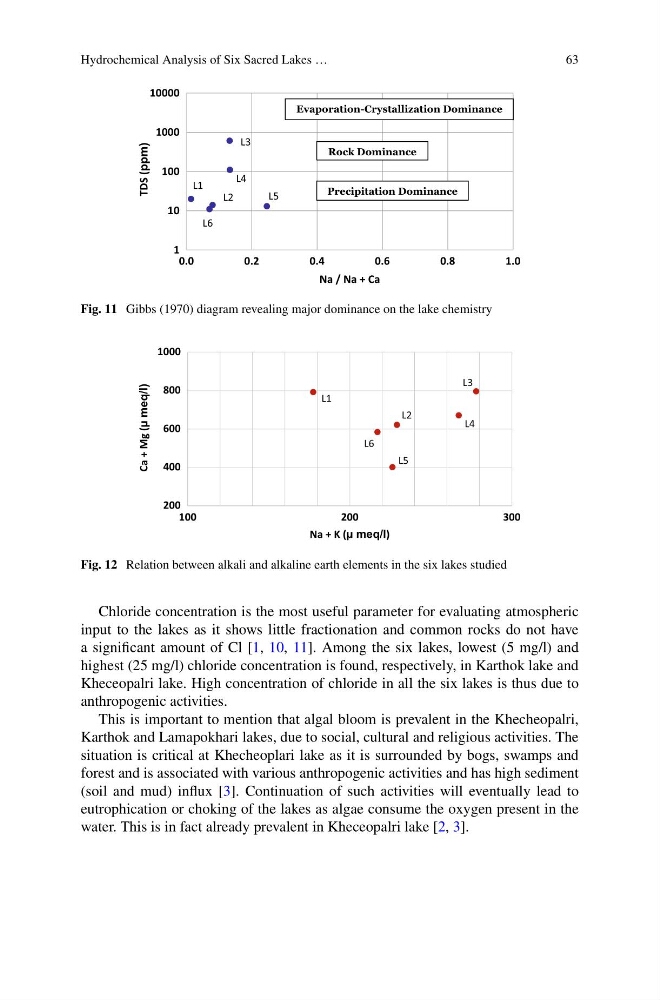
Fig. 11 Gibbs (1970) diagram revealing major dominance on the lake chemistry
L1
L2
L3
L4
L5
L6
200
400
600
800
1000
0
0
3
0
0
2
0
0
1
Ca + Mg (µ
meq/l)
Na + K (µ meq/l)
Fig. 12 Relation between alkali and alkaline earth elements in the six lakes studied
Chloride concentration is the most useful parameter for evaluating atmospheric
input to the lakes as it shows little fractionation and common rocks do not have
a significant amount of Cl [1, 10, 11]. Among the six lakes, lowest (5 mg/l) and
highest (25 mg/l) chloride concentration is found, respectively, in Karthok lake and
Kheceopalri lake. High concentration of chloride in all the six lakes is thus due to
anthropogenic activities.
This is important to mention that algal bloom is prevalent in the Khecheopalri,
Karthok and Lamapokhari lakes, due to social, cultural and religious activities. The
situation is critical at Khecheoplari lake as it is surrounded by bogs, swamps and
forest and is associated with various anthropogenic activities and has high sediment
(soil and mud) influx [3]. Continuation of such activities will eventually lead to
eutrophication or choking of the lakes as algae consume the oxygen present in the
water. This is in fact already prevalent in Kheceopalri lake [2, 3].
63
L1
L2
L3
L4
L5
L6
1
10
100
1000
10000
0.0
0.2
0.4
0.6
0.8
1.0
TDS (ppm)
Na / Na + Ca
Evaporation-Crystallization Dominance
Rock Dominance
Precipitation Dominance
Fig. 11 Gibbs (1970) diagram revealing major dominance on the lake chemistry
L1
L2
L3
L4
L5
L6
200
400
600
800
1000
0
0
3
0
0
2
0
0
1
Ca + Mg (µ
meq/l)
Na + K (µ meq/l)
Fig. 12 Relation between alkali and alkaline earth elements in the six lakes studied
Chloride concentration is the most useful parameter for evaluating atmospheric
input to the lakes as it shows little fractionation and common rocks do not have
a significant amount of Cl [1, 10, 11]. Among the six lakes, lowest (5 mg/l) and
highest (25 mg/l) chloride concentration is found, respectively, in Karthok lake and
Kheceopalri lake. High concentration of chloride in all the six lakes is thus due to
anthropogenic activities.
This is important to mention that algal bloom is prevalent in the Khecheopalri,
Karthok and Lamapokhari lakes, due to social, cultural and religious activities. The
situation is critical at Khecheoplari lake as it is surrounded by bogs, swamps and
forest and is associated with various anthropogenic activities and has high sediment
(soil and mud) influx [3]. Continuation of such activities will eventually lead to
eutrophication or choking of the lakes as algae consume the oxygen present in the
water. This is in fact already prevalent in Kheceopalri lake [2, 3].