

Hydrochemical Analysis of Six Sacred Lakes …
61
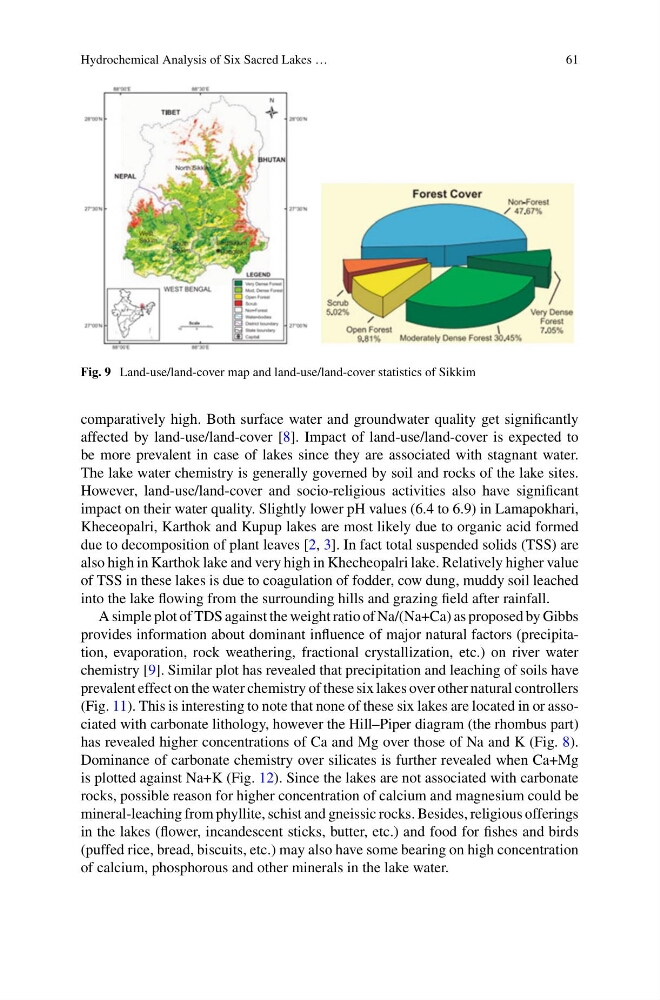
Fig. 9 Land-use/land-cover map and land-use/land-cover statistics of Sikkim
comparatively high. Both surface water and groundwater quality get significantly
affected by land-use/land-cover [8]. Impact of land-use/land-cover is expected to
be more prevalent in case of lakes since they are associated with stagnant water.
The lake water chemistry is generally governed by soil and rocks of the lake sites.
However, land-use/land-cover and socio-religious activities also have significant
impact on their water quality. Slightly lower pH values (6.4 to 6.9) in Lamapokhari,
Kheceopalri, Karthok and Kupup lakes are most likely due to organic acid formed
due to decomposition of plant leaves [2, 3]. In fact total suspended solids (TSS) are
also high in Karthok lake and very high in Khecheopalri lake. Relatively higher value
of TSS in these lakes is due to coagulation of fodder, cow dung, muddy soil leached
into the lake flowing from the surrounding hills and grazing field after rainfall.
A simple plot of TDS against the weight ratio of Na/(Na+Ca) as proposed by Gibbs
provides information about dominant influence of major natural factors (precipitation, evaporation, rock weathering, fractional crystallization, etc.) on river water
chemistry [9]. Similar plot has revealed that precipitation and leaching of soils have
prevalent effect on the water chemistry of these six lakes over other natural controllers
(Fig. 11). This is interesting to note that none of these six lakes are located in or associated with carbonate lithology, however the Hill–Piper diagram (the rhombus part)
has revealed higher concentrations of Ca and Mg over those of Na and K (Fig. 8).
Dominance of carbonate chemistry over silicates is further revealed when Ca+Mg
is plotted against Na+K (Fig. 12). Since the lakes are not associated with carbonate
rocks, possible reason for higher concentration of calcium and magnesium could be
mineral-leaching from phyllite, schist and gneissic rocks. Besides, religious offerings
in the lakes (flower, incandescent sticks, butter, etc.) and food for fishes and birds
(puffed rice, bread, biscuits, etc.) may also have some bearing on high concentration
of calcium, phosphorous and other minerals in the lake water.
61
Fig. 9 Land-use/land-cover map and land-use/land-cover statistics of Sikkim
comparatively high. Both surface water and groundwater quality get significantly
affected by land-use/land-cover [8]. Impact of land-use/land-cover is expected to
be more prevalent in case of lakes since they are associated with stagnant water.
The lake water chemistry is generally governed by soil and rocks of the lake sites.
However, land-use/land-cover and socio-religious activities also have significant
impact on their water quality. Slightly lower pH values (6.4 to 6.9) in Lamapokhari,
Kheceopalri, Karthok and Kupup lakes are most likely due to organic acid formed
due to decomposition of plant leaves [2, 3]. In fact total suspended solids (TSS) are
also high in Karthok lake and very high in Khecheopalri lake. Relatively higher value
of TSS in these lakes is due to coagulation of fodder, cow dung, muddy soil leached
into the lake flowing from the surrounding hills and grazing field after rainfall.
A simple plot of TDS against the weight ratio of Na/(Na+Ca) as proposed by Gibbs
provides information about dominant influence of major natural factors (precipitation, evaporation, rock weathering, fractional crystallization, etc.) on river water
chemistry [9]. Similar plot has revealed that precipitation and leaching of soils have
prevalent effect on the water chemistry of these six lakes over other natural controllers
(Fig. 11). This is interesting to note that none of these six lakes are located in or associated with carbonate lithology, however the Hill–Piper diagram (the rhombus part)
has revealed higher concentrations of Ca and Mg over those of Na and K (Fig. 8).
Dominance of carbonate chemistry over silicates is further revealed when Ca+Mg
is plotted against Na+K (Fig. 12). Since the lakes are not associated with carbonate
rocks, possible reason for higher concentration of calcium and magnesium could be
mineral-leaching from phyllite, schist and gneissic rocks. Besides, religious offerings
in the lakes (flower, incandescent sticks, butter, etc.) and food for fishes and birds
(puffed rice, bread, biscuits, etc.) may also have some bearing on high concentration
of calcium, phosphorous and other minerals in the lake water.