

46
P. Vasistha and R. Ganguly
used by forest department for the plantation of medicinal plants, sampling point 2
was near the local farms used for rice, wheat, maize, and barley cultivation, sampling
point 3 was near the marshy area of the lake, and sampling point 4 was the center of
the lake.
The samples were collected using the boats available at the site. The sampling was
done at about half meter below the surface of the lake, and the samples were stored
in PVC bottles filled up to the brim then tested for various physical, chemical, and
biological parameters, namely pH, temperature, BOD, DO, total coliform, ammonia,
nitrate, nitrite, conductivity of water and total dissolved solids (TDS). The values
for electrical conductivity (EC), pH, dissolved oxygen (DO), total dissolved solids
(TDS), and temperature were determined on site using portable meters and rest of
the parameters were measured according to the standard procedures by [14] and [15]
after the samples are transferred to the laboratory.
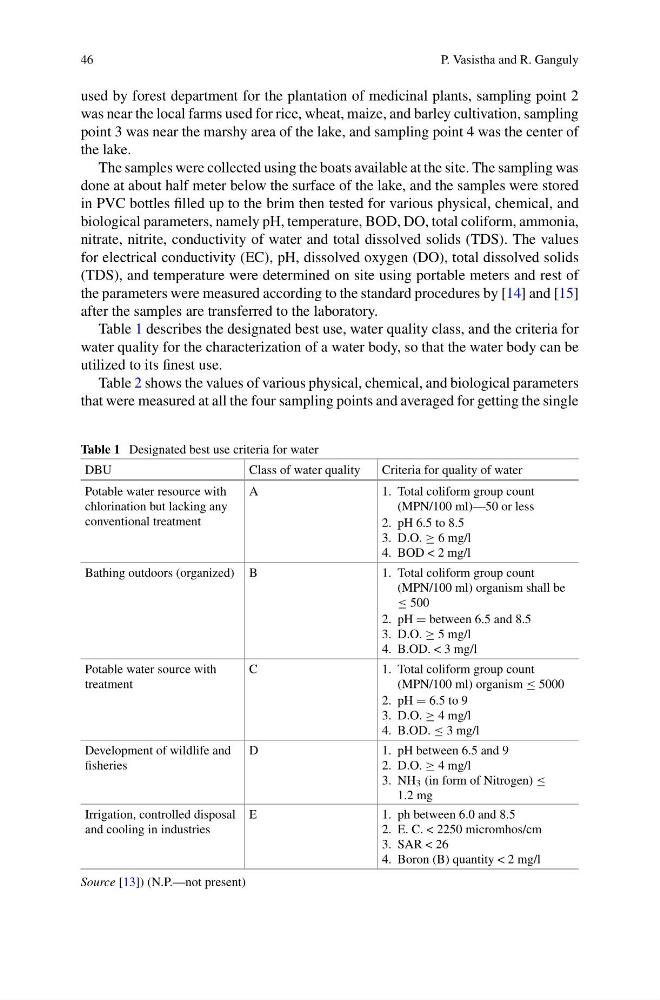
Table 1 describes the designated best use, water quality class, and the criteria for
water quality for the characterization of a water body, so that the water body can be
utilized to its finest use.
Table 2 shows the values of various physical, chemical, and biological parameters
that were measured at all the four sampling points and averaged for getting the single
Table 1 Designated best use criteria for water
DBU
Class of water quality
Criteria for quality of water
Potable water resource with
chlorination but lacking any
conventional treatment
A
1. Total coliform group count
(MPN/100 ml)—50 or less
2. pH 6.5 to 8.5
3. D.O. ≥ 6 mg/l
4. BOD < 2 mg/l
Bathing outdoors (organized) B
1. Total coliform group count
(MPN/100 ml) organism shall be
≤ 500
2. pH = between 6.5 and 8.5
3. D.O. ≥ 5 mg/l
4. B.OD. < 3 mg/l
Potable water source with
treatment
C
1. Total coliform group count
(MPN/100 ml) organism ≤ 5000
2. pH = 6.5 to 9
3. D.O. ≥ 4 mg/l
4. B.OD. ≤ 3 mg/l
Development of wildlife and
fisheries
D
1. pH between 6.5 and 9
2. D.O. ≥ 4 mg/l
3. NH 3 (in form of Nitrogen) ≤
1.2 mg
Irrigation, controlled disposal
and cooling in industries
E
1. ph between 6.0 and 8.5
2. E. C. < 2250 micromhos/cm
3. SAR < 26
4. Boron (B) quantity < 2 mg/l
Source [13]) (N.P.—not present)
P. Vasistha and R. Ganguly
used by forest department for the plantation of medicinal plants, sampling point 2
was near the local farms used for rice, wheat, maize, and barley cultivation, sampling
point 3 was near the marshy area of the lake, and sampling point 4 was the center of
the lake.
The samples were collected using the boats available at the site. The sampling was
done at about half meter below the surface of the lake, and the samples were stored
in PVC bottles filled up to the brim then tested for various physical, chemical, and
biological parameters, namely pH, temperature, BOD, DO, total coliform, ammonia,
nitrate, nitrite, conductivity of water and total dissolved solids (TDS). The values
for electrical conductivity (EC), pH, dissolved oxygen (DO), total dissolved solids
(TDS), and temperature were determined on site using portable meters and rest of
the parameters were measured according to the standard procedures by [14] and [15]
after the samples are transferred to the laboratory.
Table 1 describes the designated best use, water quality class, and the criteria for
water quality for the characterization of a water body, so that the water body can be
utilized to its finest use.
Table 2 shows the values of various physical, chemical, and biological parameters
that were measured at all the four sampling points and averaged for getting the single
Table 1 Designated best use criteria for water
DBU
Class of water quality
Criteria for quality of water
Potable water resource with
chlorination but lacking any
conventional treatment
A
1. Total coliform group count
(MPN/100 ml)—50 or less
2. pH 6.5 to 8.5
3. D.O. ≥ 6 mg/l
4. BOD < 2 mg/l
Bathing outdoors (organized) B
1. Total coliform group count
(MPN/100 ml) organism shall be
≤ 500
2. pH = between 6.5 and 8.5
3. D.O. ≥ 5 mg/l
4. B.OD. < 3 mg/l
Potable water source with
treatment
C
1. Total coliform group count
(MPN/100 ml) organism ≤ 5000
2. pH = 6.5 to 9
3. D.O. ≥ 4 mg/l
4. B.OD. ≤ 3 mg/l
Development of wildlife and
fisheries
D
1. pH between 6.5 and 9
2. D.O. ≥ 4 mg/l
3. NH 3 (in form of Nitrogen) ≤
1.2 mg
Irrigation, controlled disposal
and cooling in industries
E
1. ph between 6.0 and 8.5
2. E. C. < 2250 micromhos/cm
3. SAR < 26
4. Boron (B) quantity < 2 mg/l
Source [13]) (N.P.—not present)