

Error Estimation for Forecasting of Orographic …
301
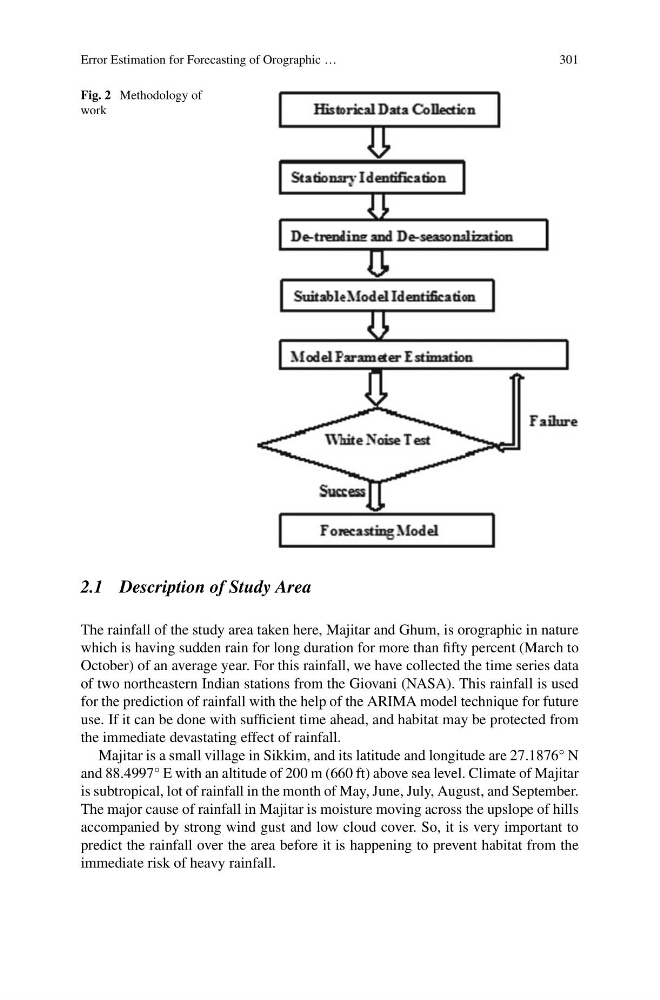
Fig. 2 Methodology of
work
2.1 Description of Study Area
The rainfall of the study area taken here, Majitar and Ghum, is orographic in nature
which is having sudden rain for long duration for more than fifty percent (March to
October) of an average year. For this rainfall, we have collected the time series data
of two northeastern Indian stations from the Giovani (NASA). This rainfall is used
for the prediction of rainfall with the help of the ARIMA model technique for future
use. If it can be done with sufficient time ahead, and habitat may be protected from
the immediate devastating effect of rainfall.
Majitar is a small village in Sikkim, and its latitude and longitude are 27.1876° N
and 88.4997° E with an altitude of 200 m (660 ft) above sea level. Climate of Majitar
is subtropical, lot of rainfall in the month of May, June, July, August, and September.
The major cause of rainfall in Majitar is moisture moving across the upslope of hills
accompanied by strong wind gust and low cloud cover. So, it is very important to
predict the rainfall over the area before it is happening to prevent habitat from the
immediate risk of heavy rainfall.
301
Fig. 2 Methodology of
work
2.1 Description of Study Area
The rainfall of the study area taken here, Majitar and Ghum, is orographic in nature
which is having sudden rain for long duration for more than fifty percent (March to
October) of an average year. For this rainfall, we have collected the time series data
of two northeastern Indian stations from the Giovani (NASA). This rainfall is used
for the prediction of rainfall with the help of the ARIMA model technique for future
use. If it can be done with sufficient time ahead, and habitat may be protected from
the immediate devastating effect of rainfall.
Majitar is a small village in Sikkim, and its latitude and longitude are 27.1876° N
and 88.4997° E with an altitude of 200 m (660 ft) above sea level. Climate of Majitar
is subtropical, lot of rainfall in the month of May, June, July, August, and September.
The major cause of rainfall in Majitar is moisture moving across the upslope of hills
accompanied by strong wind gust and low cloud cover. So, it is very important to
predict the rainfall over the area before it is happening to prevent habitat from the
immediate risk of heavy rainfall.