

8
E. Yetbarek and R. Ojha
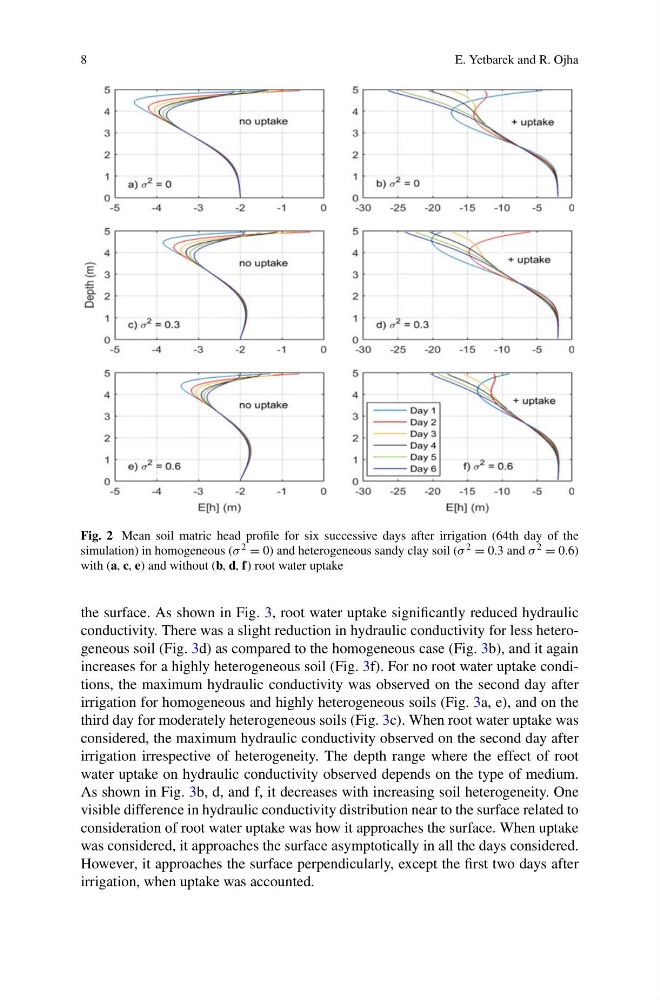
Fig. 2 Mean soil matric head profile for six successive days after irrigation (64th day of the
simulation) in homogeneous (σ 2 = 0) and heterogeneous sandy clay soil (σ 2 = 0.3 and σ 2 = 0.6)
with (a, c, e) and without (b, d, f) root water uptake
the surface. As shown in Fig. 3, root water uptake significantly reduced hydraulic
conductivity. There was a slight reduction in hydraulic conductivity for less heterogeneous soil (Fig. 3d) as compared to the homogeneous case (Fig. 3b), and it again
increases for a highly heterogeneous soil (Fig. 3f). For no root water uptake conditions, the maximum hydraulic conductivity was observed on the second day after
irrigation for homogeneous and highly heterogeneous soils (Fig. 3a, e), and on the
third day for moderately heterogeneous soils (Fig. 3c). When root water uptake was
considered, the maximum hydraulic conductivity observed on the second day after
irrigation irrespective of heterogeneity. The depth range where the effect of root
water uptake on hydraulic conductivity observed depends on the type of medium.
As shown in Fig. 3b, d, and f, it decreases with increasing soil heterogeneity. One
visible difference in hydraulic conductivity distribution near to the surface related to
consideration of root water uptake was how it approaches the surface. When uptake
was considered, it approaches the surface asymptotically in all the days considered.
However, it approaches the surface perpendicularly, except the first two days after
irrigation, when uptake was accounted.
E. Yetbarek and R. Ojha
Fig. 2 Mean soil matric head profile for six successive days after irrigation (64th day of the
simulation) in homogeneous (σ 2 = 0) and heterogeneous sandy clay soil (σ 2 = 0.3 and σ 2 = 0.6)
with (a, c, e) and without (b, d, f) root water uptake
the surface. As shown in Fig. 3, root water uptake significantly reduced hydraulic
conductivity. There was a slight reduction in hydraulic conductivity for less heterogeneous soil (Fig. 3d) as compared to the homogeneous case (Fig. 3b), and it again
increases for a highly heterogeneous soil (Fig. 3f). For no root water uptake conditions, the maximum hydraulic conductivity was observed on the second day after
irrigation for homogeneous and highly heterogeneous soils (Fig. 3a, e), and on the
third day for moderately heterogeneous soils (Fig. 3c). When root water uptake was
considered, the maximum hydraulic conductivity observed on the second day after
irrigation irrespective of heterogeneity. The depth range where the effect of root
water uptake on hydraulic conductivity observed depends on the type of medium.
As shown in Fig. 3b, d, and f, it decreases with increasing soil heterogeneity. One
visible difference in hydraulic conductivity distribution near to the surface related to
consideration of root water uptake was how it approaches the surface. When uptake
was considered, it approaches the surface asymptotically in all the days considered.
However, it approaches the surface perpendicularly, except the first two days after
irrigation, when uptake was accounted.