

Comparative Study of Scouring Around Bridge Piers
263
stream bed elevations which change due to natural or manmade causes. Contraction scour in the bridge channel involves the removal of materials from the bed,
where the flow area of the stream is reduced either by natural contraction of the
stream channel or by a bridge. General scour is the general decrease of the stream
bed during the passage of the flood wave. Local scour involves the removal of bed
materials around the structure located in the moving water.
2.1 River Flow Modelling
The river flow modelling is done for scour depth determination around bridge piers
using Hec-Ras. Upstream end of the river system is modelled by using stage hydrograph, flow hydrograph and boundary conditions of stage and flow hydrograph. In
unsteady flow model, the Saint-Venant equation is used.
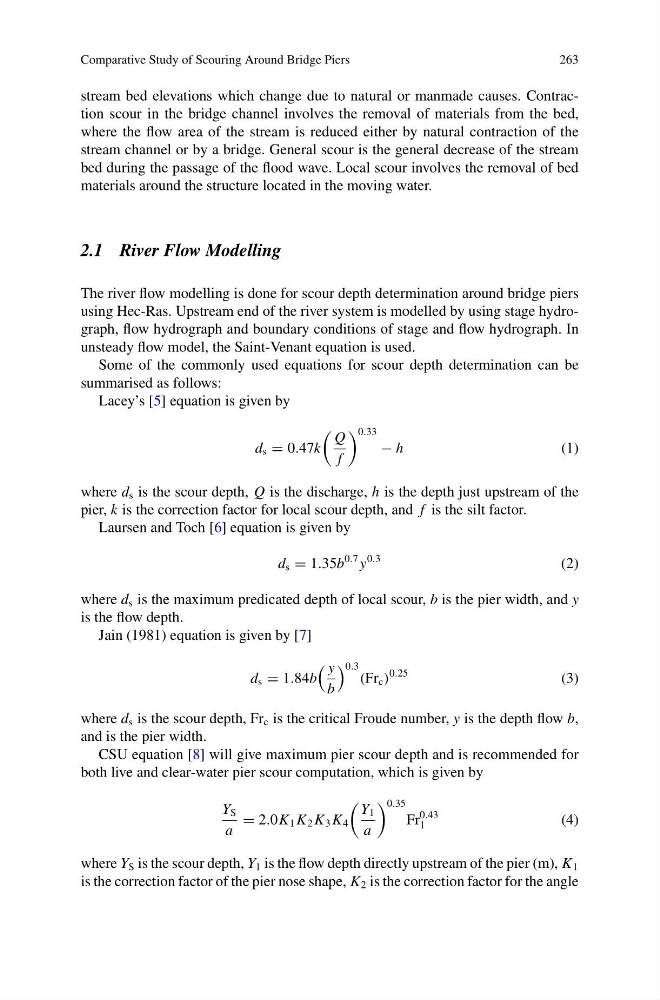
Some of the commonly used equations for scour depth determination can be
summarised as follows:
Lacey’s [5] equation is given by
d s = 0.47k
Q
f
0.33
− h
(1)
where d s is the scour depth, Q is the discharge, h is the depth just upstream of the
pier, k is the correction factor for local scour depth, and f is the silt factor.
Laursen and Toch [6] equation is given by
d s = 1.35b
0.7 y
0.3
(2)
where d s is the maximum predicated depth of local scour, b is the pier width, and y
is the flow depth.
Jain (1981) equation is given by [7]
d s = 1.84b
y
b
0.3 (Fr c )
0.25
(3)
where d s is the scour depth, Fr c is the critical Froude number, y is the depth flow b,
and is the pier width.
CSU equation [8] will give maximum pier scour depth and is recommended for
both live and clear-water pier scour computation, which is given by
Y S
a
= 2.0K 1 K 2 K 3 K 4
Y 1
a
0.35
Fr
0.43
1
(4)
where Y S is the scour depth, Y 1 is the flow depth directly upstream of the pier (m), K 1
is the correction factor of the pier nose shape, K 2 is the correction factor for the angle
263
stream bed elevations which change due to natural or manmade causes. Contraction scour in the bridge channel involves the removal of materials from the bed,
where the flow area of the stream is reduced either by natural contraction of the
stream channel or by a bridge. General scour is the general decrease of the stream
bed during the passage of the flood wave. Local scour involves the removal of bed
materials around the structure located in the moving water.
2.1 River Flow Modelling
The river flow modelling is done for scour depth determination around bridge piers
using Hec-Ras. Upstream end of the river system is modelled by using stage hydrograph, flow hydrograph and boundary conditions of stage and flow hydrograph. In
unsteady flow model, the Saint-Venant equation is used.
Some of the commonly used equations for scour depth determination can be
summarised as follows:
Lacey’s [5] equation is given by
d s = 0.47k
Q
f
0.33
− h
(1)
where d s is the scour depth, Q is the discharge, h is the depth just upstream of the
pier, k is the correction factor for local scour depth, and f is the silt factor.
Laursen and Toch [6] equation is given by
d s = 1.35b
0.7 y
0.3
(2)
where d s is the maximum predicated depth of local scour, b is the pier width, and y
is the flow depth.
Jain (1981) equation is given by [7]
d s = 1.84b
y
b
0.3 (Fr c )
0.25
(3)
where d s is the scour depth, Fr c is the critical Froude number, y is the depth flow b,
and is the pier width.
CSU equation [8] will give maximum pier scour depth and is recommended for
both live and clear-water pier scour computation, which is given by
Y S
a
= 2.0K 1 K 2 K 3 K 4
Y 1
a
0.35
Fr
0.43
1
(4)
where Y S is the scour depth, Y 1 is the flow depth directly upstream of the pier (m), K 1
is the correction factor of the pier nose shape, K 2 is the correction factor for the angle