

An IoT-Based Water Management System for Smart Cities
255
5.1 Build of the Water Tank
As mentioned above, the water is stored and supplied to each house through a smart
water tank fitted on top of each house [6]. The smart water tank has several features
as mentioned below.
5.1.1 Microcontroller Setup
The water tank is fitted with the Arduino UNO microcontroller, and it is powered
with a battery which is recharged with a solar panel. The board is kept in a waterproof
container to keep it from moisture which might cause short-circuiting. This microcontroller will control all the sensors connected in and around the tank. The UNO
is connected with an ESP-8266 Wi-Fi transmitter which is used to connect with the
nearest access point which in turn is connected to the server room to transmit data
[9].
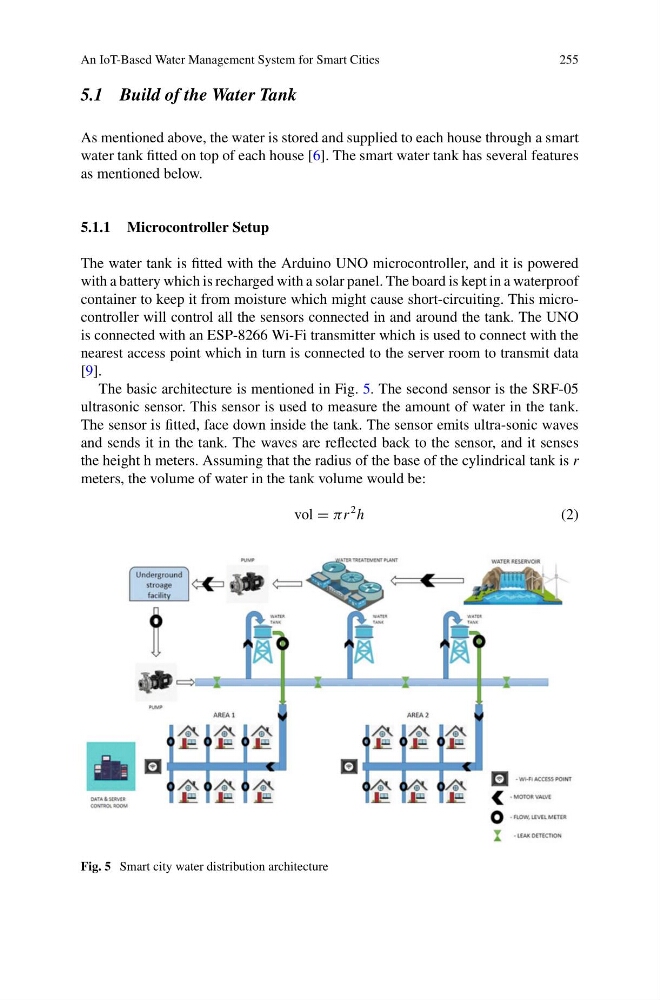
The basic architecture is mentioned in Fig. 5. The second sensor is the SRF-05
ultrasonic sensor. This sensor is used to measure the amount of water in the tank.
The sensor is fitted, face down inside the tank. The sensor emits ultra-sonic waves
and sends it in the tank. The waves are reflected back to the sensor, and it senses
the height h meters. Assuming that the radius of the base of the cylindrical tank is r
meters, the volume of water in the tank volume would be:
vol = πr
2 h
(2)
Fig. 5 Smart city water distribution architecture
255
5.1 Build of the Water Tank
As mentioned above, the water is stored and supplied to each house through a smart
water tank fitted on top of each house [6]. The smart water tank has several features
as mentioned below.
5.1.1 Microcontroller Setup
The water tank is fitted with the Arduino UNO microcontroller, and it is powered
with a battery which is recharged with a solar panel. The board is kept in a waterproof
container to keep it from moisture which might cause short-circuiting. This microcontroller will control all the sensors connected in and around the tank. The UNO
is connected with an ESP-8266 Wi-Fi transmitter which is used to connect with the
nearest access point which in turn is connected to the server room to transmit data
[9].
The basic architecture is mentioned in Fig. 5. The second sensor is the SRF-05
ultrasonic sensor. This sensor is used to measure the amount of water in the tank.
The sensor is fitted, face down inside the tank. The sensor emits ultra-sonic waves
and sends it in the tank. The waves are reflected back to the sensor, and it senses
the height h meters. Assuming that the radius of the base of the cylindrical tank is r
meters, the volume of water in the tank volume would be:
vol = πr
2 h
(2)
Fig. 5 Smart city water distribution architecture