

An IoT-Based Water Management System for Smart Cities
251
3.4 Sensors and Transmitters
The data for the analysis obtained from the water supply mechanism and the water
reservoir and tanks present in the city is collected continuously using sensors and
transmitted to the cloud [8]. This following section has the basic description of the
technology used. This project uses the Arduino UNO is an open-source microcontroller to connect and coordinate the different sensors. Arduino UNO is an opensource microcontroller developed by the Arduino group [9]. This board has 14 I/O
pins to connect different sensor and transmitter to collect the data and transmit the
data to the cloud. It is programmed using the Arduino IDE and a simple USB cable.
This board is powered by a 9volt power supply. Different sensors are used to measure
the water conditions and levels for data collection [8]. The microcontroller, sensors
and transmitters used are:
• Arduino UNO
• SRF-05 sensor (ultrasonic sensor)
• YF-S201 Hall effect sensor (Water flow sensor)
• LM393 chip-based sensor (Rain sensor)
• ESP-8266 Wi-Fi transmitter
• Stepper motor
1. RF-05 sensor (ultrasonic sensor): The SRF-05 ultrasonic sensor (Fig. 2) is a
wide range distance sensor which uses the SONAR technology [10]. The SRF-05
sensor has a range of 4 m in total.
It is used in the top of the water tank in this project to measure the amount of
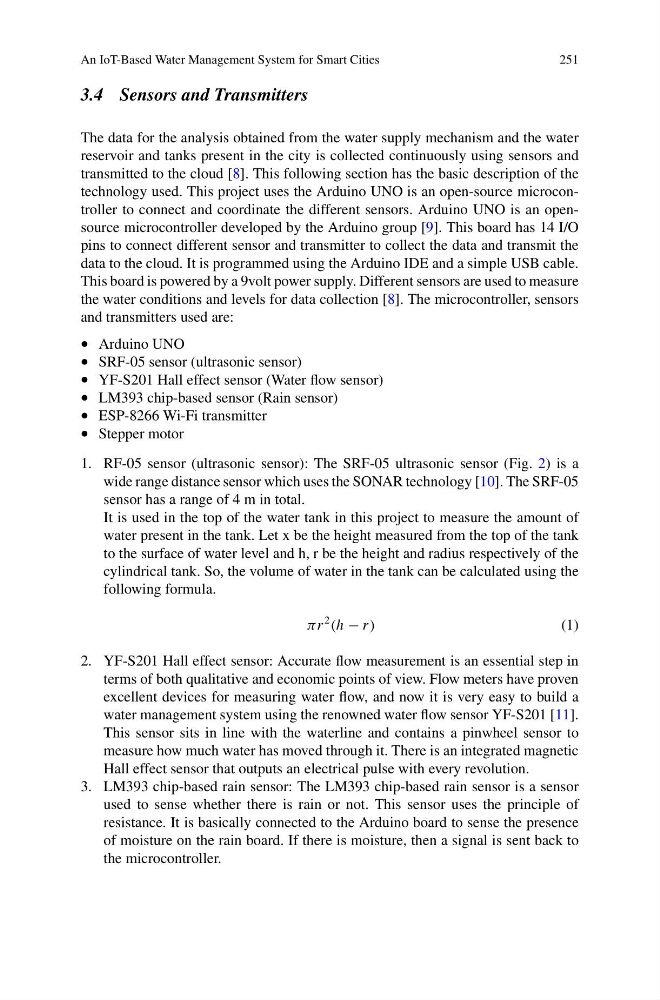
water present in the tank. Let x be the height measured from the top of the tank
to the surface of water level and h, r be the height and radius respectively of the
cylindrical tank. So, the volume of water in the tank can be calculated using the
following formula.
πr
2
(h − r )
(1)
2. YF-S201 Hall effect sensor: Accurate flow measurement is an essential step in
terms of both qualitative and economic points of view. Flow meters have proven
excellent devices for measuring water flow, and now it is very easy to build a
water management system using the renowned water flow sensor YF-S201 [11].
This sensor sits in line with the waterline and contains a pinwheel sensor to
measure how much water has moved through it. There is an integrated magnetic
Hall effect sensor that outputs an electrical pulse with every revolution.
3. LM393 chip-based rain sensor: The LM393 chip-based rain sensor is a sensor
used to sense whether there is rain or not. This sensor uses the principle of
resistance. It is basically connected to the Arduino board to sense the presence
of moisture on the rain board. If there is moisture, then a signal is sent back to
the microcontroller.
251
3.4 Sensors and Transmitters
The data for the analysis obtained from the water supply mechanism and the water
reservoir and tanks present in the city is collected continuously using sensors and
transmitted to the cloud [8]. This following section has the basic description of the
technology used. This project uses the Arduino UNO is an open-source microcontroller to connect and coordinate the different sensors. Arduino UNO is an opensource microcontroller developed by the Arduino group [9]. This board has 14 I/O
pins to connect different sensor and transmitter to collect the data and transmit the
data to the cloud. It is programmed using the Arduino IDE and a simple USB cable.
This board is powered by a 9volt power supply. Different sensors are used to measure
the water conditions and levels for data collection [8]. The microcontroller, sensors
and transmitters used are:
• Arduino UNO
• SRF-05 sensor (ultrasonic sensor)
• YF-S201 Hall effect sensor (Water flow sensor)
• LM393 chip-based sensor (Rain sensor)
• ESP-8266 Wi-Fi transmitter
• Stepper motor
1. RF-05 sensor (ultrasonic sensor): The SRF-05 ultrasonic sensor (Fig. 2) is a
wide range distance sensor which uses the SONAR technology [10]. The SRF-05
sensor has a range of 4 m in total.
It is used in the top of the water tank in this project to measure the amount of
water present in the tank. Let x be the height measured from the top of the tank
to the surface of water level and h, r be the height and radius respectively of the
cylindrical tank. So, the volume of water in the tank can be calculated using the
following formula.
πr
2
(h − r )
(1)
2. YF-S201 Hall effect sensor: Accurate flow measurement is an essential step in
terms of both qualitative and economic points of view. Flow meters have proven
excellent devices for measuring water flow, and now it is very easy to build a
water management system using the renowned water flow sensor YF-S201 [11].
This sensor sits in line with the waterline and contains a pinwheel sensor to
measure how much water has moved through it. There is an integrated magnetic
Hall effect sensor that outputs an electrical pulse with every revolution.
3. LM393 chip-based rain sensor: The LM393 chip-based rain sensor is a sensor
used to sense whether there is rain or not. This sensor uses the principle of
resistance. It is basically connected to the Arduino board to sense the presence
of moisture on the rain board. If there is moisture, then a signal is sent back to
the microcontroller.