

248
I. S. Donbosco and U. K. Chakraborty
of availability and also conservative management of this valuable resource, planned
and efficient water management is required. A water management system with the
implementation of IoT and data analytics is expected to decrease water wastage and
also be more efficient in terms of water availability and also from a conservation point
of view [3]. This paper presents a plot holding level plan for smart water management. Applicable in upcoming smart cities [4], this IoT- and DA-based system uses
user consumption behavior to optimize the water distribution. Using smart sensors,
the proposed system also presents a plan to harvest rainwater at the plot level. The
following sections of the paper will give detailed explanation on the basic terminologies used in this paper. It gives the specifications of the sensors and their usage. The
next section will give the architecture of the water supply block. Following, it is the
structure of the water tank and how its structure will help the rainwater harvesting
mechanism and how the sensors are placed on the tank. The final part is the description of the water distribution of the water in the smart city and how it is optimized
with the use of DA. In the end, the conclusions and future works summarize the paper
and the methodologies proposed and present the possible research and advancement
in the proposed methodology.
2 Existing Distribution Method
Urban water distribution methods, or the conventional method of water distribution
which is being followed in cities all around the world, work but are inefficient and
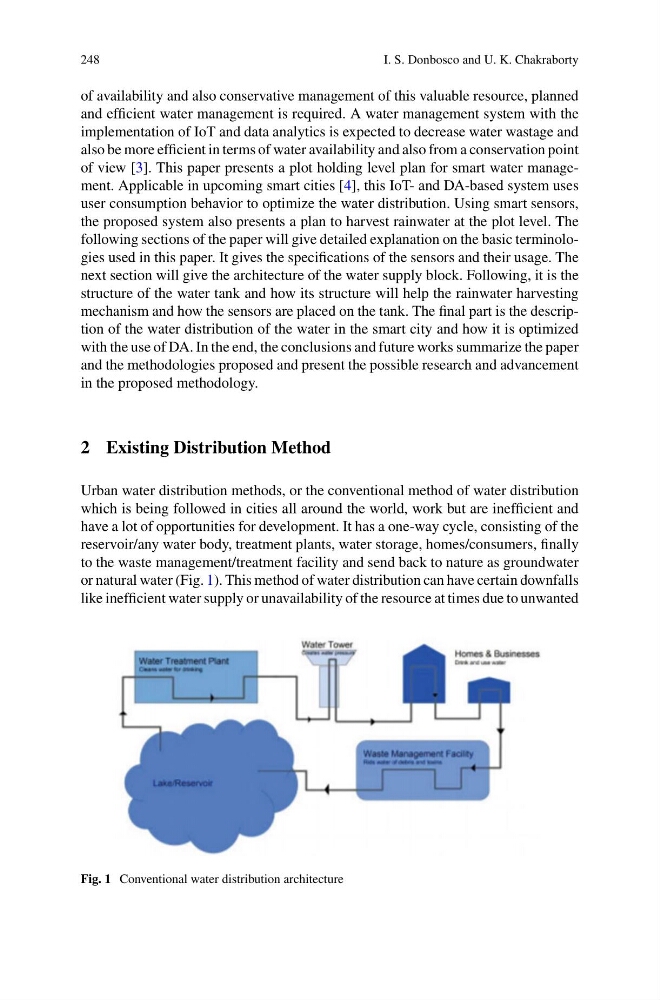
have a lot of opportunities for development. It has a one-way cycle, consisting of the
reservoir/any water body, treatment plants, water storage, homes/consumers, finally
to the waste management/treatment facility and send back to nature as groundwater
or natural water (Fig. 1). This method of water distribution can have certain downfalls
like inefficient water supply or unavailability of the resource at times due to unwanted
Fig. 1 Conventional water distribution architecture
I. S. Donbosco and U. K. Chakraborty
of availability and also conservative management of this valuable resource, planned
and efficient water management is required. A water management system with the
implementation of IoT and data analytics is expected to decrease water wastage and
also be more efficient in terms of water availability and also from a conservation point
of view [3]. This paper presents a plot holding level plan for smart water management. Applicable in upcoming smart cities [4], this IoT- and DA-based system uses
user consumption behavior to optimize the water distribution. Using smart sensors,
the proposed system also presents a plan to harvest rainwater at the plot level. The
following sections of the paper will give detailed explanation on the basic terminologies used in this paper. It gives the specifications of the sensors and their usage. The
next section will give the architecture of the water supply block. Following, it is the
structure of the water tank and how its structure will help the rainwater harvesting
mechanism and how the sensors are placed on the tank. The final part is the description of the water distribution of the water in the smart city and how it is optimized
with the use of DA. In the end, the conclusions and future works summarize the paper
and the methodologies proposed and present the possible research and advancement
in the proposed methodology.
2 Existing Distribution Method
Urban water distribution methods, or the conventional method of water distribution
which is being followed in cities all around the world, work but are inefficient and
have a lot of opportunities for development. It has a one-way cycle, consisting of the
reservoir/any water body, treatment plants, water storage, homes/consumers, finally
to the waste management/treatment facility and send back to nature as groundwater
or natural water (Fig. 1). This method of water distribution can have certain downfalls
like inefficient water supply or unavailability of the resource at times due to unwanted
Fig. 1 Conventional water distribution architecture