

236
Akankshya et al.
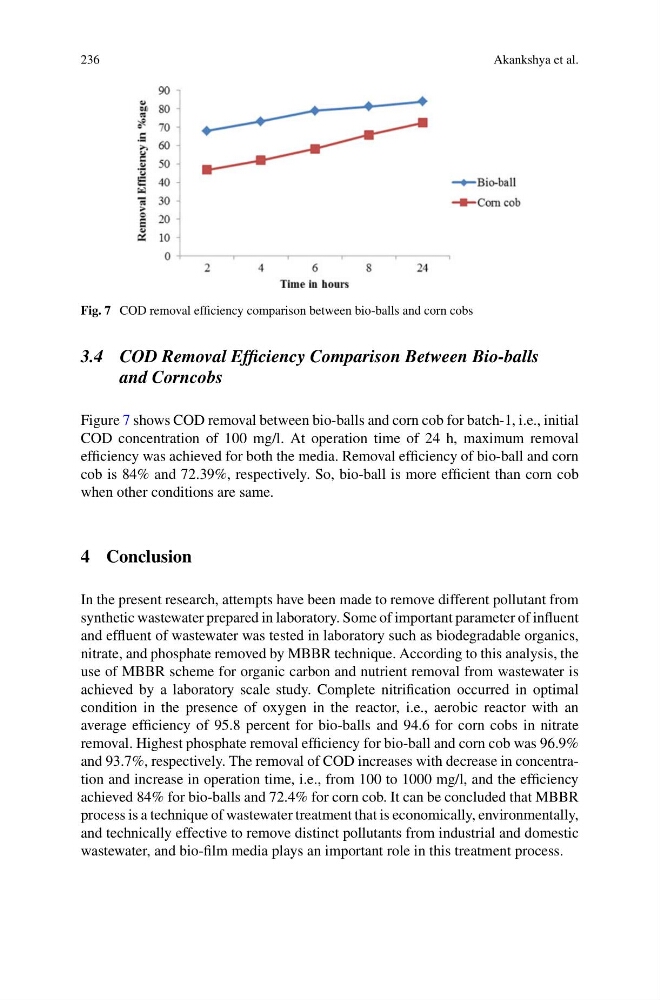
Fig. 7 COD removal efficiency comparison between bio-balls and corn cobs
3.4 COD Removal Efficiency Comparison Between Bio-balls
and Corncobs
Figure 7 shows COD removal between bio-balls and corn cob for batch-1, i.e., initial
COD concentration of 100 mg/l. At operation time of 24 h, maximum removal
efficiency was achieved for both the media. Removal efficiency of bio-ball and corn
cob is 84% and 72.39%, respectively. So, bio-ball is more efficient than corn cob
when other conditions are same.
4 Conclusion
In the present research, attempts have been made to remove different pollutant from
synthetic wastewater prepared in laboratory. Some of important parameter of influent
and effluent of wastewater was tested in laboratory such as biodegradable organics,
nitrate, and phosphate removed by MBBR technique. According to this analysis, the
use of MBBR scheme for organic carbon and nutrient removal from wastewater is
achieved by a laboratory scale study. Complete nitrification occurred in optimal
condition in the presence of oxygen in the reactor, i.e., aerobic reactor with an
average efficiency of 95.8 percent for bio-balls and 94.6 for corn cobs in nitrate
removal. Highest phosphate removal efficiency for bio-ball and corn cob was 96.9%
and 93.7%, respectively. The removal of COD increases with decrease in concentration and increase in operation time, i.e., from 100 to 1000 mg/l, and the efficiency
achieved 84% for bio-balls and 72.4% for corn cob. It can be concluded that MBBR
process is a technique of wastewater treatment that is economically, environmentally,
and technically effective to remove distinct pollutants from industrial and domestic
wastewater, and bio-film media plays an important role in this treatment process.
Akankshya et al.
Fig. 7 COD removal efficiency comparison between bio-balls and corn cobs
3.4 COD Removal Efficiency Comparison Between Bio-balls
and Corncobs
Figure 7 shows COD removal between bio-balls and corn cob for batch-1, i.e., initial
COD concentration of 100 mg/l. At operation time of 24 h, maximum removal
efficiency was achieved for both the media. Removal efficiency of bio-ball and corn
cob is 84% and 72.39%, respectively. So, bio-ball is more efficient than corn cob
when other conditions are same.
4 Conclusion
In the present research, attempts have been made to remove different pollutant from
synthetic wastewater prepared in laboratory. Some of important parameter of influent
and effluent of wastewater was tested in laboratory such as biodegradable organics,
nitrate, and phosphate removed by MBBR technique. According to this analysis, the
use of MBBR scheme for organic carbon and nutrient removal from wastewater is
achieved by a laboratory scale study. Complete nitrification occurred in optimal
condition in the presence of oxygen in the reactor, i.e., aerobic reactor with an
average efficiency of 95.8 percent for bio-balls and 94.6 for corn cobs in nitrate
removal. Highest phosphate removal efficiency for bio-ball and corn cob was 96.9%
and 93.7%, respectively. The removal of COD increases with decrease in concentration and increase in operation time, i.e., from 100 to 1000 mg/l, and the efficiency
achieved 84% for bio-balls and 72.4% for corn cob. It can be concluded that MBBR
process is a technique of wastewater treatment that is economically, environmentally,
and technically effective to remove distinct pollutants from industrial and domestic
wastewater, and bio-film media plays an important role in this treatment process.