

234
Akankshya et al.
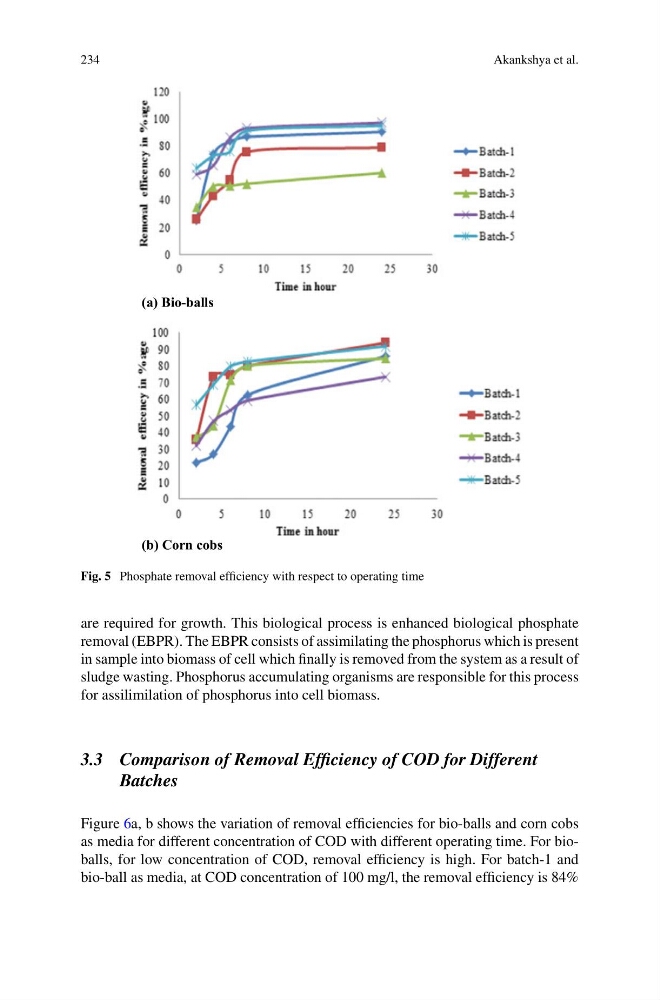
(a) Bio-balls
(b) Corn cobs
Fig. 5 Phosphate removal efficiency with respect to operating time
are required for growth. This biological process is enhanced biological phosphate
removal (EBPR). The EBPR consists of assimilating the phosphorus which is present
in sample into biomass of cell which finally is removed from the system as a result of
sludge wasting. Phosphorus accumulating organisms are responsible for this process
for assilimilation of phosphorus into cell biomass.
3.3 Comparison of Removal Efficiency of COD for Different
Batches
Figure 6a, b shows the variation of removal efficiencies for bio-balls and corn cobs
as media for different concentration of COD with different operating time. For bioballs, for low concentration of COD, removal efficiency is high. For batch-1 and
bio-ball as media, at COD concentration of 100 mg/l, the removal efficiency is 84%
Akankshya et al.
(a) Bio-balls
(b) Corn cobs
Fig. 5 Phosphate removal efficiency with respect to operating time
are required for growth. This biological process is enhanced biological phosphate
removal (EBPR). The EBPR consists of assimilating the phosphorus which is present
in sample into biomass of cell which finally is removed from the system as a result of
sludge wasting. Phosphorus accumulating organisms are responsible for this process
for assilimilation of phosphorus into cell biomass.
3.3 Comparison of Removal Efficiency of COD for Different
Batches
Figure 6a, b shows the variation of removal efficiencies for bio-balls and corn cobs
as media for different concentration of COD with different operating time. For bioballs, for low concentration of COD, removal efficiency is high. For batch-1 and
bio-ball as media, at COD concentration of 100 mg/l, the removal efficiency is 84%