

4
E. Yetbarek and R. Ojha
In real-world conditions, where water flow around the surface of the unsaturated
zone is affected by time-dependent, non-monotonic processes such as irrigation, rainfall, root water uptake, and evaporation, a more realistic predictions can be obtained
from a numerical approach that combines a turning band method to generate realizations of soil formation with different heterogeneity levels to solve the governing
partial differential equations [9, 10]. Furthermore, a numerical approach can overcome most of the limitations of deterministic and stochastic models. It should be
emphasized that extreme difficulties may arise while solving the numerical problem
when dealing with steep head gradients due to the nonlinearity and complexity of
unsaturated flows. Further, a numerical grid size much smaller than the heterogeneity
scale should be used to preserve a given statistics of the formation properties [9].
However, a 3D numerical formulation allows the fluid particles to evade zones of
low conductivity in lateral flows and may describe locally the actual flow in spatially
variable soils for cropped fields.
In this study, a nonlinear root water uptake model developed by Ojha and Rai [11]
coupled with 3D Richards equation was used to investigate the impact of soil heterogeneity and root water uptake on subsurface flow dynamics in cropped fields. A 3D
numerical approach coupled with the turning bands method to generate realizations
of soil formation properties with different heterogeneity levels to solve the governing
partial differential equation in variably saturated soils was used to simulate field scale
water flow to investigate the impact of soil heterogeneity and root water uptake on
subsurface flow dynamics in cropped fields. The governing partial differential equation was solved by a block-centered, finite-difference method with a variable time
step and uniform grid. To linearize the nonlinear terms of the governing equation, the
modified Picard iteration schemes were used. The spatial heterogeneity of the soil
hydraulic properties, evaporation, irrigation, and root water uptake was incorporated
into the simulation model to account the real-world scenarios. The results of this
work may help modelers and experimentalists to observe the significance of spatial
heterogeneity in cropped lands and consider it for irrigation scheduling and water
resources management at large.
2 Methodology
The governing equation for flow through unsaturated soils is the Richards equation.
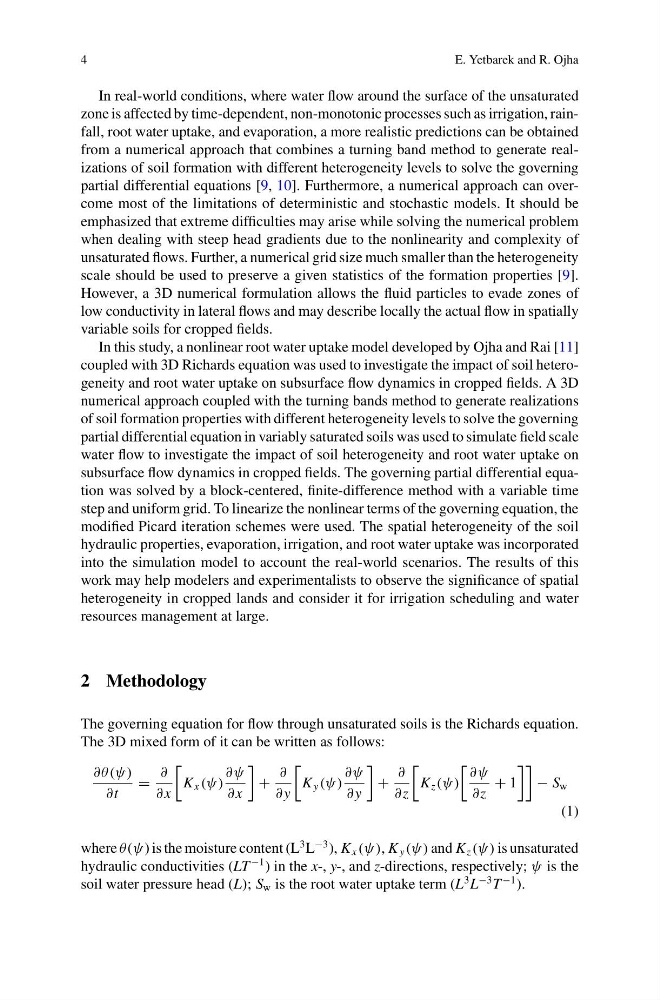
The 3D mixed form of it can be written as follows:
∂θ(ψ)
∂t
=
∂
∂ x
K x (ψ)
∂ψ
∂ x
+
∂
∂ y
K y (ψ)
∂ψ
∂ y
+
∂
∂z
K z (ψ)
∂ψ
∂z
+ 1
− S w
(1)
where θ (ψ) is the moisture content (L
3 L
−3 ), K x (ψ), K y (ψ) and K z (ψ) is unsaturated
hydraulic conductivities (LT
−1 ) in the x-, y-, and z-directions, respectively; ψ is the
soil water pressure head (L); S w is the root water uptake term (L
3 L
−3 T
−1 ).
E. Yetbarek and R. Ojha
In real-world conditions, where water flow around the surface of the unsaturated
zone is affected by time-dependent, non-monotonic processes such as irrigation, rainfall, root water uptake, and evaporation, a more realistic predictions can be obtained
from a numerical approach that combines a turning band method to generate realizations of soil formation with different heterogeneity levels to solve the governing
partial differential equations [9, 10]. Furthermore, a numerical approach can overcome most of the limitations of deterministic and stochastic models. It should be
emphasized that extreme difficulties may arise while solving the numerical problem
when dealing with steep head gradients due to the nonlinearity and complexity of
unsaturated flows. Further, a numerical grid size much smaller than the heterogeneity
scale should be used to preserve a given statistics of the formation properties [9].
However, a 3D numerical formulation allows the fluid particles to evade zones of
low conductivity in lateral flows and may describe locally the actual flow in spatially
variable soils for cropped fields.
In this study, a nonlinear root water uptake model developed by Ojha and Rai [11]
coupled with 3D Richards equation was used to investigate the impact of soil heterogeneity and root water uptake on subsurface flow dynamics in cropped fields. A 3D
numerical approach coupled with the turning bands method to generate realizations
of soil formation properties with different heterogeneity levels to solve the governing
partial differential equation in variably saturated soils was used to simulate field scale
water flow to investigate the impact of soil heterogeneity and root water uptake on
subsurface flow dynamics in cropped fields. The governing partial differential equation was solved by a block-centered, finite-difference method with a variable time
step and uniform grid. To linearize the nonlinear terms of the governing equation, the
modified Picard iteration schemes were used. The spatial heterogeneity of the soil
hydraulic properties, evaporation, irrigation, and root water uptake was incorporated
into the simulation model to account the real-world scenarios. The results of this
work may help modelers and experimentalists to observe the significance of spatial
heterogeneity in cropped lands and consider it for irrigation scheduling and water
resources management at large.
2 Methodology
The governing equation for flow through unsaturated soils is the Richards equation.
The 3D mixed form of it can be written as follows:
∂θ(ψ)
∂t
=
∂
∂ x
K x (ψ)
∂ψ
∂ x
+
∂
∂ y
K y (ψ)
∂ψ
∂ y
+
∂
∂z
K z (ψ)
∂ψ
∂z
+ 1
− S w
(1)
where θ (ψ) is the moisture content (L
3 L
−3 ), K x (ψ), K y (ψ) and K z (ψ) is unsaturated
hydraulic conductivities (LT
−1 ) in the x-, y-, and z-directions, respectively; ψ is the
soil water pressure head (L); S w is the root water uptake term (L
3 L
−3 T
−1 ).