

Bed-Bank Relationship and Flood Characterisation …
203
• With further increase in the sedimentation of the river bed, it can be seen that
much of the bank-line both right and left become susceptible to flooding or the
reach scale flood vulnerability increases with increase in sediment deposition.
• From the present position of the river bed elevation, if the rapid rate of aggradation
due to the construction of embankments causes 2.5 m rise, the threshold is reached
which makes both the banks equally vulnerable for flash flood due to embankment
breaching.
4.3 Flood Triggering
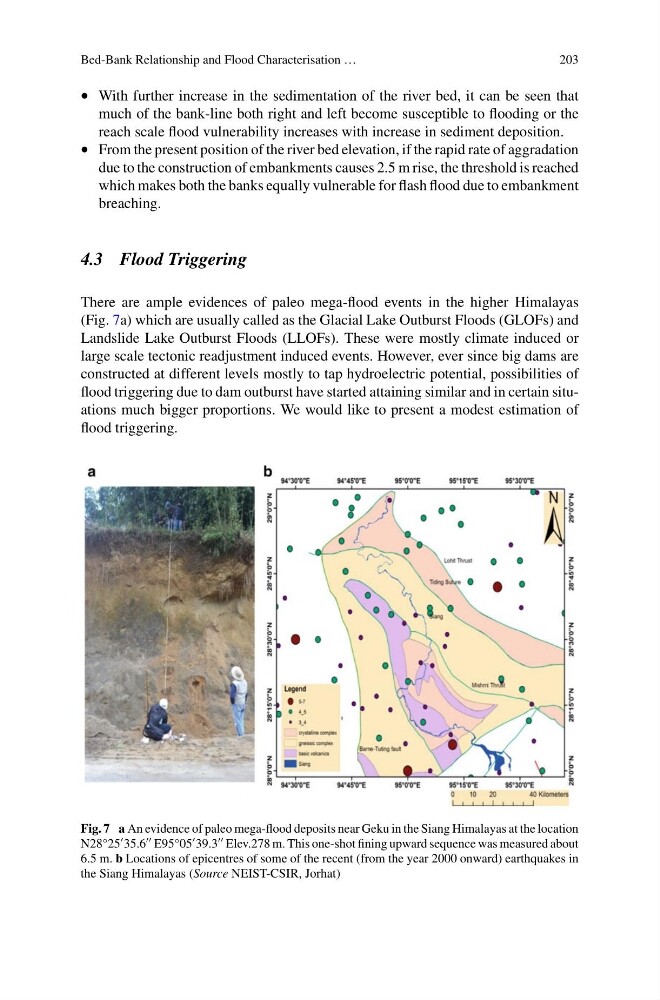
There are ample evidences of paleo mega-flood events in the higher Himalayas
(Fig. 7a) which are usually called as the Glacial Lake Outburst Floods (GLOFs) and
Landslide Lake Outburst Floods (LLOFs). These were mostly climate induced or
large scale tectonic readjustment induced events. However, ever since big dams are
constructed at different levels mostly to tap hydroelectric potential, possibilities of
flood triggering due to dam outburst have started attaining similar and in certain situations much bigger proportions. We would like to present a modest estimation of
flood triggering.
Fig. 7 a An evidence of paleo mega-flood deposits near Geku in the Siang Himalayas at the location
N28°25 35.6 E95°05 39.3 Elev.278 m. This one-shot fining upward sequence was measured about
6.5 m. b Locations of epicentres of some of the recent (from the year 2000 onward) earthquakes in
the Siang Himalayas (Source NEIST-CSIR, Jorhat)
203
• With further increase in the sedimentation of the river bed, it can be seen that
much of the bank-line both right and left become susceptible to flooding or the
reach scale flood vulnerability increases with increase in sediment deposition.
• From the present position of the river bed elevation, if the rapid rate of aggradation
due to the construction of embankments causes 2.5 m rise, the threshold is reached
which makes both the banks equally vulnerable for flash flood due to embankment
breaching.
4.3 Flood Triggering
There are ample evidences of paleo mega-flood events in the higher Himalayas
(Fig. 7a) which are usually called as the Glacial Lake Outburst Floods (GLOFs) and
Landslide Lake Outburst Floods (LLOFs). These were mostly climate induced or
large scale tectonic readjustment induced events. However, ever since big dams are
constructed at different levels mostly to tap hydroelectric potential, possibilities of
flood triggering due to dam outburst have started attaining similar and in certain situations much bigger proportions. We would like to present a modest estimation of
flood triggering.
Fig. 7 a An evidence of paleo mega-flood deposits near Geku in the Siang Himalayas at the location
N28°25 35.6 E95°05 39.3 Elev.278 m. This one-shot fining upward sequence was measured about
6.5 m. b Locations of epicentres of some of the recent (from the year 2000 onward) earthquakes in
the Siang Himalayas (Source NEIST-CSIR, Jorhat)