

110
V. Jain et al.
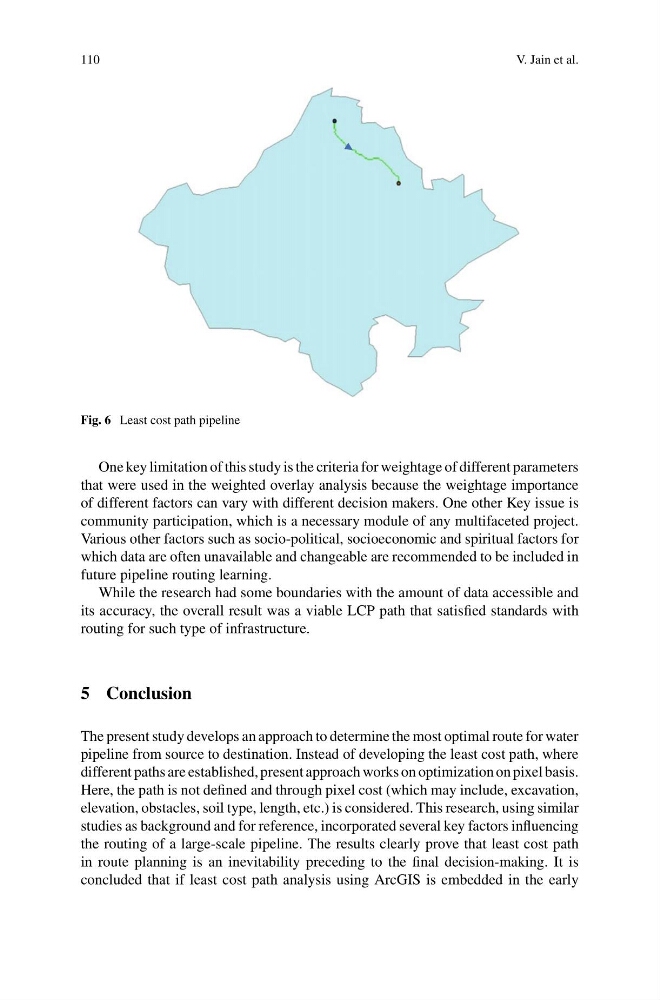
Fig. 6 Least cost path pipeline
One key limitation of this study is the criteria for weightage of different parameters
that were used in the weighted overlay analysis because the weightage importance
of different factors can vary with different decision makers. One other Key issue is
community participation, which is a necessary module of any multifaceted project.
Various other factors such as socio-political, socioeconomic and spiritual factors for
which data are often unavailable and changeable are recommended to be included in
future pipeline routing learning.
While the research had some boundaries with the amount of data accessible and
its accuracy, the overall result was a viable LCP path that satisfied standards with
routing for such type of infrastructure.
5 Conclusion
The present study develops an approach to determine the most optimal route for water
pipeline from source to destination. Instead of developing the least cost path, where
different paths are established, present approach works on optimization on pixel basis.
Here, the path is not defined and through pixel cost (which may include, excavation,
elevation, obstacles, soil type, length, etc.) is considered. This research, using similar
studies as background and for reference, incorporated several key factors influencing
the routing of a large-scale pipeline. The results clearly prove that least cost path
in route planning is an inevitability preceding to the final decision-making. It is
concluded that if least cost path analysis using ArcGIS is embedded in the early
V. Jain et al.
Fig. 6 Least cost path pipeline
One key limitation of this study is the criteria for weightage of different parameters
that were used in the weighted overlay analysis because the weightage importance
of different factors can vary with different decision makers. One other Key issue is
community participation, which is a necessary module of any multifaceted project.
Various other factors such as socio-political, socioeconomic and spiritual factors for
which data are often unavailable and changeable are recommended to be included in
future pipeline routing learning.
While the research had some boundaries with the amount of data accessible and
its accuracy, the overall result was a viable LCP path that satisfied standards with
routing for such type of infrastructure.
5 Conclusion
The present study develops an approach to determine the most optimal route for water
pipeline from source to destination. Instead of developing the least cost path, where
different paths are established, present approach works on optimization on pixel basis.
Here, the path is not defined and through pixel cost (which may include, excavation,
elevation, obstacles, soil type, length, etc.) is considered. This research, using similar
studies as background and for reference, incorporated several key factors influencing
the routing of a large-scale pipeline. The results clearly prove that least cost path
in route planning is an inevitability preceding to the final decision-making. It is
concluded that if least cost path analysis using ArcGIS is embedded in the early