

2
S. Kar
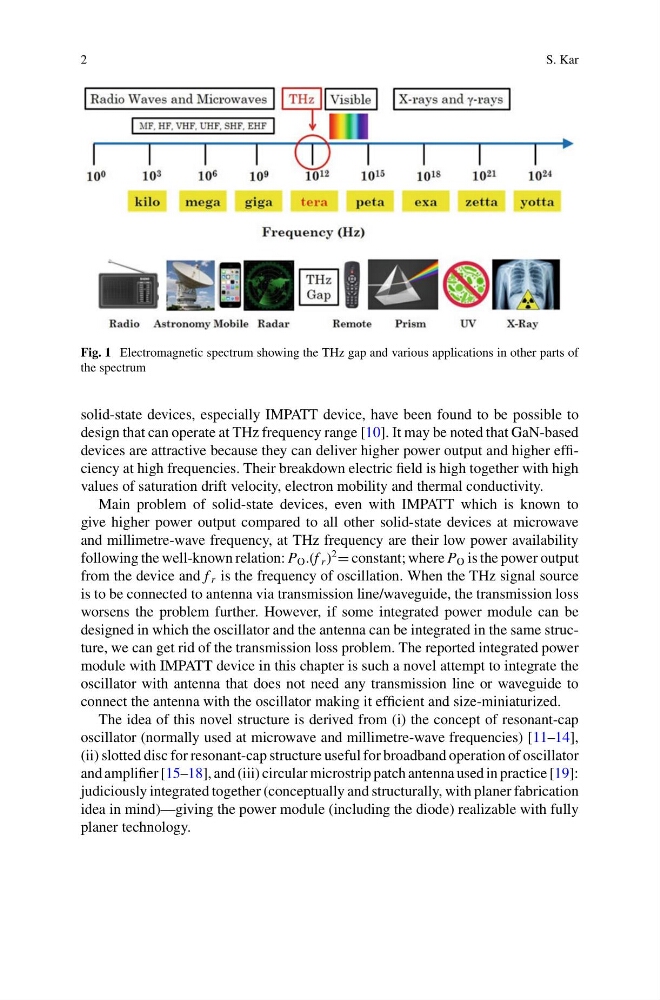
Fig. 1 Electromagnetic spectrum showing the THz gap and various applications in other parts of
the spectrum
solid-state devices, especially IMPATT device, have been found to be possible to
design that can operate at THz frequency range [10]. It may be noted that GaN-based
devices are attractive because they can deliver higher power output and higher efficiency at high frequencies. Their breakdown electric field is high together with high
values of saturation drift velocity, electron mobility and thermal conductivity.
Main problem of solid-state devices, even with IMPATT which is known to
give higher power output compared to all other solid-state devices at microwave
and millimetre-wave frequency, at THz frequency are their low power availability
following the well-known relation: P O .(f r )
2
= constant; where P O is the power output
from the device and f r is the frequency of oscillation. When the THz signal source
is to be connected to antenna via transmission line/waveguide, the transmission loss
worsens the problem further. However, if some integrated power module can be
designed in which the oscillator and the antenna can be integrated in the same structure, we can get rid of the transmission loss problem. The reported integrated power
module with IMPATT device in this chapter is such a novel attempt to integrate the
oscillator with antenna that does not need any transmission line or waveguide to
connect the antenna with the oscillator making it efficient and size-miniaturized.
The idea of this novel structure is derived from (i) the concept of resonant-cap
oscillator (normally used at microwave and millimetre-wave frequencies) [11–14],
(ii) slotted disc for resonant-cap structure useful for broadband operation of oscillator
and amplifier [15–18], and (iii) circular microstrip patch antenna used in practice [19]:
judiciously integrated together (conceptually and structurally, with planer fabrication
idea in mind)—giving the power module (including the diode) realizable with fully
planer technology.
S. Kar
Fig. 1 Electromagnetic spectrum showing the THz gap and various applications in other parts of
the spectrum
solid-state devices, especially IMPATT device, have been found to be possible to
design that can operate at THz frequency range [10]. It may be noted that GaN-based
devices are attractive because they can deliver higher power output and higher efficiency at high frequencies. Their breakdown electric field is high together with high
values of saturation drift velocity, electron mobility and thermal conductivity.
Main problem of solid-state devices, even with IMPATT which is known to
give higher power output compared to all other solid-state devices at microwave
and millimetre-wave frequency, at THz frequency are their low power availability
following the well-known relation: P O .(f r )
2
= constant; where P O is the power output
from the device and f r is the frequency of oscillation. When the THz signal source
is to be connected to antenna via transmission line/waveguide, the transmission loss
worsens the problem further. However, if some integrated power module can be
designed in which the oscillator and the antenna can be integrated in the same structure, we can get rid of the transmission loss problem. The reported integrated power
module with IMPATT device in this chapter is such a novel attempt to integrate the
oscillator with antenna that does not need any transmission line or waveguide to
connect the antenna with the oscillator making it efficient and size-miniaturized.
The idea of this novel structure is derived from (i) the concept of resonant-cap
oscillator (normally used at microwave and millimetre-wave frequencies) [11–14],
(ii) slotted disc for resonant-cap structure useful for broadband operation of oscillator
and amplifier [15–18], and (iii) circular microstrip patch antenna used in practice [19]:
judiciously integrated together (conceptually and structurally, with planer fabrication
idea in mind)—giving the power module (including the diode) realizable with fully
planer technology.