

Terahertz Radiation from Gallium Phosphide …
55
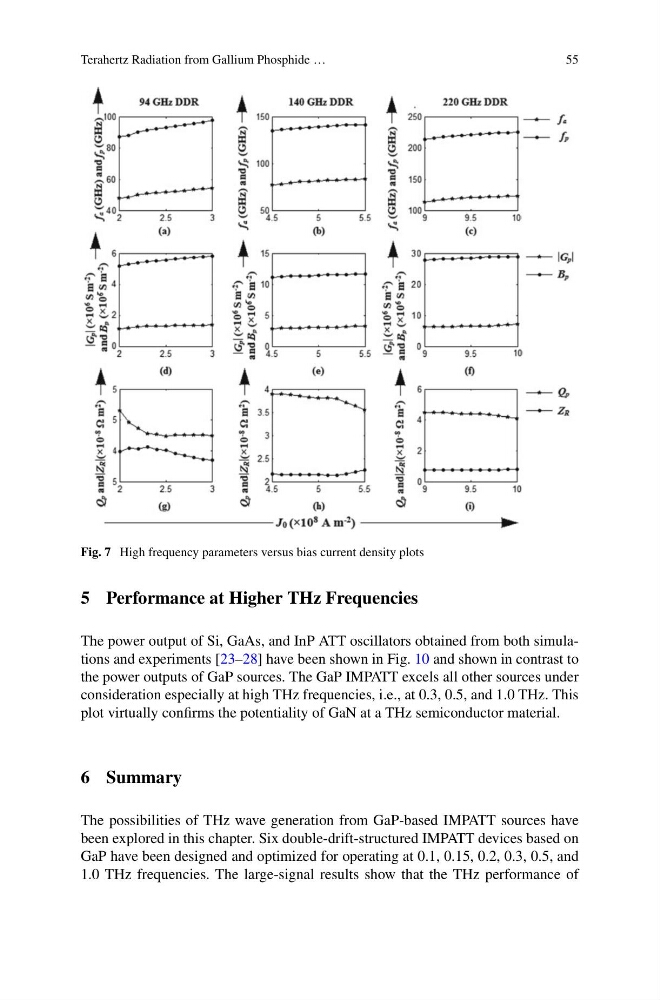
Fig. 7 High frequency parameters versus bias current density plots
5 Performance at Higher THz Frequencies
The power output of Si, GaAs, and InP ATT oscillators obtained from both simulations and experiments [23–28] have been shown in Fig. 10 and shown in contrast to
the power outputs of GaP sources. The GaP IMPATT excels all other sources under
consideration especially at high THz frequencies, i.e., at 0.3, 0.5, and 1.0 THz. This
plot virtually confirms the potentiality of GaN at a THz semiconductor material.
6 Summary
The possibilities of THz wave generation from GaP-based IMPATT sources have
been explored in this chapter. Six double-drift-structured IMPATT devices based on
GaP have been designed and optimized for operating at 0.1, 0.15, 0.2, 0.3, 0.5, and
1.0 THz frequencies. The large-signal results show that the THz performance of
55
Fig. 7 High frequency parameters versus bias current density plots
5 Performance at Higher THz Frequencies
The power output of Si, GaAs, and InP ATT oscillators obtained from both simulations and experiments [23–28] have been shown in Fig. 10 and shown in contrast to
the power outputs of GaP sources. The GaP IMPATT excels all other sources under
consideration especially at high THz frequencies, i.e., at 0.3, 0.5, and 1.0 THz. This
plot virtually confirms the potentiality of GaN at a THz semiconductor material.
6 Summary
The possibilities of THz wave generation from GaP-based IMPATT sources have
been explored in this chapter. Six double-drift-structured IMPATT devices based on
GaP have been designed and optimized for operating at 0.1, 0.15, 0.2, 0.3, 0.5, and
1.0 THz frequencies. The large-signal results show that the THz performance of