

40
A. Deyasi and A. Sarkar
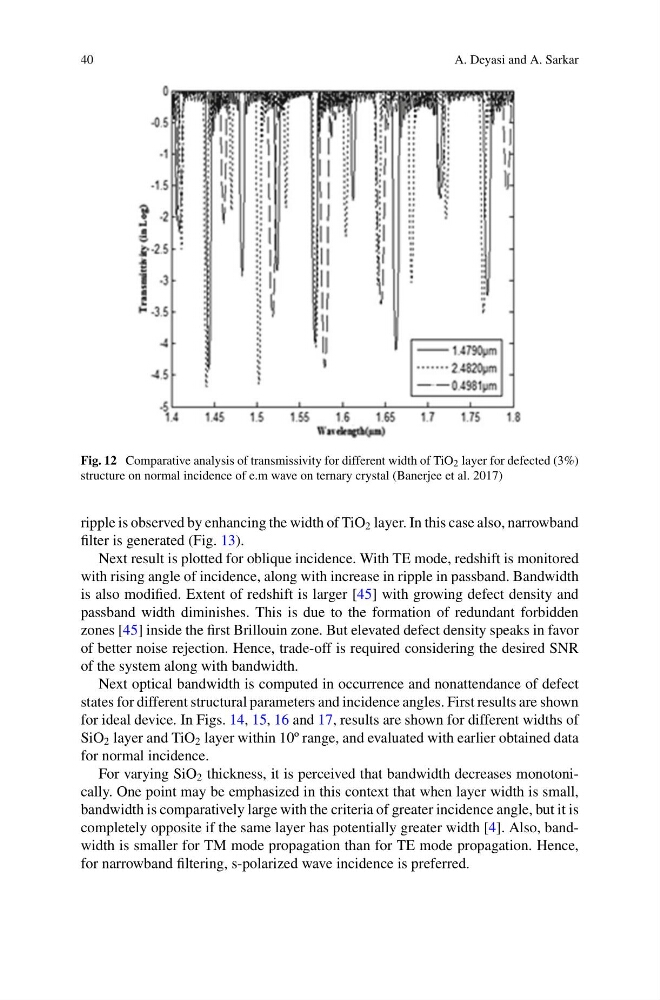
Fig. 12 Comparative analysis of transmissivity for different width of TiO 2 layer for defected (3%)
structure on normal incidence of e.m wave on ternary crystal (Banerjee et al. 2017)
ripple is observed by enhancing the width of TiO 2 layer. In this case also, narrowband
filter is generated (Fig. 13).
Next result is plotted for oblique incidence. With TE mode, redshift is monitored
with rising angle of incidence, along with increase in ripple in passband. Bandwidth
is also modified. Extent of redshift is larger [45] with growing defect density and
passband width diminishes. This is due to the formation of redundant forbidden
zones [45] inside the first Brillouin zone. But elevated defect density speaks in favor
of better noise rejection. Hence, trade-off is required considering the desired SNR
of the system along with bandwidth.
Next optical bandwidth is computed in occurrence and nonattendance of defect
states for different structural parameters and incidence angles. First results are shown
for ideal device. In Figs. 14, 15, 16 and 17, results are shown for different widths of
SiO 2 layer and TiO 2 layer within 10º range, and evaluated with earlier obtained data
for normal incidence.
For varying SiO 2 thickness, it is perceived that bandwidth decreases monotonically. One point may be emphasized in this context that when layer width is small,
bandwidth is comparatively large with the criteria of greater incidence angle, but it is
completely opposite if the same layer has potentially greater width [4]. Also, bandwidth is smaller for TM mode propagation than for TE mode propagation. Hence,
for narrowband filtering, s-polarized wave incidence is preferred.
A. Deyasi and A. Sarkar
Fig. 12 Comparative analysis of transmissivity for different width of TiO 2 layer for defected (3%)
structure on normal incidence of e.m wave on ternary crystal (Banerjee et al. 2017)
ripple is observed by enhancing the width of TiO 2 layer. In this case also, narrowband
filter is generated (Fig. 13).
Next result is plotted for oblique incidence. With TE mode, redshift is monitored
with rising angle of incidence, along with increase in ripple in passband. Bandwidth
is also modified. Extent of redshift is larger [45] with growing defect density and
passband width diminishes. This is due to the formation of redundant forbidden
zones [45] inside the first Brillouin zone. But elevated defect density speaks in favor
of better noise rejection. Hence, trade-off is required considering the desired SNR
of the system along with bandwidth.
Next optical bandwidth is computed in occurrence and nonattendance of defect
states for different structural parameters and incidence angles. First results are shown
for ideal device. In Figs. 14, 15, 16 and 17, results are shown for different widths of
SiO 2 layer and TiO 2 layer within 10º range, and evaluated with earlier obtained data
for normal incidence.
For varying SiO 2 thickness, it is perceived that bandwidth decreases monotonically. One point may be emphasized in this context that when layer width is small,
bandwidth is comparatively large with the criteria of greater incidence angle, but it is
completely opposite if the same layer has potentially greater width [4]. Also, bandwidth is smaller for TM mode propagation than for TE mode propagation. Hence,
for narrowband filtering, s-polarized wave incidence is preferred.