

Performance Estimation of Defected Ternary Photonic …
37
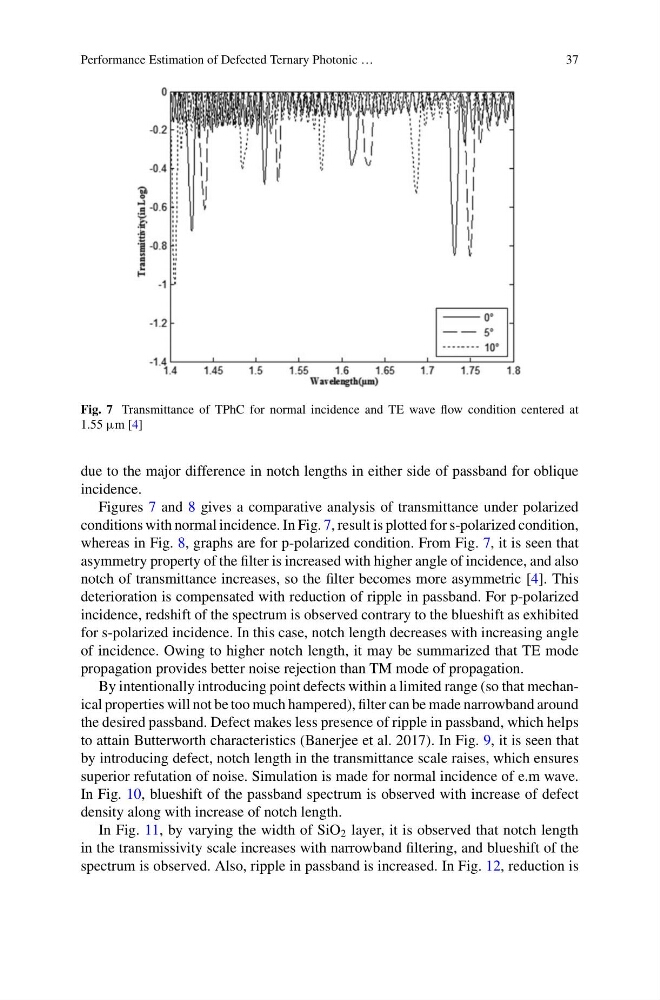
Fig. 7 Transmittance of TPhC for normal incidence and TE wave flow condition centered at
1.55 µm [4]
due to the major difference in notch lengths in either side of passband for oblique
incidence.
Figures 7 and 8 gives a comparative analysis of transmittance under polarized
conditions with normal incidence. In Fig. 7, result is plotted for s-polarized condition,
whereas in Fig. 8, graphs are for p-polarized condition. From Fig. 7, it is seen that
asymmetry property of the filter is increased with higher angle of incidence, and also
notch of transmittance increases, so the filter becomes more asymmetric [4]. This
deterioration is compensated with reduction of ripple in passband. For p-polarized
incidence, redshift of the spectrum is observed contrary to the blueshift as exhibited
for s-polarized incidence. In this case, notch length decreases with increasing angle
of incidence. Owing to higher notch length, it may be summarized that TE mode
propagation provides better noise rejection than TM mode of propagation.
By intentionally introducing point defects within a limited range (so that mechanical properties will not be too much hampered), filter can be made narrowband around
the desired passband. Defect makes less presence of ripple in passband, which helps
to attain Butterworth characteristics (Banerjee et al. 2017). In Fig. 9, it is seen that
by introducing defect, notch length in the transmittance scale raises, which ensures
superior refutation of noise. Simulation is made for normal incidence of e.m wave.
In Fig. 10, blueshift of the passband spectrum is observed with increase of defect
density along with increase of notch length.
In Fig. 11, by varying the width of SiO 2 layer, it is observed that notch length
in the transmissivity scale increases with narrowband filtering, and blueshift of the
spectrum is observed. Also, ripple in passband is increased. In Fig. 12, reduction is
37
Fig. 7 Transmittance of TPhC for normal incidence and TE wave flow condition centered at
1.55 µm [4]
due to the major difference in notch lengths in either side of passband for oblique
incidence.
Figures 7 and 8 gives a comparative analysis of transmittance under polarized
conditions with normal incidence. In Fig. 7, result is plotted for s-polarized condition,
whereas in Fig. 8, graphs are for p-polarized condition. From Fig. 7, it is seen that
asymmetry property of the filter is increased with higher angle of incidence, and also
notch of transmittance increases, so the filter becomes more asymmetric [4]. This
deterioration is compensated with reduction of ripple in passband. For p-polarized
incidence, redshift of the spectrum is observed contrary to the blueshift as exhibited
for s-polarized incidence. In this case, notch length decreases with increasing angle
of incidence. Owing to higher notch length, it may be summarized that TE mode
propagation provides better noise rejection than TM mode of propagation.
By intentionally introducing point defects within a limited range (so that mechanical properties will not be too much hampered), filter can be made narrowband around
the desired passband. Defect makes less presence of ripple in passband, which helps
to attain Butterworth characteristics (Banerjee et al. 2017). In Fig. 9, it is seen that
by introducing defect, notch length in the transmittance scale raises, which ensures
superior refutation of noise. Simulation is made for normal incidence of e.m wave.
In Fig. 10, blueshift of the passband spectrum is observed with increase of defect
density along with increase of notch length.
In Fig. 11, by varying the width of SiO 2 layer, it is observed that notch length
in the transmissivity scale increases with narrowband filtering, and blueshift of the
spectrum is observed. Also, ripple in passband is increased. In Fig. 12, reduction is