

204
M. Singh et al.
4 State-of-Art-of Comparison
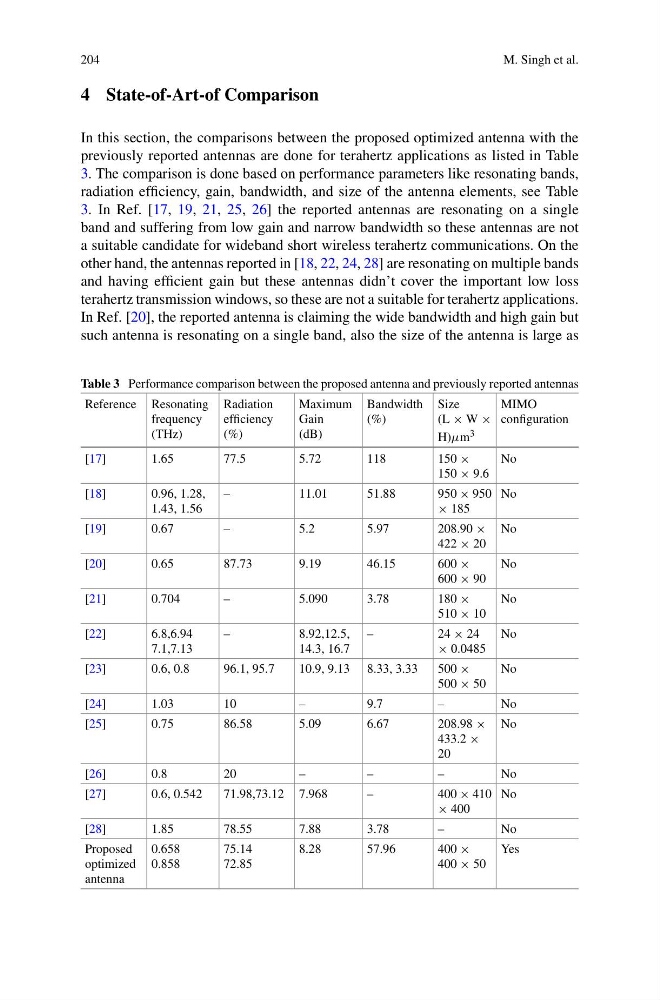
In this section, the comparisons between the proposed optimized antenna with the
previously reported antennas are done for terahertz applications as listed in Table
3. The comparison is done based on performance parameters like resonating bands,
radiation efficiency, gain, bandwidth, and size of the antenna elements, see Table
3. In Ref. [17, 19, 21, 25, 26] the reported antennas are resonating on a single
band and suffering from low gain and narrow bandwidth so these antennas are not
a suitable candidate for wideband short wireless terahertz communications. On the
other hand, the antennas reported in [18, 22, 24, 28] are resonating on multiple bands
and having efficient gain but these antennas didn’t cover the important low loss
terahertz transmission windows, so these are not a suitable for terahertz applications.
In Ref. [20], the reported antenna is claiming the wide bandwidth and high gain but
such antenna is resonating on a single band, also the size of the antenna is large as
Table 3 Performance comparison between the proposed antenna and previously reported antennas
Reference Resonating
frequency
(THz)
Radiation
efficiency
(%)
Maximum
Gain
(dB)
Bandwidth
(%)
Size
(L × W ×
H)μm 3
MIMO
configuration
[17]
1.65
77.5
5.72
118
150 ×
150 × 9.6
No
[18]
0.96, 1.28,
1.43, 1.56
–
11.01
51.88
950 × 950
× 185
No
[19]
0.67
–
5.2
5.97
208.90 ×
422 × 20
No
[20]
0.65
87.73
9.19
46.15
600 ×
600 × 90
No
[21]
0.704
–
5.090
3.78
180 ×
510 × 10
No
[22]
6.8,6.94
7.1,7.13
–
8.92,12.5,
14.3, 16.7
–
24 × 24
× 0.0485
No
[23]
0.6, 0.8
96.1, 95.7
10.9, 9.13 8.33, 3.33
500 ×
500 × 50
No
[24]
1.03
10
–
9.7
–
No
[25]
0.75
86.58
5.09
6.67
208.98 ×
433.2 ×
20
No
[26]
0.8
20
–
–
–
No
[27]
0.6, 0.542
71.98,73.12 7.968
–
400 × 410
× 400
No
[28]
1.85
78.55
7.88
3.78
–
No
Proposed
optimized
antenna
0.658
0.858
75.14
72.85
8.28
57.96
400 ×
400 × 50
Yes
M. Singh et al.
4 State-of-Art-of Comparison
In this section, the comparisons between the proposed optimized antenna with the
previously reported antennas are done for terahertz applications as listed in Table
3. The comparison is done based on performance parameters like resonating bands,
radiation efficiency, gain, bandwidth, and size of the antenna elements, see Table
3. In Ref. [17, 19, 21, 25, 26] the reported antennas are resonating on a single
band and suffering from low gain and narrow bandwidth so these antennas are not
a suitable candidate for wideband short wireless terahertz communications. On the
other hand, the antennas reported in [18, 22, 24, 28] are resonating on multiple bands
and having efficient gain but these antennas didn’t cover the important low loss
terahertz transmission windows, so these are not a suitable for terahertz applications.
In Ref. [20], the reported antenna is claiming the wide bandwidth and high gain but
such antenna is resonating on a single band, also the size of the antenna is large as
Table 3 Performance comparison between the proposed antenna and previously reported antennas
Reference Resonating
frequency
(THz)
Radiation
efficiency
(%)
Maximum
Gain
(dB)
Bandwidth
(%)
Size
(L × W ×
H)μm 3
MIMO
configuration
[17]
1.65
77.5
5.72
118
150 ×
150 × 9.6
No
[18]
0.96, 1.28,
1.43, 1.56
–
11.01
51.88
950 × 950
× 185
No
[19]
0.67
–
5.2
5.97
208.90 ×
422 × 20
No
[20]
0.65
87.73
9.19
46.15
600 ×
600 × 90
No
[21]
0.704
–
5.090
3.78
180 ×
510 × 10
No
[22]
6.8,6.94
7.1,7.13
–
8.92,12.5,
14.3, 16.7
–
24 × 24
× 0.0485
No
[23]
0.6, 0.8
96.1, 95.7
10.9, 9.13 8.33, 3.33
500 ×
500 × 50
No
[24]
1.03
10
–
9.7
–
No
[25]
0.75
86.58
5.09
6.67
208.98 ×
433.2 ×
20
No
[26]
0.8
20
–
–
–
No
[27]
0.6, 0.542
71.98,73.12 7.968
–
400 × 410
× 400
No
[28]
1.85
78.55
7.88
3.78
–
No
Proposed
optimized
antenna
0.658
0.858
75.14
72.85
8.28
57.96
400 ×
400 × 50
Yes