

200
M. Singh et al.
0
30
60
90
120
150
180
210
240
270
300
330
-20
-10
0
10
-20
-10
0
10
Gain (dB)
E-Plane
H-Plane
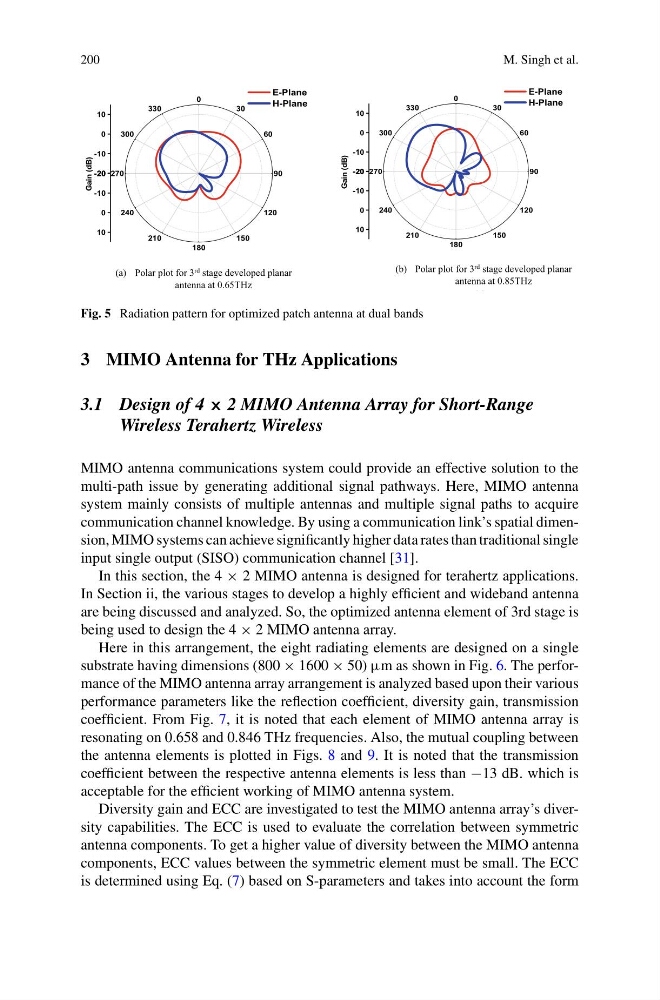
(a) Polar plot for 3 rd stage developed planar
antenna at 0.65THz
0
30
60
90
120
150
180
210
240
270
300
330
-20
-10
0
10
-20
-10
0
10
Gain (dB)
E-Plane
H-Plane
(b) Polar plot for 3 rd stage developed planar
antenna at 0.85THz
( )
Fig. 5 Radiation pattern for optimized patch antenna at dual bands
3 MIMO Antenna for THz Applications
3.1 Design of 4 × 2 MIMO Antenna Array for Short-Range
Wireless Terahertz Wireless
MIMO antenna communications system could provide an effective solution to the
multi-path issue by generating additional signal pathways. Here, MIMO antenna
system mainly consists of multiple antennas and multiple signal paths to acquire
communication channel knowledge. By using a communication link’s spatial dimension, MIMO systems can achieve significantly higher data rates than traditional single
input single output (SISO) communication channel [31].
In this section, the 4 × 2 MIMO antenna is designed for terahertz applications.
In Section ii, the various stages to develop a highly efficient and wideband antenna
are being discussed and analyzed. So, the optimized antenna element of 3rd stage is
being used to design the 4 × 2 MIMO antenna array.
Here in this arrangement, the eight radiating elements are designed on a single
substrate having dimensions (800 × 1600 × 50) μm as shown in Fig. 6. The performance of the MIMO antenna array arrangement is analyzed based upon their various
performance parameters like the reflection coefficient, diversity gain, transmission
coefficient. From Fig. 7, it is noted that each element of MIMO antenna array is
resonating on 0.658 and 0.846 THz frequencies. Also, the mutual coupling between
the antenna elements is plotted in Figs. 8 and 9. It is noted that the transmission
coefficient between the respective antenna elements is less than −13 dB. which is
acceptable for the efficient working of MIMO antenna system.
Diversity gain and ECC are investigated to test the MIMO antenna array’s diversity capabilities. The ECC is used to evaluate the correlation between symmetric
antenna components. To get a higher value of diversity between the MIMO antenna
components, ECC values between the symmetric element must be small. The ECC
is determined using Eq. (7) based on S-parameters and takes into account the form
M. Singh et al.
0
30
60
90
120
150
180
210
240
270
300
330
-20
-10
0
10
-20
-10
0
10
Gain (dB)
E-Plane
H-Plane
(a) Polar plot for 3 rd stage developed planar
antenna at 0.65THz
0
30
60
90
120
150
180
210
240
270
300
330
-20
-10
0
10
-20
-10
0
10
Gain (dB)
E-Plane
H-Plane
(b) Polar plot for 3 rd stage developed planar
antenna at 0.85THz
( )
Fig. 5 Radiation pattern for optimized patch antenna at dual bands
3 MIMO Antenna for THz Applications
3.1 Design of 4 × 2 MIMO Antenna Array for Short-Range
Wireless Terahertz Wireless
MIMO antenna communications system could provide an effective solution to the
multi-path issue by generating additional signal pathways. Here, MIMO antenna
system mainly consists of multiple antennas and multiple signal paths to acquire
communication channel knowledge. By using a communication link’s spatial dimension, MIMO systems can achieve significantly higher data rates than traditional single
input single output (SISO) communication channel [31].
In this section, the 4 × 2 MIMO antenna is designed for terahertz applications.
In Section ii, the various stages to develop a highly efficient and wideband antenna
are being discussed and analyzed. So, the optimized antenna element of 3rd stage is
being used to design the 4 × 2 MIMO antenna array.
Here in this arrangement, the eight radiating elements are designed on a single
substrate having dimensions (800 × 1600 × 50) μm as shown in Fig. 6. The performance of the MIMO antenna array arrangement is analyzed based upon their various
performance parameters like the reflection coefficient, diversity gain, transmission
coefficient. From Fig. 7, it is noted that each element of MIMO antenna array is
resonating on 0.658 and 0.846 THz frequencies. Also, the mutual coupling between
the antenna elements is plotted in Figs. 8 and 9. It is noted that the transmission
coefficient between the respective antenna elements is less than −13 dB. which is
acceptable for the efficient working of MIMO antenna system.
Diversity gain and ECC are investigated to test the MIMO antenna array’s diversity capabilities. The ECC is used to evaluate the correlation between symmetric
antenna components. To get a higher value of diversity between the MIMO antenna
components, ECC values between the symmetric element must be small. The ECC
is determined using Eq. (7) based on S-parameters and takes into account the form