

72
Siloxanes are completely synthetic organic compounds included in cosmetics,
deodorants, shampoos, soaps, food additives, drugs and anti-foam products [112].
They are generally found in significant concentrations of up to 400 mg/m3 in biogas
derived from municipal waste [130, 131]. Siloxanes must be removed from the biogas stream, as by burning they are oxidized to microcrystalline silicon oxide that
can deposit in the combustion chamber causing severe damages to engines [112].
The most common and effective techniques for removing siloxanes from biogas are
physical processes such as absorption/adsorption or condensation [1, 132].
7 By-product Management Options
and Advanced Processing
Biogas is the main product with economic value resulting from the recovery of
residual biomass by anaerobic fermentation, but a valuable by-product is also the
liquid material left in the digester. It is rich in trace elements and basic nutrients for
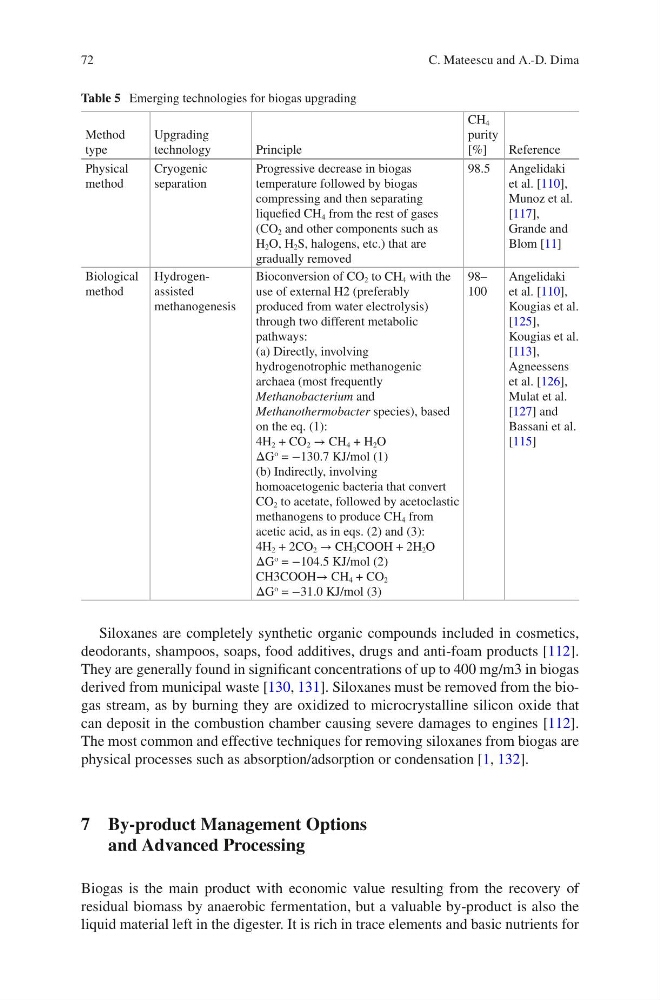
Table 5 Emerging technologies for biogas upgrading
Method
type
Upgrading
technology
Principle
CH 4
purity
[%]
Reference
Physical
method
Cryogenic
separation
Progressive decrease in biogas
temperature followed by biogas
compressing and then separating
liquefied CH 4 from the rest of gases
(CO 2 and other components such as
H 2 O, H 2 S, halogens, etc.) that are
gradually removed
98.5 Angelidaki
et al. [110],
Munoz et al.
[117],
Grande and
Blom [11]
Biological
method
Hydrogenassisted
methanogenesis
Bioconversion of CO 2 to CH 4 with the
use of external H2 (preferably
produced from water electrolysis)
through two different metabolic
pathways:
(a) Directly, involving
hydrogenotrophic methanogenic
archaea (most frequently
Methanobacterium and
Methanothermobacter species), based
on the eq. (1):
4H 2 + CO 2 → CH 4 + H 2 O
ΔG
o = −130.7 KJ/mol (1)
(b) Indirectly, involving
homoacetogenic bacteria that convert
CO 2 to acetate, followed by acetoclastic
methanogens to produce CH 4 from
acetic acid, as in eqs. (2) and (3):
4H 2 + 2CO 2 → CH 3 COOH + 2H 2 O
ΔG
o = −104.5 KJ/mol (2)
CH3COOH→ CH 4 + CO 2
ΔG
o = −31.0 KJ/mol (3)
98–
100
Angelidaki
et al. [110],
Kougias et al.
[125],
Kougias et al.
[113],
Agneessens
et al. [126],
Mulat et al.
[127] and
Bassani et al.
[115]
C. Mateescu and A.-D. Dima
Siloxanes are completely synthetic organic compounds included in cosmetics,
deodorants, shampoos, soaps, food additives, drugs and anti-foam products [112].
They are generally found in significant concentrations of up to 400 mg/m3 in biogas
derived from municipal waste [130, 131]. Siloxanes must be removed from the biogas stream, as by burning they are oxidized to microcrystalline silicon oxide that
can deposit in the combustion chamber causing severe damages to engines [112].
The most common and effective techniques for removing siloxanes from biogas are
physical processes such as absorption/adsorption or condensation [1, 132].
7 By-product Management Options
and Advanced Processing
Biogas is the main product with economic value resulting from the recovery of
residual biomass by anaerobic fermentation, but a valuable by-product is also the
liquid material left in the digester. It is rich in trace elements and basic nutrients for
Table 5 Emerging technologies for biogas upgrading
Method
type
Upgrading
technology
Principle
CH 4
purity
[%]
Reference
Physical
method
Cryogenic
separation
Progressive decrease in biogas
temperature followed by biogas
compressing and then separating
liquefied CH 4 from the rest of gases
(CO 2 and other components such as
H 2 O, H 2 S, halogens, etc.) that are
gradually removed
98.5 Angelidaki
et al. [110],
Munoz et al.
[117],
Grande and
Blom [11]
Biological
method
Hydrogenassisted
methanogenesis
Bioconversion of CO 2 to CH 4 with the
use of external H2 (preferably
produced from water electrolysis)
through two different metabolic
pathways:
(a) Directly, involving
hydrogenotrophic methanogenic
archaea (most frequently
Methanobacterium and
Methanothermobacter species), based
on the eq. (1):
4H 2 + CO 2 → CH 4 + H 2 O
ΔG
o = −130.7 KJ/mol (1)
(b) Indirectly, involving
homoacetogenic bacteria that convert
CO 2 to acetate, followed by acetoclastic
methanogens to produce CH 4 from
acetic acid, as in eqs. (2) and (3):
4H 2 + 2CO 2 → CH 3 COOH + 2H 2 O
ΔG
o = −104.5 KJ/mol (2)
CH3COOH→ CH 4 + CO 2
ΔG
o = −31.0 KJ/mol (3)
98–
100
Angelidaki
et al. [110],
Kougias et al.
[125],
Kougias et al.
[113],
Agneessens
et al. [126],
Mulat et al.
[127] and
Bassani et al.
[115]
C. Mateescu and A.-D. Dima