

66
important aspect as major disturbances in the microbial equilibria generally lead to
ceased gas production and consequently to important financial loses for industrial
plants. There are various factors affecting the performance of biomethane and biohydrogen obtaining processes, but most commonly, they are classified as related
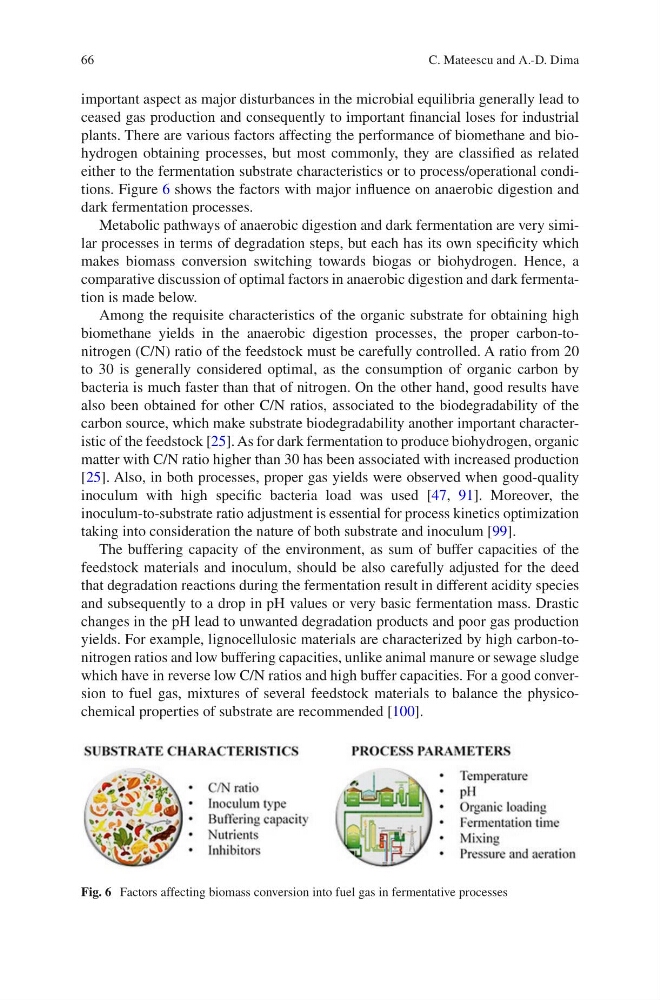
either to the fermentation substrate characteristics or to process/operational conditions. Figure 6 shows the factors with major influence on anaerobic digestion and
dark fermentation processes.
Metabolic pathways of anaerobic digestion and dark fermentation are very similar processes in terms of degradation steps, but each has its own specificity which
makes biomass conversion switching towards biogas or biohydrogen. Hence, a
comparative discussion of optimal factors in anaerobic digestion and dark fermentation is made below.
Among the requisite characteristics of the organic substrate for obtaining high
biomethane yields in the anaerobic digestion processes, the proper carbon-tonitrogen (C/N) ratio of the feedstock must be carefully controlled. A ratio from 20
to 30 is generally considered optimal, as the consumption of organic carbon by
bacteria is much faster than that of nitrogen. On the other hand, good results have
also been obtained for other C/N ratios, associated to the biodegradability of the
carbon source, which make substrate biodegradability another important characteristic of the feedstock [25]. As for dark fermentation to produce biohydrogen, organic
matter with C/N ratio higher than 30 has been associated with increased production
[25]. Also, in both processes, proper gas yields were observed when good-quality
inoculum with high specific bacteria load was used [47, 91]. Moreover, the
inoculum-to- substrate ratio adjustment is essential for process kinetics optimization
taking into consideration the nature of both substrate and inoculum [99].
The buffering capacity of the environment, as sum of buffer capacities of the
feedstock materials and inoculum, should be also carefully adjusted for the deed
that degradation reactions during the fermentation result in different acidity species
and subsequently to a drop in pH values or very basic fermentation mass. Drastic
changes in the pH lead to unwanted degradation products and poor gas production
yields. For example, lignocellulosic materials are characterized by high carbon-tonitrogen ratios and low buffering capacities, unlike animal manure or sewage sludge
which have in reverse low C/N ratios and high buffer capacities. For a good conversion to fuel gas, mixtures of several feedstock materials to balance the physicochemical properties of substrate are recommended [100].
Fig. 6 Factors affecting biomass conversion into fuel gas in fermentative processes
C. Mateescu and A.-D. Dima
important aspect as major disturbances in the microbial equilibria generally lead to
ceased gas production and consequently to important financial loses for industrial
plants. There are various factors affecting the performance of biomethane and biohydrogen obtaining processes, but most commonly, they are classified as related
either to the fermentation substrate characteristics or to process/operational conditions. Figure 6 shows the factors with major influence on anaerobic digestion and
dark fermentation processes.
Metabolic pathways of anaerobic digestion and dark fermentation are very similar processes in terms of degradation steps, but each has its own specificity which
makes biomass conversion switching towards biogas or biohydrogen. Hence, a
comparative discussion of optimal factors in anaerobic digestion and dark fermentation is made below.
Among the requisite characteristics of the organic substrate for obtaining high
biomethane yields in the anaerobic digestion processes, the proper carbon-tonitrogen (C/N) ratio of the feedstock must be carefully controlled. A ratio from 20
to 30 is generally considered optimal, as the consumption of organic carbon by
bacteria is much faster than that of nitrogen. On the other hand, good results have
also been obtained for other C/N ratios, associated to the biodegradability of the
carbon source, which make substrate biodegradability another important characteristic of the feedstock [25]. As for dark fermentation to produce biohydrogen, organic
matter with C/N ratio higher than 30 has been associated with increased production
[25]. Also, in both processes, proper gas yields were observed when good-quality
inoculum with high specific bacteria load was used [47, 91]. Moreover, the
inoculum-to- substrate ratio adjustment is essential for process kinetics optimization
taking into consideration the nature of both substrate and inoculum [99].
The buffering capacity of the environment, as sum of buffer capacities of the
feedstock materials and inoculum, should be also carefully adjusted for the deed
that degradation reactions during the fermentation result in different acidity species
and subsequently to a drop in pH values or very basic fermentation mass. Drastic
changes in the pH lead to unwanted degradation products and poor gas production
yields. For example, lignocellulosic materials are characterized by high carbon-tonitrogen ratios and low buffering capacities, unlike animal manure or sewage sludge
which have in reverse low C/N ratios and high buffer capacities. For a good conversion to fuel gas, mixtures of several feedstock materials to balance the physicochemical properties of substrate are recommended [100].
Fig. 6 Factors affecting biomass conversion into fuel gas in fermentative processes
C. Mateescu and A.-D. Dima