

723
mechanism and product distribution was investigated [6]. The obtained results indicated the catalysts calcined at lower-temperature produced mixed oxides of ZnOZnCr 2 O 4 are active and selective for 2MP synthesis. Moreover, 2MP selectivity
remarkably depends upon catalyst crystallite size and acid-base strength. The mixed
oxide catalyst characterization results showed that low-temperature treated catalyst
produced higher 2MP yields, whereas the high-temperature one was more selective
toward 2-pyrazinylmethanol. Based on the detailed experiments, a linear correlation
was drawn between the rate of 2-pyrazinylmethanol and calcination temperature,
which might be due to a decrease in the surface –OH groups on the Zn-O-Cr surface. In addition, the Zn-Cr mixed oxide catalyst activities were rationalized with
poisoning studies using 2,6-dimethylpyridine (interacts with Brønsted acid site
selectively) and pyridine (blocks both Lewis and Brønsted acid sites) to see the
influence acid- base sites on 2MP rate [7].
1.2 Synthesis of 2,6-Dimethylpyrazine Over
the CuCr 2 O 4 Catalysts
In the previous section, a detailed investigation was discussed in the synthesis of
2-methylpyrazine (2MP). It has been established that under the reaction conditions,
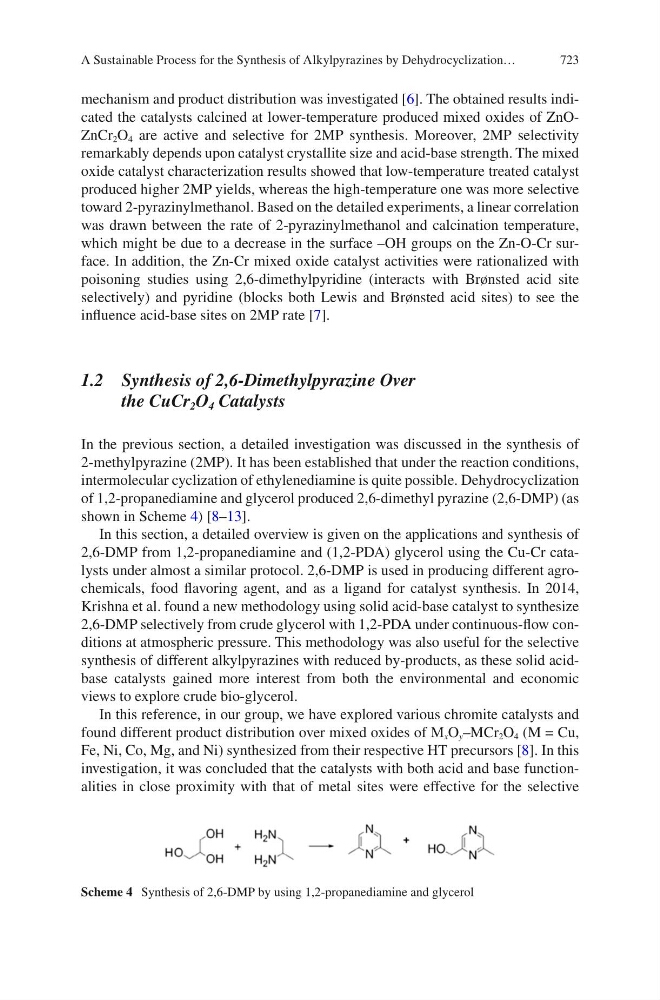
intermolecular cyclization of ethylenediamine is quite possible. Dehydrocyclization
of 1,2-propanediamine and glycerol produced 2,6-dimethyl pyrazine (2,6-DMP) (as
shown in Scheme 4) [8–13].
In this section, a detailed overview is given on the applications and synthesis of
2,6-DMP from 1,2-propanediamine and (1,2-PDA) glycerol using the Cu-Cr catalysts under almost a similar protocol. 2,6-DMP is used in producing different agrochemicals, food flavoring agent, and as a ligand for catalyst synthesis. In 2014,
Krishna et al. found a new methodology using solid acid-base catalyst to synthesize
2,6-DMP selectively from crude glycerol with 1,2-PDA under continuous-flow conditions at atmospheric pressure. This methodology was also useful for the selective
synthesis of different alkylpyrazines with reduced by-products, as these solid acidbase catalysts gained more interest from both the environmental and economic
views to explore crude bio-glycerol.
In this reference, in our group, we have explored various chromite catalysts and
found different product distribution over mixed oxides of M x O y –MCr 2 O 4 (M = Cu,
Fe, Ni, Co, Mg, and Ni) synthesized from their respective HT precursors [8]. In this
investigation, it was concluded that the catalysts with both acid and base functionalities in close proximity with that of metal sites were effective for the selective
Scheme 4 Synthesis of 2,6-DMP by using 1,2-propanediamine and glycerol
A Sustainable Process for the Synthesis of Alkylpyrazines by Dehydrocyclization…