

695
Silver nanoparticles (Ag-NPs) were synthesized by extracting cellulose from
water hyacinth [87]. Silver nanoparticles were prepared by adding 1 M of silver
nitrate solution in 45 mL solution of cellulose (0.5 g/100 mL) at 75 °C at different
pH (4, 8 and 11). The average particle mean diameter was obtained 5.69 ± 5.89,
4.53 ± 1.36 and 2.68 ± 0.69 nm at different pH 4, 8 and 11, respectively.
4.6 Water Hyacinth as a Source of Bio-oil
Pyrolysis has been extensively used for producing bio-oil from water hyacinth by
many researchers. Various factors affecting bio-oil production are presented in
Ishikawa diagram (Fig. 6).
Wauton and Ogbeide [88] have studied the characteristics of bio-oil obtained
from Eichhornia crassipes. The biomass has been heated to 450 °C at a rate of
50 °C/min. The particle size of plant material was 0.6 mm, while the inert gas flowrate was maintained at 100 cm
3
/min. Characteristic properties of bio-oil were noted
as 2.93 pH, 58.58% water content, 220 °C flash point, 1004.3 kg/m
3
density, 19.8 cSt
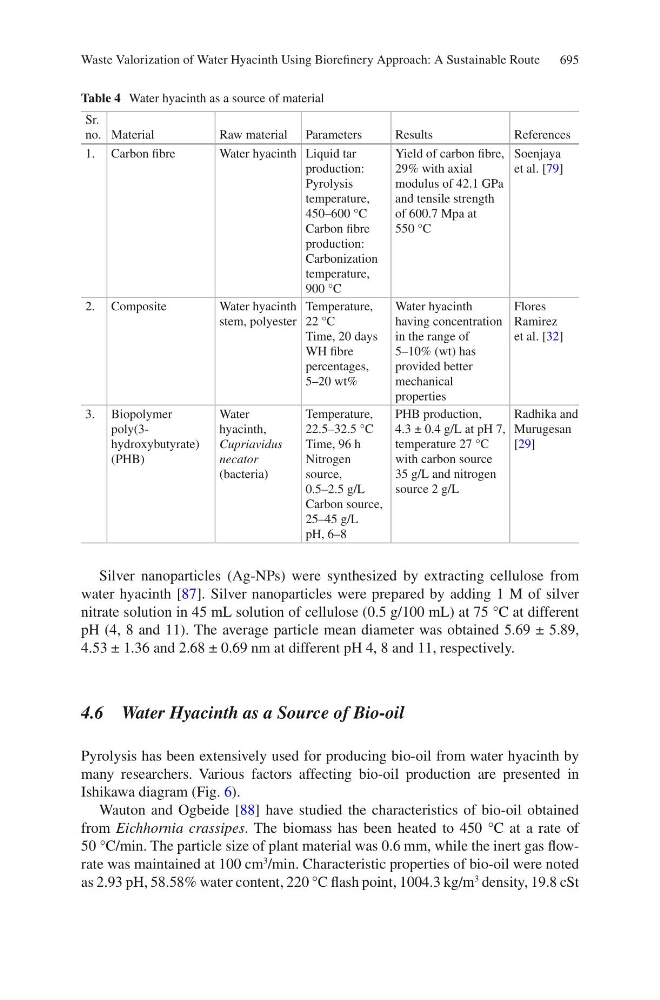
Table 4 Water hyacinth as a source of material
Sr.
no. Material
Raw material Parameters
Results
References
1. Carbon fibre
Water hyacinth Liquid tar
production:
Pyrolysis
temperature,
450–600 °C
Carbon fibre
production:
Carbonization
temperature,
900 °C
Yield of carbon fibre,
29% with axial
modulus of 42.1 GPa
and tensile strength
of 600.7 Mpa at
550 °C
Soenjaya
et al. [79]
2. Composite
Water hyacinth
stem, polyester
Temperature,
22 °C
Time, 20 days
WH fibre
percentages,
5–20 wt%
Water hyacinth
having concentration
in the range of
5–10% (wt) has
provided better
mechanical
properties
Flores
Ramirez
et al. [32]
3. Biopolymer
poly(3hydroxybutyrate)
(PHB)
Water
hyacinth,
Cupriavidus
necator
(bacteria)
Temperature,
22.5–32.5 °C
Time, 96 h
Nitrogen
source,
0.5–2.5 g/L
Carbon source,
25–45 g/L
pH, 6–8
PHB production,
4.3 ± 0.4 g/L at pH 7,
temperature 27 °C
with carbon source
35 g/L and nitrogen
source 2 g/L
Radhika and
Murugesan
[29]
Waste Valorization of Water Hyacinth Using Biorefinery Approach: A Sustainable Route