

693
low-cost material for engineering, natural fibres from water hyacinth have been
used because of the presence of a higher cellulose fraction and lesser cellulose
diameter and can be reinforced with polymer composites. Table 4 shows studies on
biopolymer, carbon fibre and composite.
4.5 Water Hyacinth as a Source of Lignocelluloses
The reuse and recycling of agro-industrial lignocellulosic wastes are considered
under phase II biorefinery in which single biomass produces multiple products such
as bio-based products (food, feed, chemicals) and bioenergy (biofuels, power, heat)
which are produced using integrated and sustainable processes [80].
Biocomposite from water hyacinth fibre (WHF) pulp and tapioca starch has been
prepared by Asrofi et al. [81]. Water hyacinth fibre was treated with 25% NaOH
solution at temperature about 130 °C and 2 bar pressure for 6 h followed by neutralization and solar drying. The dried pulp was homogenized with water, tapioca powder and glycerol and then gelatinized. The mould thus prepared was tested for
tensile strength (6.68 MPa) and tensile modulus (210.95 MPa). This method was
improved by Asrofi et al. [81] upon incorporating sonication at 40 kHz with 100%
amplitude and 250 W which has resulted in 83% increase in tensile strength and
108% increase in tensile modulus.
Chonsakorn et al. [82] have studied the effect of different extraction methods for
improving the quality of fibre from raw Eichhornia crassipes. The methods include
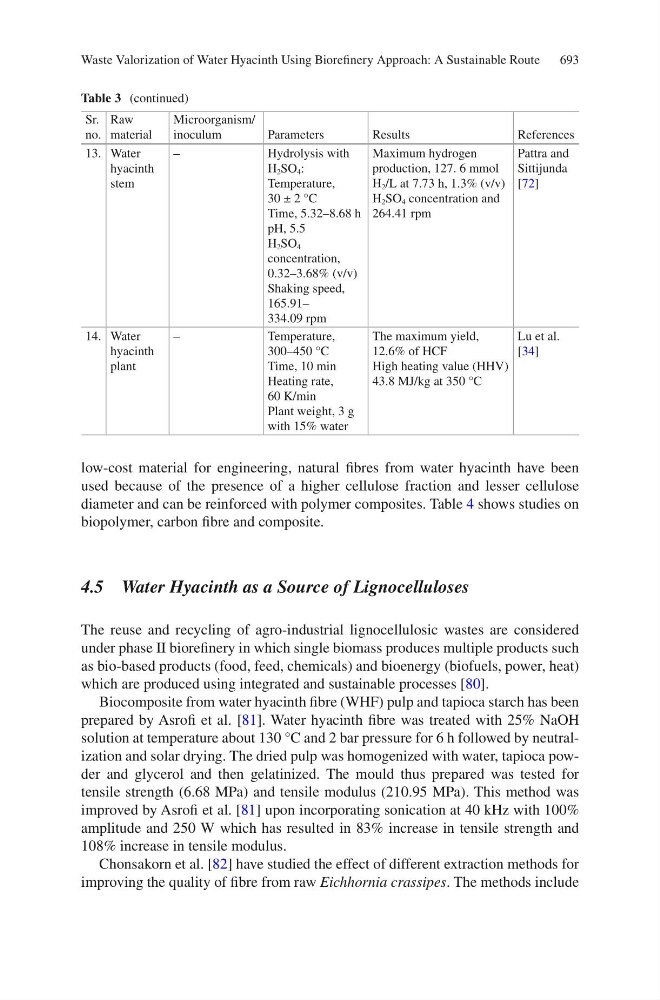
Table 3 (continued)
Sr.
no.
Raw
material
Microorganism/
inoculum
Parameters
Results
References
13. Water
hyacinth
stem
–
Hydrolysis with
H 2 SO 4 :
Temperature,
30 ± 2 °C
Time, 5.32–8.68 h
pH, 5.5
H 2 SO 4
concentration,
0.32–3.68% (v/v)
Shaking speed,
165.91–
334.09 rpm
Maximum hydrogen
production, 127. 6 mmol
H 2 /L at 7.73 h, 1.3% (v/v)
H 2 SO 4 concentration and
264.41 rpm
Pattra and
Sittijunda
[72]
14. Water
hyacinth
plant
–
Temperature,
300–450 °C
Time, 10 min
Heating rate,
60 K/min
Plant weight, 3 g
with 15% water
The maximum yield,
12.6% of HCF
High heating value (HHV)
43.8 MJ/kg at 350 °C
Lu et al.
[34]
Waste Valorization of Water Hyacinth Using Biorefinery Approach: A Sustainable Route