

60
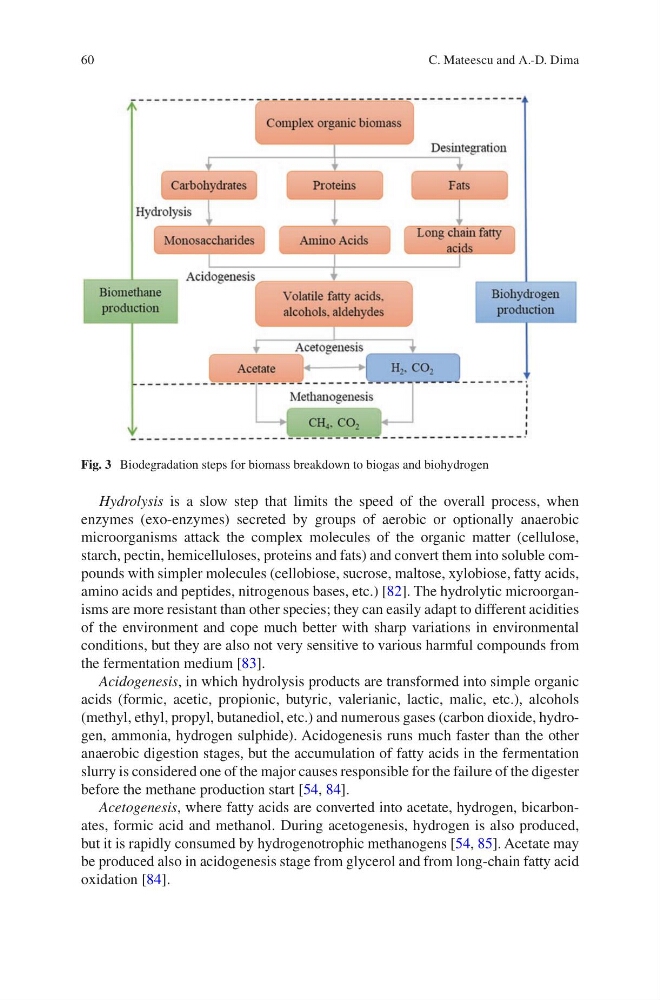
Hydrolysis is a slow step that limits the speed of the overall process, when
enzymes (exo-enzymes) secreted by groups of aerobic or optionally anaerobic
microorganisms attack the complex molecules of the organic matter (cellulose,
starch, pectin, hemicelluloses, proteins and fats) and convert them into soluble compounds with simpler molecules (cellobiose, sucrose, maltose, xylobiose, fatty acids,
amino acids and peptides, nitrogenous bases, etc.) [82]. The hydrolytic microorganisms are more resistant than other species; they can easily adapt to different acidities
of the environment and cope much better with sharp variations in environmental
conditions, but they are also not very sensitive to various harmful compounds from
the fermentation medium [83].
Acidogenesis, in which hydrolysis products are transformed into simple organic
acids (formic, acetic, propionic, butyric, valerianic, lactic, malic, etc.), alcohols
(methyl, ethyl, propyl, butanediol, etc.) and numerous gases (carbon dioxide, hydrogen, ammonia, hydrogen sulphide). Acidogenesis runs much faster than the other
anaerobic digestion stages, but the accumulation of fatty acids in the fermentation
slurry is considered one of the major causes responsible for the failure of the digester
before the methane production start [54, 84].
Acetogenesis, where fatty acids are converted into acetate, hydrogen, bicarbonates, formic acid and methanol. During acetogenesis, hydrogen is also produced,
but it is rapidly consumed by hydrogenotrophic methanogens [54, 85]. Acetate may
be produced also in acidogenesis stage from glycerol and from long- chain fatty acid
oxidation [84].
Fig. 3 Biodegradation steps for biomass breakdown to biogas and biohydrogen
C. Mateescu and A.-D. Dima
Hydrolysis is a slow step that limits the speed of the overall process, when
enzymes (exo-enzymes) secreted by groups of aerobic or optionally anaerobic
microorganisms attack the complex molecules of the organic matter (cellulose,
starch, pectin, hemicelluloses, proteins and fats) and convert them into soluble compounds with simpler molecules (cellobiose, sucrose, maltose, xylobiose, fatty acids,
amino acids and peptides, nitrogenous bases, etc.) [82]. The hydrolytic microorganisms are more resistant than other species; they can easily adapt to different acidities
of the environment and cope much better with sharp variations in environmental
conditions, but they are also not very sensitive to various harmful compounds from
the fermentation medium [83].
Acidogenesis, in which hydrolysis products are transformed into simple organic
acids (formic, acetic, propionic, butyric, valerianic, lactic, malic, etc.), alcohols
(methyl, ethyl, propyl, butanediol, etc.) and numerous gases (carbon dioxide, hydrogen, ammonia, hydrogen sulphide). Acidogenesis runs much faster than the other
anaerobic digestion stages, but the accumulation of fatty acids in the fermentation
slurry is considered one of the major causes responsible for the failure of the digester
before the methane production start [54, 84].
Acetogenesis, where fatty acids are converted into acetate, hydrogen, bicarbonates, formic acid and methanol. During acetogenesis, hydrogen is also produced,
but it is rapidly consumed by hydrogenotrophic methanogens [54, 85]. Acetate may
be produced also in acidogenesis stage from glycerol and from long- chain fatty acid
oxidation [84].
Fig. 3 Biodegradation steps for biomass breakdown to biogas and biohydrogen
C. Mateescu and A.-D. Dima