

644
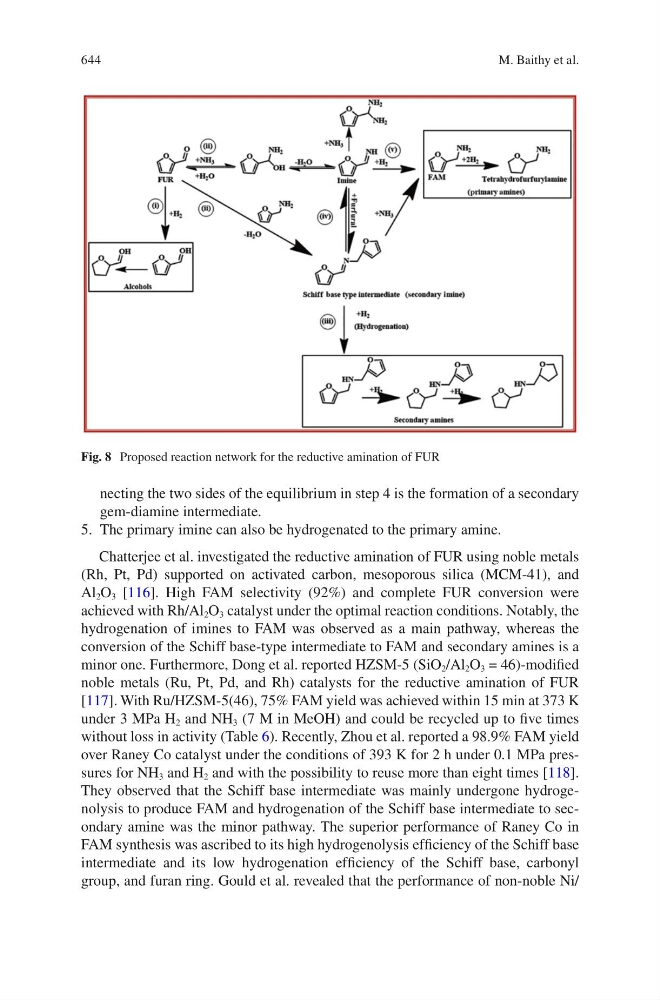
necting the two sides of the equilibrium in step 4 is the formation of a secondary
gem-diamine intermediate.
5. The primary imine can also be hydrogenated to the primary amine.
Chatterjee et al. investigated the reductive amination of FUR using noble metals
(Rh, Pt, Pd) supported on activated carbon, mesoporous silica (MCM-41), and
Al 2 O 3 [116]. High FAM selectivity (92%) and complete FUR conversion were
achieved with Rh/Al 2 O 3 catalyst under the optimal reaction conditions. Notably, the
hydrogenation of imines to FAM was observed as a main pathway, whereas the
conversion of the Schiff base-type intermediate to FAM and secondary amines is a
minor one. Furthermore, Dong et al. reported HZSM-5 (SiO 2 /Al 2 O 3 = 46)-modified
noble metals (Ru, Pt, Pd, and Rh) catalysts for the reductive amination of FUR
[117]. With Ru/HZSM-5(46), 75% FAM yield was achieved within 15 min at 373 K
under 3 MPa H 2 and NH 3 (7 M in MeOH) and could be recycled up to five times
without loss in activity (Table 6). Recently, Zhou et al. reported a 98.9% FAM yield
over Raney Co catalyst under the conditions of 393 K for 2 h under 0.1 MPa pressures for NH 3 and H 2 and with the possibility to reuse more than eight times [118].
They observed that the Schiff base intermediate was mainly undergone hydrogenolysis to produce FAM and hydrogenation of the Schiff base intermediate to secondary amine was the minor pathway. The superior performance of Raney Co in
FAM synthesis was ascribed to its high hydrogenolysis efficiency of the Schiff base
intermediate and its low hydrogenation efficiency of the Schiff base, carbonyl
group, and furan ring. Gould et al. revealed that the performance of non-noble Ni/
Fig. 8 Proposed reaction network for the reductive amination of FUR
M. Baithy et al.