

642
atmospheric O 2 (1 bar) [113]. The remarkable performance of the catalyst was associated with a strong interaction between framework Cu species and V guest which
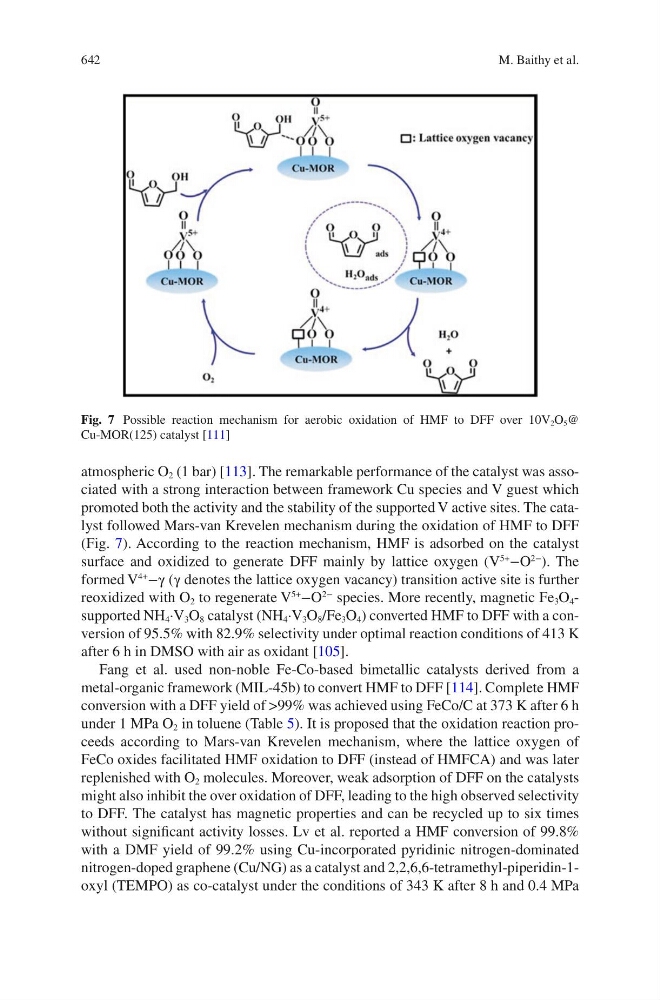
promoted both the activity and the stability of the supported V active sites. The catalyst followed Mars-van Krevelen mechanism during the oxidation of HMF to DFF
(Fig. 7). According to the reaction mechanism, HMF is adsorbed on the catalyst
surface and oxidized to generate DFF mainly by lattice oxygen (V
5+
−O
2−
). The
formed V
4+
−γ (γ denotes the lattice oxygen vacancy) transition active site is further
reoxidized with O 2 to regenerate V
5+
−O
2−
species. More recently, magnetic Fe 3 O 4 -
supported NH 4 ·V 3 O 8 catalyst (NH 4 ·V 3 O 8 /Fe 3 O 4 ) converted HMF to DFF with a conversion of 95.5% with 82.9% selectivity under optimal reaction conditions of 413 K
after 6 h in DMSO with air as oxidant [105].
Fang et al. used non-noble Fe-Co-based bimetallic catalysts derived from a
metal-organic framework (MIL-45b) to convert HMF to DFF [114]. Complete HMF
conversion with a DFF yield of >99% was achieved using FeCo/C at 373 K after 6 h
under 1 MPa O 2 in toluene (Table 5). It is proposed that the oxidation reaction proceeds according to Mars-van Krevelen mechanism, where the lattice oxygen of
FeCo oxides facilitated HMF oxidation to DFF (instead of HMFCA) and was later
replenished with O 2 molecules. Moreover, weak adsorption of DFF on the catalysts
might also inhibit the over oxidation of DFF, leading to the high observed selectivity
to DFF. The catalyst has magnetic properties and can be recycled up to six times
without significant activity losses. Lv et al. reported a HMF conversion of 99.8%
with a DMF yield of 99.2% using Cu-incorporated pyridinic nitrogen-dominated
nitrogen-doped graphene (Cu/NG) as a catalyst and 2,2,6,6-tetramethyl-piperidin- 1oxyl (TEMPO) as co-catalyst under the conditions of 343 K after 8 h and 0.4 MPa
Fig. 7 Possible reaction mechanism for aerobic oxidation of HMF to DFF over 10V 2 O 5 @
Cu-MOR(125) catalyst [111]
M. Baithy et al.