

606
5 Conclusions
This book chapter provides an in-depth summary of mesoporous catalysts widely
used to produce hydrogen via steam reforming of methanol, ethanol and glycerol.
The main characterization techniques used to identify these mesostructures are N 2
adsorption-desorption textural property analysis and XRD patterns which confirms
whether the structure has short-, medium- or long-range ordered mesoporosity.
Unlike ethanol and glycerol that are reformed at high temperature (400–700 °C),
methanol reforming is performed at relatively low temperature (<300 °C), making
it more commercially viable in terms of energy consumption and safety costs.
However, ethanol reforming is very popular because ethanol is a more available
feedstock and glycerol has the highest hydrogen-to-carbon ratio. While Cu-based
catalysts are commonly used for SRM, Ni- and Co-based catalysts are preferred for
SRE and SRG. Promoters like group 1 and 2 metals significantly improve (1) catalyst activity by reducing the crystal sizes of the metals, thereby improving reducibility of the metal oxides and (2) increasing the basicity of the catalyst which
minimizes coking and increases the shelf-life of the catalyst. Depending on the type
of support used, bimetallic catalysts like Cu-Ni, Pd-Ni and Ni-Co have been shown
to increase hydrogen selectivity and catalyst stability. Generally, the siliceous mesoporous supports (e.g. SBA-15, MCM-41, MCM-48, KIT-6) exhibit substantially
better stability than the crystalline metal oxides (e.g. TiO 2 , Al 2 O 3 , CeO 2 ).
Acknowledgements The authors acknowledge the funding received from NSF CREST (1242152)
and UNC-ROI (#110092). This work was performed at North Carolina A&T State University. The
authors greatly appreciate the analytical support provided by Mr. James King (Chemistry
Department) and Mr. Nafeezuddin Mohammad (Joint School of Nanoscience and Nanoengineering).
We thank Mr. Nafeez Mohammad for his help with the manuscript.
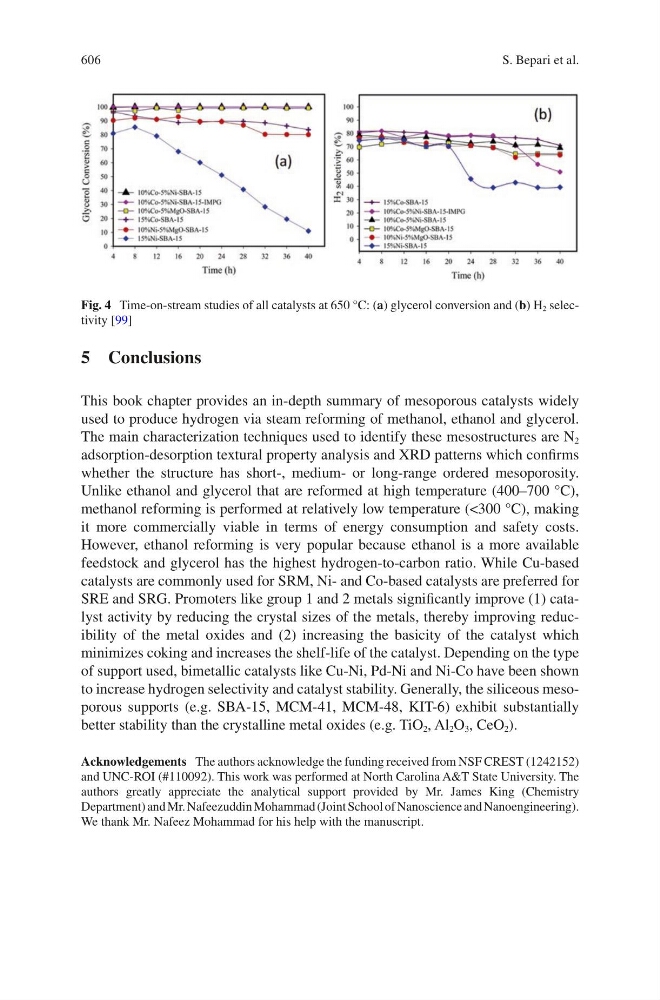
Fig. 4 Time-on-stream studies of all catalysts at 650 °C: (a) glycerol conversion and (b) H 2 selectivity [99]
S. Bepari et al.