

602
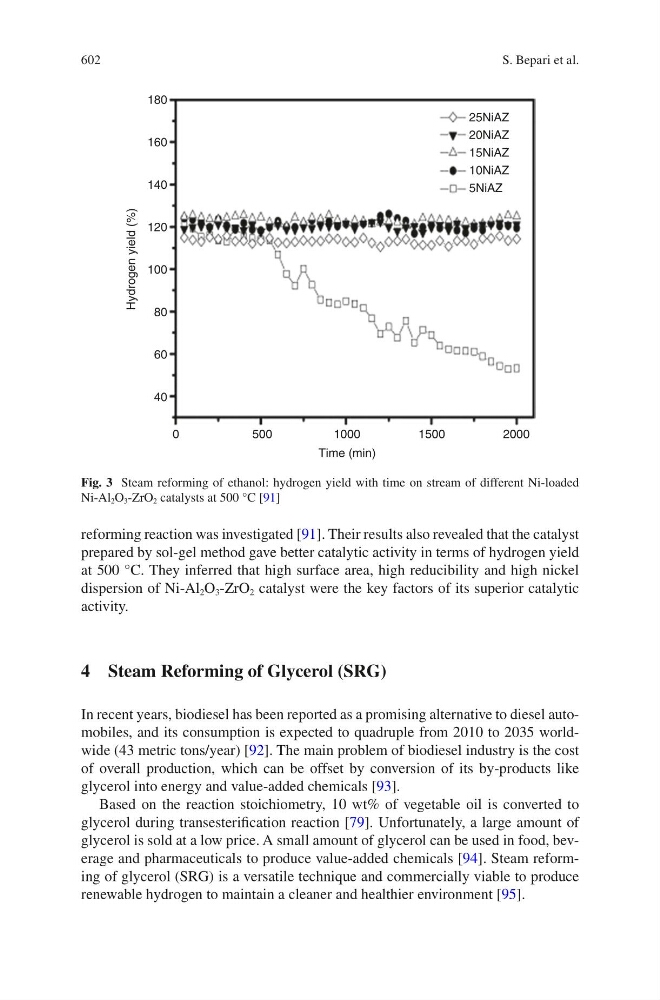
reforming reaction was investigated [91]. Their results also revealed that the catalyst
prepared by sol-gel method gave better catalytic activity in terms of hydrogen yield
at 500 °C. They inferred that high surface area, high reducibility and high nickel
dispersion of Ni-Al 2 O 3 -ZrO 2 catalyst were the key factors of its superior catalytic
activity.
4 Steam Reforming of Glycerol (SRG)
In recent years, biodiesel has been reported as a promising alternative to diesel automobiles, and its consumption is expected to quadruple from 2010 to 2035 worldwide (43 metric tons/year) [92]. The main problem of biodiesel industry is the cost
of overall production, which can be offset by conversion of its by-products like
glycerol into energy and value-added chemicals [93].
Based on the reaction stoichiometry, 10 wt% of vegetable oil is converted to
glycerol during transesterification reaction [79]. Unfortunately, a large amount of
glycerol is sold at a low price. A small amount of glycerol can be used in food, beverage and pharmaceuticals to produce value-added chemicals [94]. Steam reforming of glycerol (SRG) is a versatile technique and commercially viable to produce
renewable hydrogen to maintain a cleaner and healthier environment [95].
180
25NiAZ
20NiAZ
15NiAZ
10NiAZ
5NiAZ
160
140
120
100
Hydrogen yield (%)
80
60
40
0
500
1000
Time (min)
1500
2000
Fig. 3 Steam reforming of ethanol: hydrogen yield with time on stream of different Ni-loaded
Ni-Al 2 O 3 -ZrO 2 catalysts at 500 °C [91]
S. Bepari et al.