

559
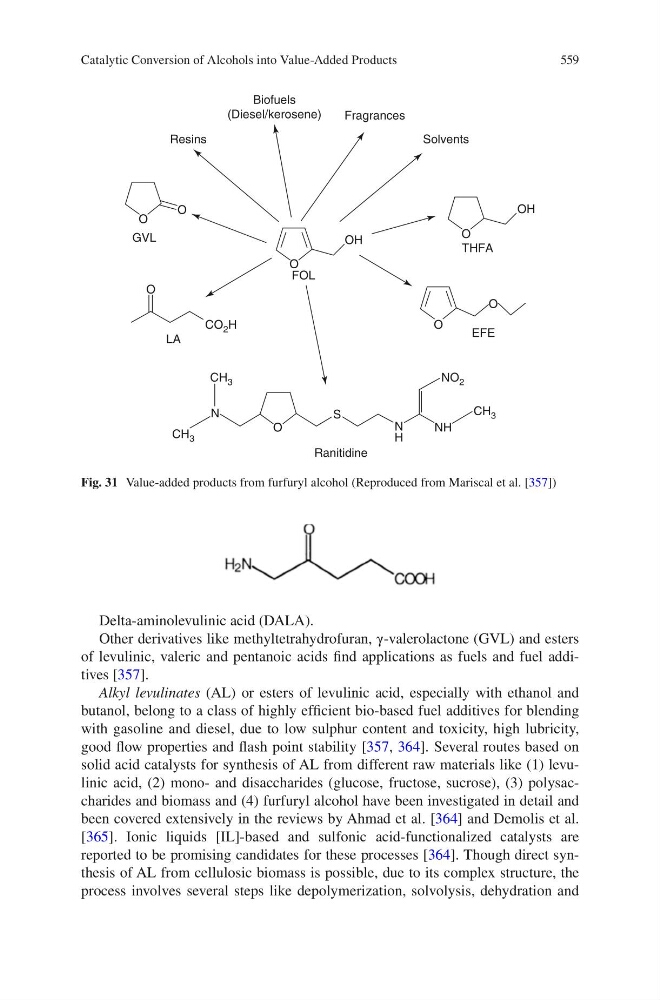
Delta-aminolevulinic acid (DALA).
Other derivatives like methyltetrahydrofuran, γ-valerolactone (GVL) and esters
of levulinic, valeric and pentanoic acids find applications as fuels and fuel additives [357].
Alkyl levulinates (AL) or esters of levulinic acid, especially with ethanol and
butanol, belong to a class of highly efficient bio-based fuel additives for blending
with gasoline and diesel, due to low sulphur content and toxicity, high lubricity,
good flow properties and flash point stability [357, 364]. Several routes based on
solid acid catalysts for synthesis of AL from different raw materials like (1) levulinic acid, (2) mono- and disaccharides (glucose, fructose, sucrose), (3) polysaccharides and biomass and (4) furfuryl alcohol have been investigated in detail and
been covered extensively in the reviews by Ahmad et al. [364] and Demolis et al.
[365]. Ionic liquids [IL]-based and sulfonic acid-functionalized catalysts are
reported to be promising candidates for these processes [364]. Though direct synthesis of AL from cellulosic biomass is possible, due to its complex structure, the
process involves several steps like depolymerization, solvolysis, dehydration and
Biofuels
(Diesel/kerosene)
Fragrances
Solvents
O
O
O
EFE
NO 2
CH 3
CO 2 H
LA
CH 3
CH 3
NH
N
H
S
O
O
O
O
Resins
GVL
O
OH
FOL
N
Ranitidine
OH
THFA
Fig. 31 Value-added products from furfuryl alcohol (Reproduced from Mariscal et al. [357])
Catalytic Conversion of Alcohols into Value-Added Products