

549
6 Value Added Products from Sugar Alcohols: Sorbitol,
Mannitol and Xylitol
Sorbitol is a versatile platform chemical with highly reactive hydroxyl groups,
which undergo a variety of transformations like dehydration, hydrogenolysis, oxidation and aqueous phase reforming to yield value-added products with many applications [136, 311]. An illustration of the applications of sorbitol and its derivatives
in pharma, medicinal, cosmetics, food, confectionary, bioplastics and elastomers
industries, brought out by Kobayashi and Fukuoka [312], is presented in Scheme 7.
Isosorbide (1,4:3,6-dianhydrohexitol) is one such derivative of sorbitol, with multiple applications (Scheme 7) with a market size of US$ 396 million in 2018 which
is projected to grow at CAGR of 8.5% during 2019–2025 [313]. A number of
isosorbide- based biopolymers like polyethylene isosorbide terephthalate (PEIT),
polycarbonate, isocyanate-free polyurethane [314], polyisosorbide succinate and
isosorbide diesters are produced from isosorbide. Hence, production of isosorbide
from sorbitol by acid-catalysed stepwise dehydration (Scheme 8) and directly from
cellulose has been the subject of extensive investigations. Different types of solid
acid catalysts like supported metal catalysts, zeolites, heteropoly acids, metal phosphates and ion-exchange resins have been explored for the conversion of sorbitol to
isosorbide [136, 311]. Otomo et al. [315] could achieve isosorbide selectivity of
80% with zeolite β catalyst with SAR-75. Sulphonic acid-functionalized silica,
modified with optimum loading of (3-mercapto-propyl) trimethoxy silane (MPTS)
catalysts displayed better performance, with 100% sorbitol conversion and 84%
yield of isosorbide [316]. Direct conversion of cellulose to isosorbide, using a combination of Amberlyst 70 ion-exchange catalyst (for cellulose hydrolysis to glucose
and dehydration of sorbitol to isosorbide) and 4% Ru/C (for hydrogenation of glucose to sorbitol) to get 55.8% yield of isosorbide in single-pot process, has been
reported by Yamaguchi et al. [317].
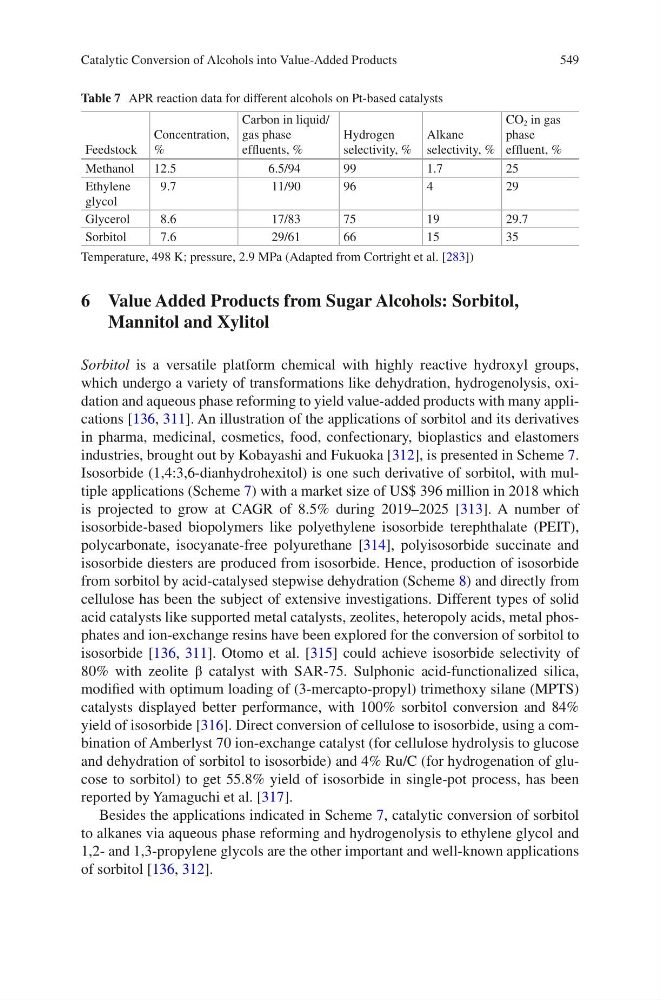
Besides the applications indicated in Scheme 7, catalytic conversion of sorbitol
to alkanes via aqueous phase reforming and hydrogenolysis to ethylene glycol and
1,2- and 1,3-propylene glycols are the other important and well-known applications
of sorbitol [136, 312].
Table 7 APR reaction data for different alcohols on Pt-based catalysts
Feedstock
Concentration,
%
Carbon in liquid/
gas phase
effluents, %
Hydrogen
selectivity, %
Alkane
selectivity, %
CO 2 in gas
phase
effluent, %
Methanol
12.5
6.5/94
99
1.7
25
Ethylene
glycol
9.7
11/90
96
4
29
Glycerol
8.6
17/83
75
19
29.7
Sorbitol
7.6
29/61
66
15
35
Temperature, 498 K; pressure, 2.9 MPa (Adapted from Cortright et al. [283])
Catalytic Conversion of Alcohols into Value-Added Products